

Primary market research is only as strong as the way it is conducted.
Avoiding bias, selecting the right audience, and listening to criticism are essential.
When done properly, it clearly shows how primary market research helps businesses grow through better decisions and stronger customer relationships.
Primary market research is a direct pathway to understanding real customer needs, behaviors, and expectations. However, many businesses fail to fully benefit from it because they make common methodological mistakes that distort results. Poorly designed questions, the wrong sample size, leading respondents, or ignoring negative feedback can all lead to misleading insights and flawed business strategies. To truly understand how primary market research helps businesses grow, companies must not only conduct research but also conduct it correctly. This section explores the most common mistakes in primary market research and how to avoid them so that your data remains accurate, reliable, and actionable.
What is Primary Market Research with Examples

Another type of market research is called primary, which is market research that’s created by you, collecting firsthand data from (and interacting directly with) your target audience. As opposed to secondary research, which works with data already published by outside sources, primary research is the information that you’ve collected yourself, and that is fitted specifically to your business needs. If you’re asking what is primary market research, this is it: customized, direct, and highly actionable.
For example:
- Surveying to know what the customers would like.
- Hosting focus groups to try out a product idea.
- Conducting interviews with customers to learn about their pain points.
Not only is this type of research good; it’s necessary. It’s the data-driven basis for making decisions on what your strategies should look like and whether they map to what real customers want and need. This is exactly what is primary market research is meant to achieve—clarity, direction, and precision in strategy.
Common Primary Market Research Techniques

Primary market research is not one-size-fits-all. Here are several approaches that you can take, depending on the specific requirements of your project, to gain valuable insights. Before choosing, ask yourself again: What is primary market research, and which method fits best?
Surveys
Surveys are one of the simplest, most scalable options available for collecting data from your audience. With something like Google Forms or SurveyMonkey, questions can be sent to thousands of respondents in short order.
When to use surveys:
- For determining customer satisfaction.
- To assess product interest.
- To identify key demographics.
Example survey question:
“What specific functionalities are admitted in a new smart phone app?”
When conducting surveys, it’s useful to revisit what is primary market research so you can ensure your questions are aligned with its purpose.
Interviews
Interviews are one-on-one conversations with customers, providing you with rich qualitative data. They enable businesses to not only hear personal opinions but also discover feelings underlying customer reactions.
When to use interviews:
- To know the pain points of your customers.
- To study novel aspects of user experience.
Pro tip:
Develop open-ended questions to help questionees elaborate on matters. This encourages better understanding aligned with what is primary market research really aims to uncover—true customer sentiment.
Focus Groups
Focus groups are interviews of a few individuals assembled to converse about a certain subject. They allow you to see how groups work, they allow you to see brainstorming, they allow you to see reaction in this controlled manner.
When to use focus groups:
- To try out new branding, packaging, or product ideas.
- To let you know what your customers think of your business.
Example use case:
A beverage company commissioning a focus group to gain feedback on a soon-to-be introduced flavor prior to selling it in stores.
It’s a textbook example of what is primary market research in action.
Observation
And sometimes the best way to find out about customers is to watch how they behave in the world. You can learn things that they might not tell you by watching how they interact with products or services.
When to use observation:
- For observing in-store customer behaviour.
- To uncover usability problems in apps or websites.You can learn more about Driving Growth with Marketing Analytics Services
Primary vs Secondary Market Research: A Clear Comparison

To truly understand the value of primary market research, it is important to compare it with secondary market research. While both approaches are useful, they serve different purposes and provide different types of insights. Knowing the differences helps businesses choose the right research method—or use both strategically—to make better decisions. This comparison also highlights how primary market research helps businesses grow by providing direct, relevant, and real-time customer insights.
Key Differences in Data Source
One of the most fundamental distinctions between primary and secondary research is the source of data.
Primary market research involves collecting data directly from your target audience. This means businesses gather firsthand information through surveys, interviews, focus groups, observations, or experiments. Because the data comes straight from real customers, it is highly specific to your business, industry, and objectives. This direct connection is a major reason why primary research is so powerful in shaping business strategy.
Secondary market research, on the other hand, relies on existing data that has already been collected and published by others. This may include industry reports, academic studies, government statistics, competitor analyses, or market trend publications. While secondary data can provide useful background information, it is not customized to your business and may not fully reflect your unique customer base.
Cost and Time Considerations
Another major difference lies in cost and time investment.
Primary research is typically more expensive and time-consuming because it requires designing research methods, recruiting participants, collecting responses, and analyzing results. However, this investment often pays off because the insights gained are highly relevant and actionable. Businesses that want to understand customer behavior deeply and improve decision-making often find that this effort is worthwhile—demonstrating again how primary market research helps businesses grow in a meaningful way.
Secondary research is generally faster and more affordable since the data is already available. Companies can quickly access reports, articles, or databases without conducting their own studies. While this is useful for initial exploration or background understanding, it does not replace the depth and specificity of primary research.
Reliability and Accuracy
The reliability of data also differs between the two approaches.
Well-conducted primary research tends to be highly reliable because businesses control the research design, sample selection, and data collection process. This allows them to minimize bias and ensure that the findings truly reflect their target audience. When done correctly, primary research provides a strong foundation for strategic decisions.
Secondary research, while often credible, may not always be perfectly aligned with your business needs. The data might be outdated, generalized, or based on a different audience or industry context. Businesses must carefully evaluate secondary sources to ensure accuracy and relevance before using them for decision-making.
Use Cases: When to Use Each
Both primary and secondary research have valuable roles in business strategy, but they are best used in different situations.
Primary research is most effective when a business needs:
- Direct customer feedback on a new product or service
- Deep understanding of customer pain points and motivations
- Insights tailored specifically to their brand or market
- Data to support important strategic decisions
This is where the impact of primary research becomes most visible, showing how primary market research helps businesses grow by reducing uncertainty and aligning strategies with real customer needs.
Secondary research is more suitable when a business wants to:
- Understand overall industry trends
- Analyze competitor performance
- Gain background knowledge before conducting primary research
- Save time and resources in the early stages of market exploration
Using Both Together for Maximum Impact
The most effective research strategy often combines both primary and secondary methods.
For example, a business might first use secondary research to understand general market trends and identify potential opportunities. Then, they can conduct primary research to validate those findings with their own audience. This blended approach provides both broad context and deep, customized insights.
By integrating both methods, businesses gain a well-rounded understanding of their market. However, it is the primary research component that ultimately drives stronger, more informed decision-making—clearly demonstrating how primary market research helps businesses grow in the long term
Quantitative vs Qualitative Primary Research

Understanding the difference between quantitative and qualitative primary research is crucial to fully grasp how primary market research helps businesses grow. Both approaches serve different purposes, yet they complement each other when used together. While quantitative research focuses on measurable data and statistics, qualitative research explores deeper opinions, motivations, and behaviors. Knowing when and how to use each can significantly improve business decision-making.
What Numeric Data (Quantitative Research) Tells You
Quantitative primary research is based on numerical data that can be measured, analyzed, and compared. It helps businesses identify patterns, trends, and statistical relationships within their target market. This type of research is particularly useful when companies need large-scale, objective insights.
With quantitative data, businesses can answer questions such as:
- What percentage of customers prefer a specific product feature?
- How many users are satisfied with customer service?
- What is the average spending behavior of a target audience?
By analyzing numbers and metrics, companies gain a clearer picture of market demand, customer behavior, and overall performance. This structured approach is one of the key reasons how primary market research helps businesses grow, as it reduces uncertainty and supports data-driven strategies.
Best tools for quantitative research:
- Google Forms
- SurveyMonkey
- Typeform
- Excel or SPSS for data analysis
Best situations to use quantitative research:
- Measuring customer satisfaction levels
- Evaluating product demand
- Understanding pricing preferences
- Tracking brand awareness
What Opinion-Based Insights (Qualitative Research) Reveal
Qualitative primary research focuses on understanding customer thoughts, emotions, and experiences rather than numerical data. It provides depth and context, helping businesses understand the “why” behind customer behavior.
Instead of asking “How many customers like this product?”, qualitative research asks:
- Why do customers prefer this product?
- What challenges do users face with our service?
- How do customers feel about our brand?
This approach is essential for discovering pain points, uncovering hidden needs, and improving customer experience. It plays a major role in explaining how primary market research helps businesses grow, as it enables companies to build stronger emotional connections with their audience.
Best tools for qualitative research:
- One-on-one interviews (Zoom, Google Meet)
- Focus group discussions
- Customer feedback sessions
- User experience (UX) testing
Best situations to use qualitative research:
- Exploring customer motivations
- Testing new product concepts
- Understanding brand perception
- Improving user experience
Combining Both for Stronger Business Growth
The most successful businesses use both quantitative and qualitative research together. Numbers show trends, while personal insights explain those trends. This balanced approach maximizes the effectiveness of decision-making and clearly demonstrates how primary market research helps businesses grow in a practical and sustainable way.
For example:
- A company may use a survey (quantitative) to identify that 70% of customers are unhappy with delivery time.
- Then, through interviews (qualitative), they discover that customers feel frustrated due to unclear tracking updates.
By integrating both methods, businesses gain a complete understanding of their audience, leading to smarter strategies and stronger growth.
Planning and Conducting Primary Market Research
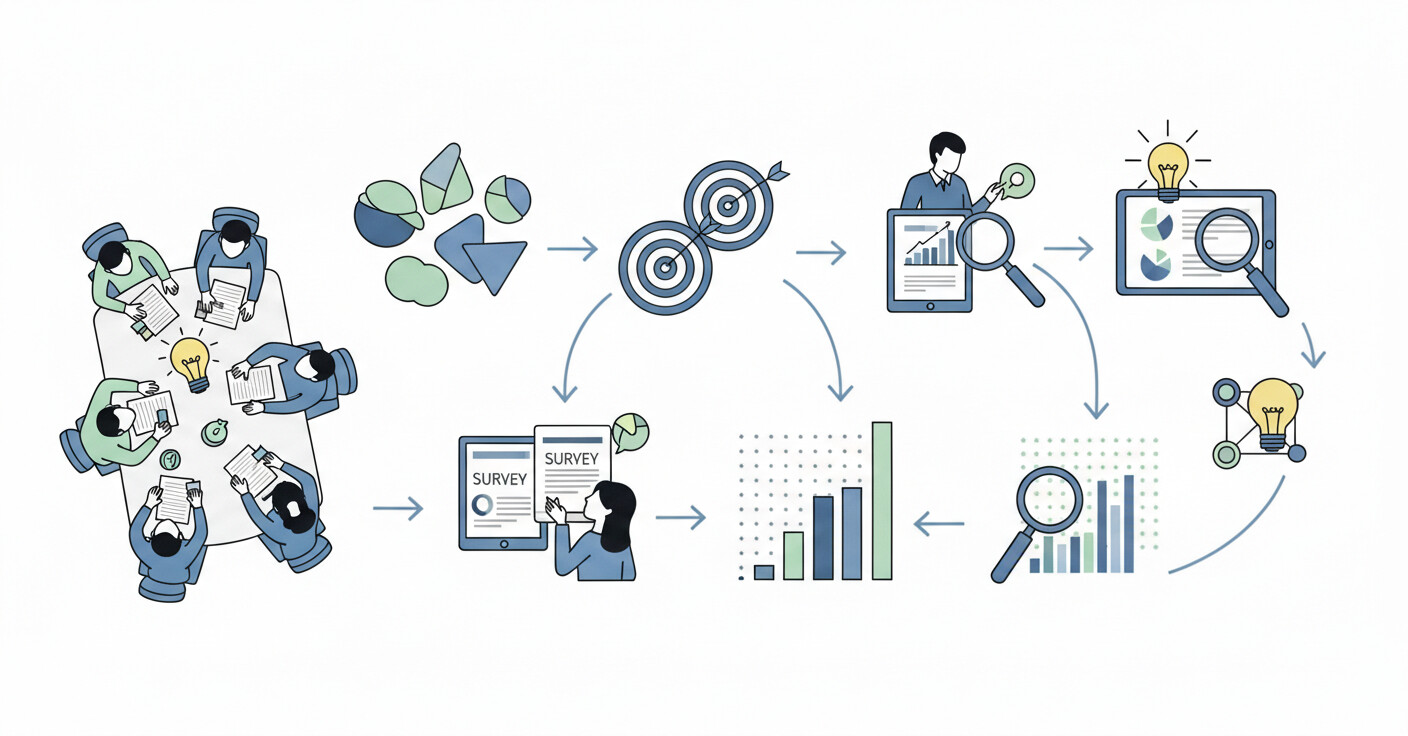
Any successful primary research must be carefully planned. Just follow these how-to steps for the best results. If you’re still unclear about what primary market research is, this section will show you how to actually implement it.
Define Research Goals
Determine what it is you want to learn. Are you seeking new market? Trying to test a new feature? This definition of the purpose will support the whole research. This is the foundation of understanding what is primary market research.
Example goal:
“Explain why we are losing this group (25-35 years old) to our online sales.”
Identify Your Target Audience
Who are you trying to reach? Identify your audience by demographics, occupation, interests or income. This clarity will help ensure your research is targeted to the correct group.
Tip:
Segment your audiences and tailor your messaging with buyer personas.
Choose the Right Methodology
Choose the research method(s) that suit your objectives. Think back to what is primary market research is about—it’s about gathering real, usable insights from the right sources.
For instance:
- Leverage surveys for high-level feedback.
- Interview to gain a greater understanding.
Prepare Your Materials
Create objective, no-nonsense questionnaires or discussion guides. Ask only questions that will generate valuable answers.
Example:
Rather than “Do you like our product?” ask, “What could make you generally feel better about our product?”
This type of question is rooted in the core principle of what is primary market research—actionable and specific insights.
Collect Data
Carry out your study according to your methodology. Whether virtual or in-person, have a smooth process and make participants comfortable enough to share what is on their mind.
Organize and Store Data
Tools like spreadsheets or dedicated software will help you keep your data in a safe and organized place.
Interpretation of Original Market Research Data
Data in its raw form is only meaningful when it translates into insights that can be acted upon. Here’s how to sift through your findings and understand what is primary market research is giving you in terms of value.
Organize the Data
Begin by clustering like responses. If you polled 1,000 people, break down the results by demographics or types of questions.
Identify Trends
Find patterns in the information.
For instance:
- “60% prefer packaging that is eco-friendly.”
- “Fast delivery is one of our most common customer preferences.”
Compare Results
Compare your results to what was previously known and how things are usually done in your field. It will give your data some context, and you’ll be able to see what you can do better. This reflection ties directly back to what is primary market research meant to enhance—strategic improvement.
Draw Actionable Conclusions
What do the results tell you about what your audience wants or needs? Leverage this information to inform decisions such as product launches, marketing initiatives or enhancements to customer service.
For example:
Depending on your survey results that show that your customers would prefer affordability instead of features, look at creating affordable products.
Advantages of Primary Market Research
There’s no doubt of the benefits of there being primary market research. But to truly appreciate them, you must understand what is primary market research and how it differs from general assumptions or indirect data.
Custom Insights
Your research should be customized, so the reports aren’t just any old secondary report.
Real-Time Data
Receive current insights that mirror what the current market or customer sentiments are.
Improved Decision Making
Decisions rooted in data minimize risk and optimize results.
Better Understanding Customers
Your customers are the most important part of your business.
Discover the customer motivations and attitudes that result in your target’s behavior—and position your offerings to meet them. This insight is at the very core of what is primary market research.
Competitive Edge
Understanding your market better than your competitors keeps you ahead of the curve.
Begin Your Journey in Primary Market Research
Primary market research isn’t just a thing — it’s an edge in our data-driven world. And, by obtaining first-hand feedback from your audience, you will be able to learn more about them and then fulfill their needs, resolve their pains, and craft more intelligent business decisions. When businesses fully grasp what is primary market research, they unlock a new level of potential.
Now that you’re clear on what is primary market research and how to use it, the only question i,s what are you going to do? Start your very first research project today and reveal the insights that will transform your business.
You Can Learn More about How Do You Conduct Market Research
Frequently Asked Questions (FAQ)
1. Why do businesses make mistakes in primary market research?
Many businesses rush the process, use poorly designed questions, or fail to define their target audience clearly. Lack of planning and expertise often leads to flawed data collection.
2. How does biased research affect business decisions?
Biased research produces misleading results, which can lead to wrong product development, ineffective marketing strategies, and wasted resources.
3. What is the ideal sample size for primary research?
There is no one-size-fits-all number. The sample size depends on your target audience, research goals, and statistical confidence level. Larger, representative samples generally provide more reliable insights.
4. Why is negative feedback important in primary research?
Negative feedback reveals weaknesses, customer pain points, and areas for improvement. It helps businesses refine products, services, and overall strategy.
5. How does avoiding mistakes improve business growth?
By eliminating common research errors, businesses collect more accurate data, make better decisions, reduce risk, and better understand their customers—demonstrating how primary market research helps businesses grow.