
Account Engagement Scoring: Measuring Business Interest and Opportunities
 18 min read
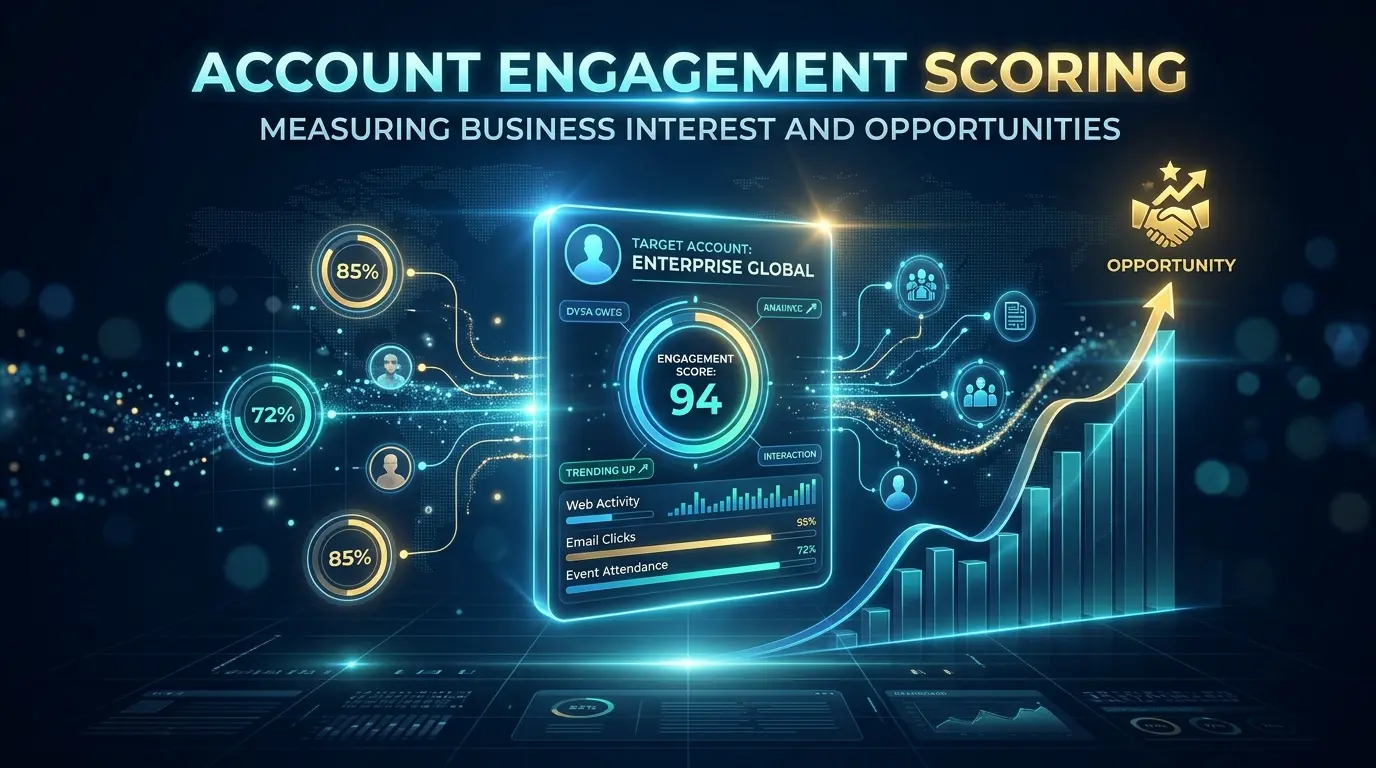
Account Engagement Scoring helps businesses understand how actively potential customers interact with their brand, content, products, and marketing channels. By evaluating account activity, interaction patterns, buying signals, and customer behavior, marketing and sales teams can identify promising accounts and prioritize their efforts. A well-developed scoring model connects engagement data with business objectives, improves account qualification, and supports more effective account-based marketing strategies. It also creates better alignment between marketing and sales by providing a clearer picture of account interest and purchase readiness.
Understanding which businesses are genuinely interested in a company’s products or services is an important part of successful account-based marketing. While website visits, email clicks, content downloads, and webinar registrations can indicate interest, these activities do not always reveal how valuable an account might become. Some businesses interact with marketing materials regularly but have no immediate purchasing plans, while others demonstrate strong buying interest through a smaller number of meaningful interactions.
This is where Account Engagement Scoring becomes particularly useful. It provides a structured way to evaluate how target accounts interact with a brand and determine which relationships deserve greater attention. Instead of looking at individual activities separately, businesses can combine different engagement signals to develop a more complete understanding of account interest.
For B2B organizations, this approach is especially important because purchasing decisions often involve several stakeholders, extended evaluation periods, and multiple communication channels. A company might research a solution through its website, attend a webinar, interact with sales representatives, and revisit product information before considering a purchase. Tracking these activities together helps marketers recognize developing opportunities that might otherwise remain unnoticed.
An effective scoring approach also strengthens communication between marketing and sales. Both teams can use shared engagement information to understand account behavior, identify meaningful opportunities, and make better decisions about when to initiate conversations.
Understanding the Role of Account Engagement Scoring
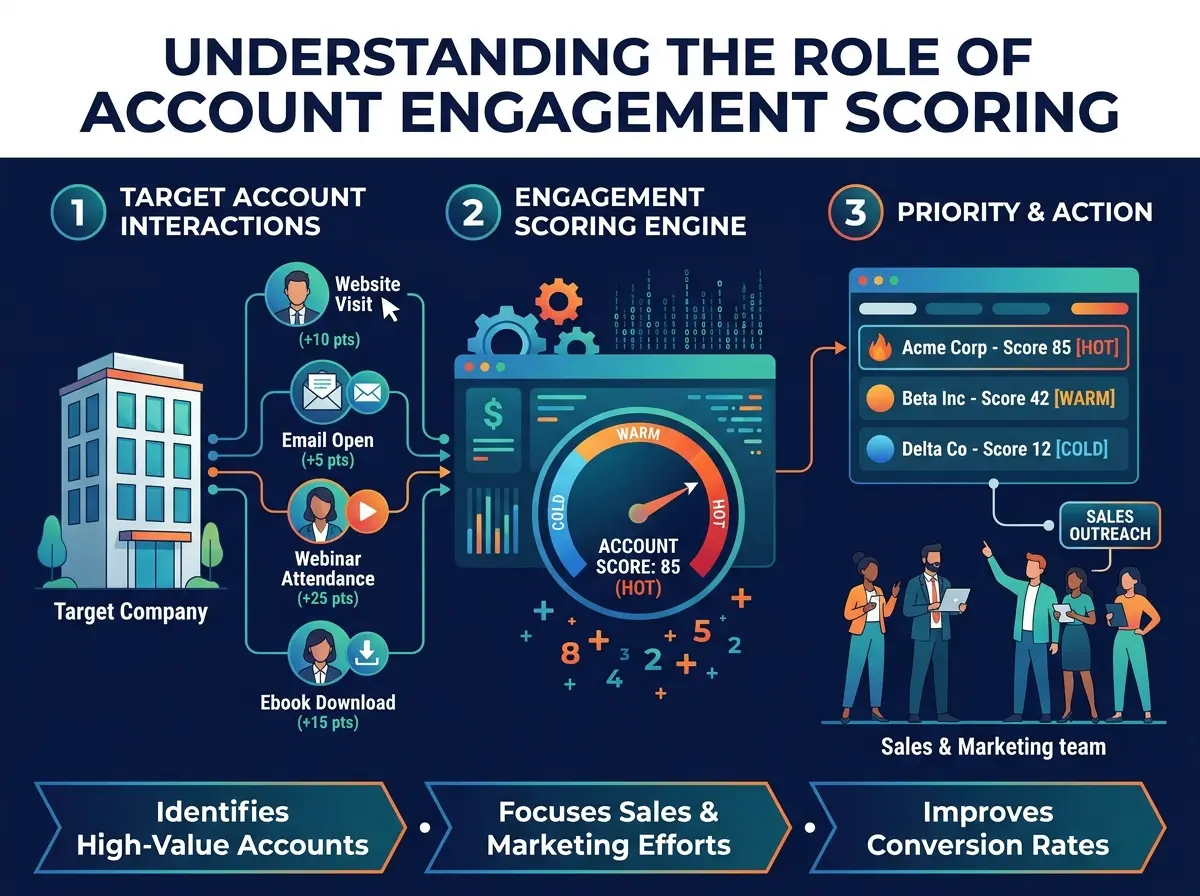
Account Engagement Scoring is the process of assigning values to interactions and activities associated with a target business. These values help organizations understand the level of interest an account demonstrates throughout its relationship with a brand.
Unlike traditional lead scoring, which often evaluates individual contacts, account-level scoring considers the combined behavior of people associated with the same organization. This distinction matters because B2B purchases rarely depend on one person’s decisions. Marketing managers, department heads, technical specialists, procurement teams, and executives may all participate in evaluating a potential solution.
For example, an employee might download a product comparison report, another might attend an educational webinar, and a department manager might repeatedly visit the company’s pricing page. When these interactions are connected to the same organization, they provide a stronger indication of business interest than any individual activity could offer.
Account-level evaluation makes it possible to understand these relationships collectively. It also helps businesses distinguish between accounts that simply recognize their brand and those actively researching potential solutions.
The purpose is not to assign the highest possible score to every active organization. Instead, businesses should identify interactions that indicate meaningful interest and connect those signals with their ideal customer profiles.
Why Individual Interactions Do Not Tell the Complete Story
A single marketing interaction rarely provides enough information to determine whether an account is ready for a sales conversation. Someone might open an email because of an interesting subject line without having any intention of purchasing. Similarly, a website visitor may read an article for educational purposes rather than researching a specific product.
This makes context essential when evaluating engagement.
Account Activity Tracking allows businesses to examine different interactions over time instead of treating every activity as an isolated event. Website visits, email responses, webinar attendance, product inquiries, and content downloads can reveal different levels of interest.
Consider two organizations that have visited the same company’s website several times. The first organization reads general educational articles and occasionally opens newsletters. The second explores service pages, downloads pricing information, attends a product demonstration, and returns to review customer success stories.
Although both accounts generate website activity, their behavior suggests different levels of purchasing interest. The second account demonstrates more focused research and may deserve greater attention from the sales team.
Account Interaction Data becomes more valuable when organizations understand the purpose behind each activity. Repeated visits to a pricing page may indicate stronger commercial interest than several visits to unrelated blog posts. However, businesses should avoid assuming that every repeated interaction automatically represents purchase readiness.
Combining Account Engagement Metrics for Better Evaluation
A reliable scoring model depends on selecting engagement metrics that reflect how target accounts interact with a business. These metrics should represent different stages of the customer journey rather than focusing exclusively on easily measured activities.
Content engagement is one important area. Reading articles, downloading reports, viewing case studies, and exploring product resources can reveal how an account researches a particular problem. Educational content may indicate early interest, while product comparisons and implementation resources can suggest more advanced consideration.
Email engagement provides another useful perspective. Newsletter subscriptions, meaningful email responses, webinar invitations, and campaign interactions help marketers understand whether an organization continues to pay attention to its communications. However, email opens should receive limited weight because privacy features and automated systems can make them unreliable indicators of genuine interest.
Website behavior offers additional context. Visits to pricing pages, product descriptions, service pages, and customer testimonials can reveal what an organization wants to understand before making a decision. Businesses can also examine the frequency and recency of these visits to identify changing interest levels.
Event participation is another valuable signal. Registering for an event shows some level of curiosity, but attending a live session, asking relevant questions, or requesting additional information demonstrates more active involvement.
These Account Engagement Metrics should work together. No single measurement needs to determine an account’s overall score. A balanced evaluation creates a more realistic picture of business interest and reduces the risk of prioritizing accounts based on superficial activity.
The Importance of B2B Engagement Scoring in Complex Buying Journeys
B2B purchasing journeys are rarely straightforward. A potential customer may discover a brand through search engines, explore educational resources, compare providers, consult internal stakeholders, and eventually contact a sales representative. These activities can happen over several weeks or months.
B2B Engagement Scoring helps businesses recognize how account interest develops during this process.
For example, an organization researching marketing automation software might initially interact with introductory articles. Later, its employees may attend webinars, explore product features, and download comparison materials. Eventually, a senior decision-maker might request a consultation.
Each stage provides different information about the organization’s needs and readiness. A scoring model can reflect these differences by assigning greater importance to activities that demonstrate deeper commercial interest.
This approach becomes particularly valuable when multiple stakeholders are involved. An account with several engaged contacts may represent a stronger opportunity than one with a single highly active individual.
Businesses should also consider the nature of their target industries. Engagement patterns for financial technology companies may differ from those of manufacturing organizations or professional service providers. Industry-specific expectations should therefore influence how scoring models evaluate interactions.
For companies targeting specialized sectors, Account-Based Marketing for Fintech offers a useful perspective on how industry-focused targeting can support more relevant business communication.
Using Account Behavior Analysis to Recognize Buying Interest
Account Behavior Analysis examines how organizations interact with a brand across different channels and over time. It helps marketing teams identify patterns that reveal what potential customers are researching, which topics attract their attention, and how their interests change.
A useful analysis looks beyond the number of interactions. It considers the relationship between activities, their frequency, their timing, and the subjects involved.
For instance, an account that repeatedly explores content about data security, integration capabilities, and implementation costs may be evaluating solutions for a specific business requirement. When several employees from that organization demonstrate similar interests, the pattern becomes even more meaningful.
Behavioral patterns can also reveal changes in engagement. An account that was previously inactive but suddenly begins attending webinars and reviewing product information may be entering a new research phase. Recognizing this change allows marketing teams to respond with relevant communication rather than relying on outdated assumptions.
Retargeting can also support these efforts when used thoughtfully. Businesses can reconnect with selected organizations through relevant advertisements and content based on their previous interests. However, advertising activity should complement engagement analysis rather than replace it. Account-Based Retargeting Strategies explores how targeted advertising can help businesses maintain visibility among important accounts.
The goal of behavioral analysis is to understand the reasons behind engagement and use that understanding to improve the relevance of future interactions.
Lead Engagement Signals and the Value of Multiple Stakeholders
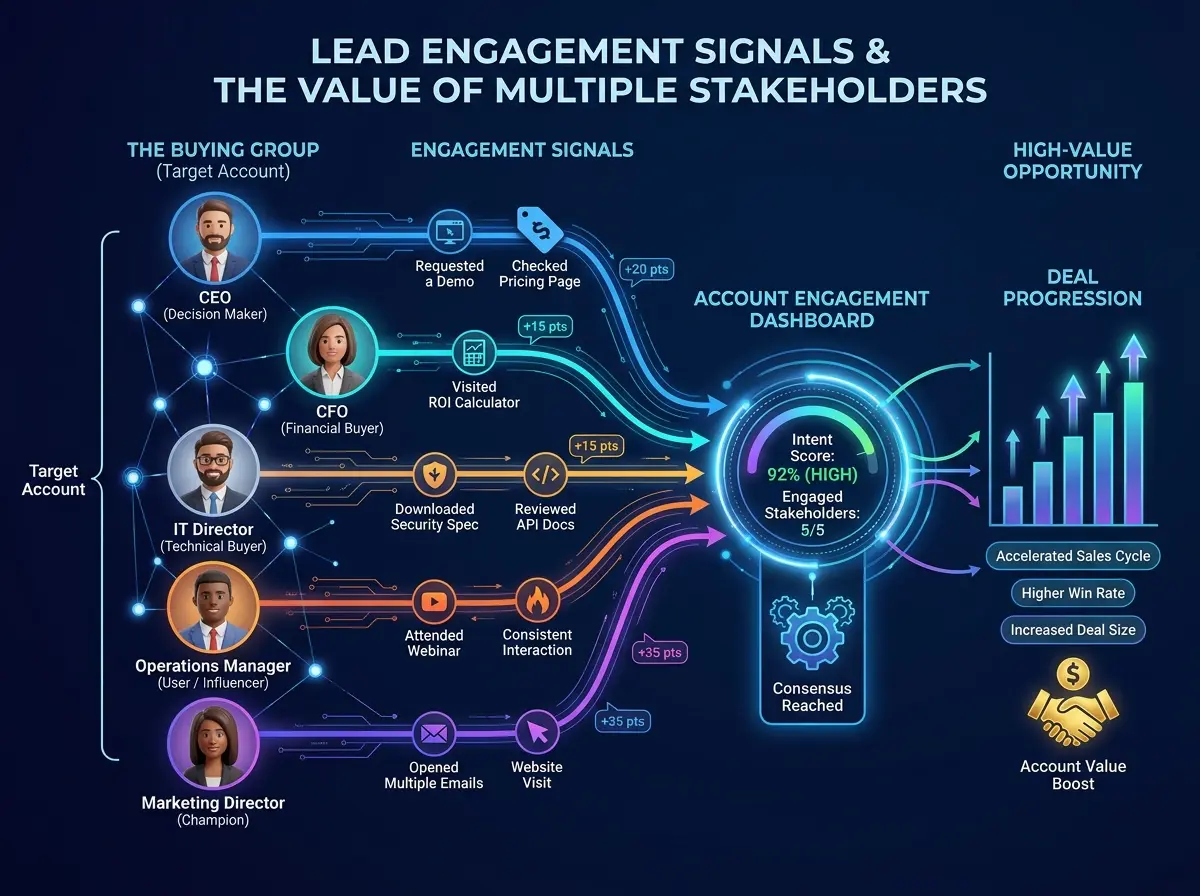
Lead Engagement Signals are useful indicators of how individual contacts respond to a company’s marketing and sales activities. When these signals are connected at the account level, they provide a broader understanding of organizational interest.
A single contact might regularly read newsletters, while another downloads technical documents and a third participates in a product demonstration. These individuals may have different responsibilities, but their activities could be connected to the same purchasing decision.
This is why account-level evaluation should consider both individual engagement and collective participation.
Marketing teams can examine which departments are interacting with their content, whether senior decision-makers are becoming involved, and whether engagement is spreading across an organization. An account with participation from several relevant departments may indicate a more developed buying process.
However, stakeholder quantity alone should not determine account quality. Five unrelated interactions from employees with no purchasing influence may be less valuable than one meaningful conversation with a decision-maker.
Businesses should therefore evaluate the relevance of each contact, their professional responsibilities, and the nature of their interactions.
A strong account scoring system connects these signals without treating every contact as equally influential. This helps sales representatives understand who is involved in the buying process and which relationships may require additional attention.
Account Intent Tracking and the Difference Between Interest and Readiness
Engagement and purchase intent are closely connected, but they are not identical.
An organization can interact with educational content frequently without having an immediate need for a product. Another account might show fewer interactions but demonstrate strong commercial interest through a pricing inquiry or a request for a product demonstration.
Account Intent Tracking helps businesses understand these differences by evaluating activities that suggest an organization is actively researching a solution.
First-party intent signals come from interactions with a company’s own digital properties. These may include visits to product pages, repeated searches within a website, requests for consultations, and engagement with product-specific resources.
Additional intent information may come from external research activities when businesses use suitable third-party data providers. These sources can indicate whether organizations are researching relevant industry topics beyond a particular company’s website.
Combining intent information with engagement history creates a more complete picture. For example, an account that frequently explores implementation resources while researching related industry solutions may represent a developing opportunity.
Nevertheless, intent data should always be interpreted carefully. Research activity does not guarantee purchasing plans, and organizations should validate important signals through relevant conversations.
The strongest results come from combining behavioral evidence, business fit, and direct communication rather than relying on intent information alone.
Building Effective Engagement Score Models
An engagement scoring model determines how different activities contribute to an account’s overall evaluation. Its structure should reflect the organization’s marketing objectives, sales process, and ideal customer profile.
A practical model can begin by identifying the interactions that matter most. These might include attending product demonstrations, requesting consultations, downloading industry reports, visiting pricing pages, and participating in relevant events.
Each activity receives a value based on its importance. For example, a consultation request could receive more points than a general newsletter subscription because it represents a stronger indication of commercial interest.
The model should also account for engagement frequency. An organization that repeatedly demonstrates interest may deserve greater attention than one with a single interaction. However, excessive activity should not automatically create an inflated score.
Time is another important consideration. Engagement that occurred recently may be more relevant than interactions recorded several months earlier. A score can gradually decrease when an account stops interacting with the brand, helping organizations avoid prioritizing outdated opportunities.
Negative signals should also be considered. Unsubscribing from communications, requesting removal from marketing lists, or demonstrating a lack of fit may reduce the relevance of an account for particular campaigns. Privacy preferences and communication restrictions must always be respected.
Once these elements are established, organizations can create different engagement categories, such as low, moderate, and high engagement. These categories should have clear definitions so that marketing and sales teams interpret account scores consistently.
The model should remain flexible. As the business collects more information about successful opportunities, it can adjust scoring values to better reflect actual purchasing behavior.
Turning Customer Engagement Scores into Sales Opportunities
Customer Engagement Scores become valuable when businesses use them to support meaningful decisions. A score that simply appears in a marketing dashboard provides limited value unless it influences how accounts are researched, communicated with, and prioritized.
Marketing teams can use these scores to identify organizations that deserve more personalized campaigns. Highly engaged accounts might receive invitations to product demonstrations, relevant case studies, or industry-specific resources. Accounts with moderate engagement may benefit from educational content that addresses their current research interests.
Sales teams can use the same information to prepare more relevant conversations. Instead of approaching an organization without context, representatives can understand which resources its employees explored and which topics generated interest.
This does not mean that every high-scoring account should immediately become a sales opportunity. Business fit, available budget, organizational needs, purchasing authority, and timing still matter.
A useful scoring framework therefore combines engagement with qualification information. Account Qualification Metrics can help businesses determine whether an organization matches their target market, has a relevant business requirement, and represents a realistic opportunity.
When engagement and qualification are evaluated together, organizations can make more informed decisions about where to invest their resources.
How Webinars Strengthen Account Engagement
Webinars provide an opportunity for businesses to build deeper relationships with target accounts through educational discussions, expert presentations, and product-focused sessions.
Unlike passive content consumption, live events can reveal more detailed engagement. Participants may ask questions, interact with speakers, explore specific challenges, and request additional information after the session.
These interactions can contribute useful signals to account scoring models. However, attendance duration, participation, questions, and follow-up requests should be evaluated separately because they represent different levels of involvement.
For account-based marketing teams, webinars can also support relationships with multiple stakeholders from the same organization. Different employees may attend sessions related to their individual responsibilities while exploring the same broader business challenge.
Live Webinars for ABM highlights the role of live educational experiences in engaging selected business accounts and creating more meaningful interactions.
When webinar participation is connected with other account activities, marketers gain a better understanding of how organizations respond to their content and where additional communication may be useful.
Improving Account Engagement Scoring Through Data Quality
Even a well-designed scoring model can produce misleading results when its underlying information is incomplete or inaccurate.
Duplicate contact records, outdated company details, incorrect account associations, and missing activity information can distort engagement measurements. For example, when several contacts from the same organization are recorded under different company profiles, their combined interest may not be recognized.
Maintaining consistent account records is therefore essential. Marketing platforms and customer relationship management systems should use reliable identifiers to connect contacts, organizations, and their interactions.
Data integration also matters. Website analytics, email marketing platforms, event management systems, and CRM software should contribute information in a consistent format whenever possible.
Businesses should regularly review their scoring models to identify inaccurate measurements and outdated assumptions. Comparing engagement scores with actual sales outcomes can reveal whether high-scoring accounts genuinely become qualified opportunities.
Another important consideration is transparency. Sales representatives should understand why an account received a particular score rather than seeing only a numerical value. Clear scoring explanations make it easier to trust the system and provide feedback when an account’s evaluation does not reflect its real situation.
As organizations improve their data quality and measurement processes, engagement scoring becomes a more dependable part of their marketing operations.
The Future of Account Engagement Scoring

Account engagement evaluation is becoming increasingly connected with automation, predictive analytics, and artificial intelligence. These technologies can help businesses identify behavioral patterns across large numbers of accounts and recognize changes that may be difficult to detect through manual analysis.
Predictive models can examine historical engagement information alongside qualification data to estimate which accounts are more likely to become customers. Automated systems can also update scores as new activities occur, allowing marketing teams to respond to changing account behavior.
However, automation should support human judgment rather than replace it. A high engagement score cannot fully explain an organization’s internal priorities, financial circumstances, or purchasing decisions.
Businesses must also maintain responsible data practices. Collecting and analyzing customer information should follow applicable privacy requirements, respect communication preferences, and provide appropriate controls over personal data.
The most effective future scoring systems will combine reliable information, relevant behavioral analysis, and practical sales knowledge. This combination can help organizations build stronger relationships while making better use of their marketing resources.
Conclusion
Account Engagement Scoring gives B2B organizations a clearer understanding of how potential customers interact with their brands and where meaningful opportunities may be developing. By combining account activity, behavioral patterns, stakeholder participation, and intent signals, businesses can move beyond isolated engagement measurements and evaluate relationships more effectively. These insights can also support broader digital strategies, including Voice-Activated Affiliate Marketing, by helping businesses understand audience interests and identify relevant engagement opportunities.
Its real value comes from connecting scoring information with account qualification, personalized communication, and sales priorities. When supported by reliable data and regularly reviewed scoring models, this approach helps marketing and sales teams identify promising accounts, understand customer interests, and build more productive business relationships.
Rather than treating engagement as a collection of disconnected activities, organizations can use it as a foundation for more informed account-based marketing decisions.
Frequently Asked Questions
1. What is Account Engagement Scoring?
Account Engagement Scoring is a method of evaluating how businesses interact with a brand by assigning values to activities such as website visits, content downloads, webinar participation, and product inquiries. It helps organizations identify accounts demonstrating meaningful interest.
2. How is account engagement scoring different from lead scoring?
Lead scoring primarily evaluates the activities and characteristics of individual contacts. Account engagement scoring considers interactions across an entire organization, helping businesses understand collective interest from multiple stakeholders.
3. Which metrics are important for account engagement scoring?
Important metrics include website activity, email interactions, content consumption, webinar attendance, product page visits, consultation requests, and engagement frequency. The most useful metrics depend on the company’s sales process and marketing objectives.
4. Why is account engagement scoring important for B2B marketing?
B2B purchasing decisions often involve multiple stakeholders and extended evaluation periods. Account engagement scoring helps marketers recognize organizational interest, prioritize potential opportunities, and coordinate more relevant communication with sales teams.
5. How do engagement score models work?
Engagement score models assign different values to account activities based on their relevance and importance. Meaningful actions receive higher scores, while less significant interactions receive lower values. Some models also consider engagement recency and negative signals.
6. Can account engagement scoring identify purchase intent?
It can help identify activities associated with potential purchase interest, such as repeated pricing page visits, product demonstrations, and consultation requests. However, engagement scores should be combined with additional qualification information before determining sales readiness.
7. What role does account behavior analysis play in engagement scoring?
Account behavior analysis helps businesses identify patterns in how organizations interact with their content and marketing channels. It reveals changes in interest, recurring research topics, and interactions that may indicate developing business opportunities.
8. How can multiple stakeholders influence an account engagement score?
Interactions from different employees can provide a broader understanding of organizational interest. When relevant decision-makers and department representatives engage with a brand, their combined activities may indicate a more developed purchasing process.
9. How often should businesses review their engagement scoring models?
Businesses should review their models regularly and whenever major changes occur in their products, target markets, or sales processes. Comparing scores with actual sales outcomes helps identify areas where scoring values need adjustment.
10. Can automation improve account engagement scoring?
Yes. Marketing automation and predictive analytics can collect interaction data, update account scores, identify behavioral patterns, and notify teams when engagement changes. Human review remains important for interpreting scores and validating business opportunities.


Live Webinars for ABM: Strategies to Engage High-Value Accounts


Balancing Personalization and Privacy in Modern ABM

Virtual Events and Webinars: Powerful Strategies for ABM Success