
Account-Based Marketing for Fintech: Precision Targeting Strategies
 13 min read
The fintech industry thrives on precision. From algorithmic trading to fraud detection, financial technology companies understand that accuracy can make or break their success. This same principle applies to marketing, and account-based marketing has emerged as the surgical approach that fintech companies need to cut through noise and reach high-value prospects.
Traditional marketing casts a wide net, hoping to catch as many leads as possible. Account-based marketing flips this approach entirely. Instead of targeting thousands of prospects with generic messaging, ABM focuses on a select group of high-value accounts with personalized campaigns designed specifically for their needs.
For fintech companies dealing with complex B2B sales cycles, regulatory considerations, and sophisticated buyers, this targeted approach isn’t just beneficial—it’s essential. This guide explores how fintech companies can implement precision targeting strategies that drive real results.
Understanding Account-Based Marketing in the Fintech Context

Account-based marketing represents a strategic shift from volume-based lead generation to quality-focused account engagement. Rather than measuring success by the number of leads generated, ABM prioritizes engagement depth and conversion quality from predetermined target accounts.
Fintech companies face unique challenges that make ABM particularly valuable. Long sales cycles often span six months to two years, involving multiple stakeholders who each have different priorities and concerns. A chief technology officer worries about integration capabilities, while a chief financial officer focuses on cost-effectiveness and ROI.
Additionally, fintech buyers are typically well-informed and skeptical. They’ve likely encountered numerous vendors promising revolutionary solutions, making them resistant to generic sales pitches. These prospects respond better to communications that demonstrate a deep understanding of their specific business challenges and regulatory environment.
The regulatory complexity of financial services also creates barriers that generic marketing cannot overcome. A payment processing company serving healthcare providers operates under different compliance requirements than one serving e-commerce platforms. Account based marketing allows fintech companies to address these nuanced considerations directly.
Identifying High-Value Target Accounts
Success in account-based marketing starts with selecting the right accounts. Fintech companies must look beyond traditional firmographic data to identify prospects with the highest potential value and likelihood of conversion.
Revenue potential serves as the primary filter, but calculating this requires more nuance than simple company size. A mid-sized regional bank might represent a higher lifetime value than a larger institution if it’s more likely to adopt innovative solutions quickly. Consider factors like budget authority, decision-making speed, and growth trajectory when evaluating potential accounts.
Technology stack compatibility plays a crucial role in account selection. Companies already using complementary fintech solutions often prove more receptive to additional innovations. Research prospects’ current vendors and identify those with infrastructure that aligns with your solution’s requirements.
Timing indicators can make the difference between a successful outreach and a missed opportunity. Monitor for trigger events such as funding rounds, executive hires, regulatory changes, or public statements about digital transformation initiatives. These signals suggest companies may be more open to evaluating new solutions.
Geographic considerations matter particularly for fintech companies. Regulatory requirements vary significantly between regions, and some solutions may only apply to specific markets. Focus on accounts operating in jurisdictions where your solution provides clear compliance benefits.
Developing Buyer Personas for Fintech Decision-Makers
Effective account-based marketing requires a deep understanding of the people behind purchasing decisions. Fintech buying committees typically include multiple stakeholders, each with distinct motivations and concerns.
Chief financial officers approach fintech solutions with a focus on cost reduction and risk mitigation. They want to see clear ROI projections, understand implementation costs, and evaluate how new solutions might affect existing financial processes. When crafting messages for CFOs, emphasize quantifiable benefits and provide detailed cost-benefit analyses.
Technology leaders evaluate solutions through the lens of integration complexity, security implications, and long-term scalability. Chief technology officers and IT directors need technical specifications, architecture diagrams, and evidence of successful implementations in similar environments. They appreciate detailed documentation and access to technical support teams.
Risk and compliance officers represent increasingly important stakeholders in fintech purchasing decisions. These professionals focus on regulatory adherence, audit trail capabilities, and potential compliance risks. Content for this audience should highlight security certifications, compliance features, and risk mitigation capabilities.
Business unit leaders who will actually use the solution bring operational perspectives to the decision process. They care about user experience, training requirements, and how new tools will affect daily workflows. These stakeholders respond well to demonstrations, user testimonials, and implementation timelines.
Creating Personalized Content and Messaging
Generic marketing materials fail in account-based marketing scenarios. Fintech companies must develop content that speaks directly to specific accounts and their unique challenges.
Start by researching each target account thoroughly. Review their recent financial reports, press releases, and executive communications to understand current priorities and challenges. Look for public statements about digital transformation goals, regulatory compliance concerns, or operational efficiency initiatives.
Develop account-specific value propositions that connect your solution directly to their stated objectives. If a target company recently announced plans to expand into new markets, explain how your solution facilitates geographic expansion while maintaining compliance. If they’ve expressed concerns about operational costs, focus on efficiency gains and cost reduction potential.
Case studies prove particularly powerful when tailored to specific accounts. Instead of generic success stories, develop case studies featuring companies with similar characteristics, challenges, or objectives as your target accounts. If possible, create multiple versions highlighting different aspects of the same implementation to appeal to various stakeholders within the buying committee.
Interactive content can differentiate your outreach in crowded fintech markets. Consider developing ROI calculators customized for specific account types, interactive demos that showcase features relevant to their use case, or assessment tools that help them evaluate their current state against industry benchmarks.
Multi-Channel Engagement Strategies
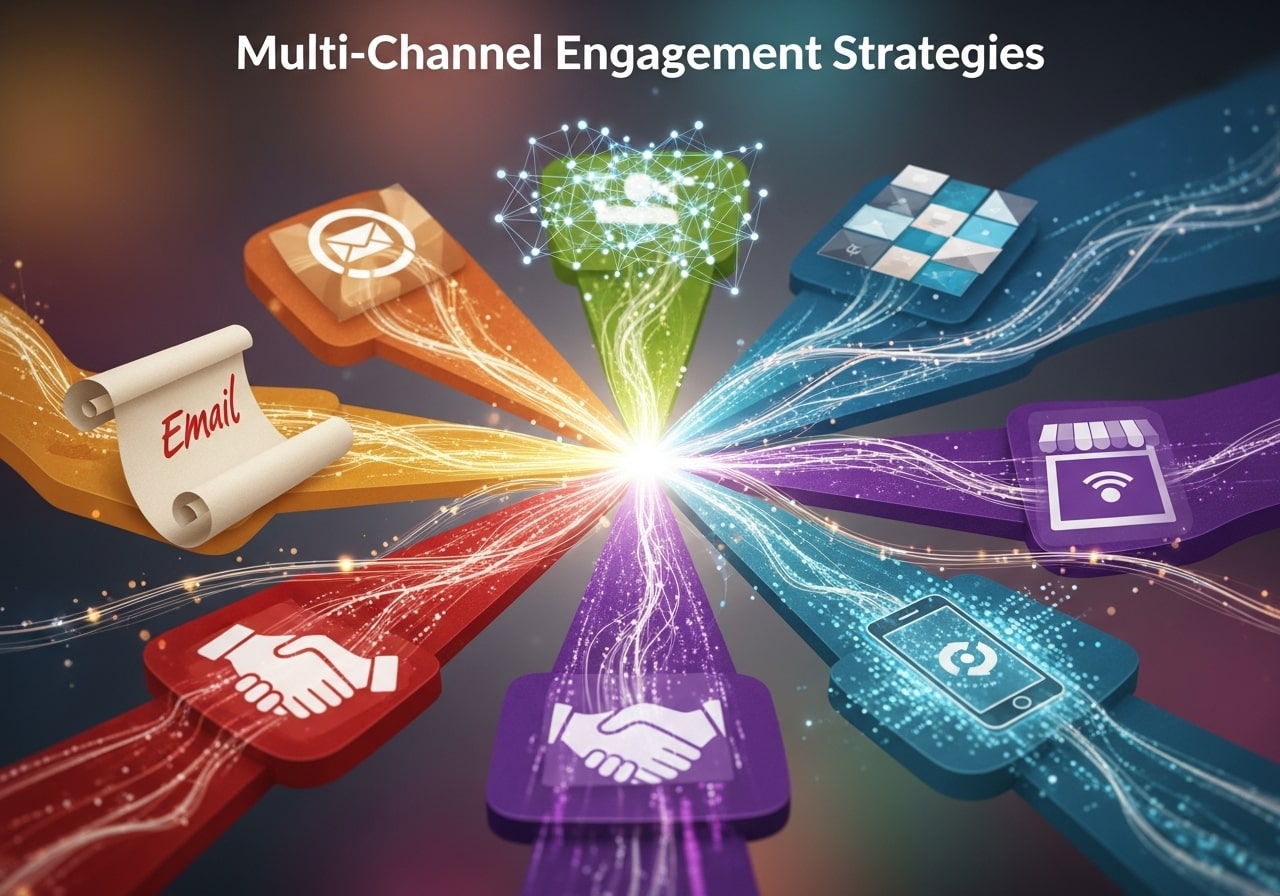
Account-based marketing requires coordinated outreach across multiple touchpoints to build momentum and maintain engagement throughout long sales cycles.
LinkedIn represents the primary social platform for B2B fintech outreach. Research target accounts’ key stakeholders and engage with their content before making direct contact. Share insights relevant to their industry or role, comment thoughtfully on their posts, and establish familiarity before initiating sales conversations.
Email campaigns in ABM contexts require more sophistication than traditional email marketing. Sequence messages to build upon previous interactions and provide progressively more detailed information. Track engagement carefully and adjust timing or messaging based on recipient behavior.
Direct mail has experienced a renaissance in B2B marketing because physical materials stand out in digital-heavy communication environments. Consider sending relevant industry reports, branded items that provide ongoing utility, or personalized gifts that reference specific account characteristics.
Account-based advertising through platforms like LinkedIn and Google allows precise targeting of specific companies and job titles. Create ad campaigns that serve different messages to various stakeholders within the same organization, ensuring each person sees content relevant to their role and interests.
Leveraging Technology for Precision Targeting
Modern ABM platforms provide the technological foundation necessary for sophisticated account-based marketing campaigns. These tools enable fintech companies to orchestrate complex, multi-touchpoint campaigns while tracking engagement across all channels.
Customer relationship management integration ensures that account-based marketing activities align with broader sales efforts. Choose platforms that sync seamlessly with your existing CRM to provide sales teams with complete visibility into marketing touchpoints and account engagement history.
Intent data platforms help identify when target accounts are actively researching solutions in your category. These tools monitor content consumption patterns, search behavior, and website visits to provide early indicators of purchase intent. For fintech companies, this intelligence can be particularly valuable given the extensive research periods that precede major technology purchases.
Marketing automation capabilities enable personalized communication at scale. Set up automated workflows that deliver relevant content based on engagement patterns, job titles, and account characteristics. However, avoid over-automation in account-based marketing contexts—high-value prospects expect and deserve human attention.
Measuring ABM Success in Fintech
Traditional marketing metrics like cost per lead become less relevant in account-based marketing contexts. Success measurement must focus on account-level engagement and progression through the sales funnel.
Account engagement scoring provides a comprehensive view of prospect interest across all touchpoints. Track email opens, content downloads, website visits, and social media interactions to develop engagement scores for each target account. Rising engagement scores often precede sales opportunities.
Pipeline acceleration metrics help evaluate whether account-based marketing efforts are shortening sales cycles. Compare the average time from first contact to closed deal between ABM targets and traditionally acquired accounts to measure the impact on sales velocity.
Deal size comparisons reveal whether the precision targeting approach is delivering higher-value opportunities. Account-based marketing should generate larger deals than broad-based marketing efforts due to better account selection and more sophisticated nurturing processes.
Customer lifetime value analysis helps justify ABM investments by demonstrating the long-term value of acquired accounts. Track retention rates, expansion opportunities, and referral generation from ABM-acquired customers to calculate true return on investment.
Overcoming Common ABM Challenges in Fintech
Fintech companies implementing account-based marketing often encounter specific obstacles that require strategic solutions.
Long sales cycles can make it difficult to maintain momentum and justify marketing spend. Combat this challenge by developing content for different stages of the buyer journey and implementing lead scoring systems that identify accounts advancing through the pipeline. Celebrate incremental wins like increased engagement or additional stakeholder involvement to maintain team motivation.
Multiple stakeholders complicate message development and campaign orchestration. Map out buying committees for target accounts and develop role-specific content tracks that speak to each stakeholder’s priorities. Use marketing automation to deliver appropriate messages to different roles while maintaining campaign coordination.
Regulatory considerations can limit marketing approaches and messaging options. Work closely with legal teams to ensure all marketing materials comply with relevant regulations. Consider developing compliance-focused content that positions regulatory adherence as a competitive advantage rather than a burden.
Limited budgets require careful resource allocation and precise execution. Start with a smaller number of high-potential accounts rather than spreading efforts too thin. Prove ROI with initial successes before expanding program scope.
The Future of Account-Based Marketing in Fintech

The evolution of account-based marketing continues as new technologies and market conditions create fresh opportunities and challenges for fintech companies.
Artificial intelligence and machine learning capabilities are enhancing account selection and personalization at scale. These technologies can analyze vast amounts of data to identify patterns that human marketers might miss, improving targeting precision and message relevance.
Privacy regulations and data protection requirements are reshaping how companies collect and use prospect information. Fintech ABM programs must adapt to operate effectively within increasingly strict data governance frameworks while still delivering personalized experiences.
Integration between marketing and sales technologies continues to deepen, creating more seamless handoffs between marketing-generated engagement and sales-driven conversations. This alignment becomes particularly important in complex B2B fintech sales environments.
Building Your Fintech ABM Foundation
Account-based marketing success requires systematic planning and careful execution. Start by identifying your highest-value prospect accounts using the criteria discussed earlier, focusing on quality over quantity in your initial selections.
Invest in the technology infrastructure necessary to support sophisticated campaigns while ensuring integration with existing sales and marketing systems. The right platform can make the difference between a successful program and a resource-intensive failure.
Develop your content library with account-specific materials, case studies, and interactive tools that demonstrate clear value to fintech buyers. Remember that high-quality, relevant content often matters more than campaign volume.
Train your sales and marketing teams on ABM principles and ensure alignment between both functions. Account-based marketing works best when sales and marketing operate as a unified revenue team rather than separate departments.
Account-based marketing represents more than a marketing tactic—it’s a strategic approach that aligns perfectly with the precision and sophistication that define successful fintech companies. By implementing the targeting strategies and best practices outlined in this guide, fintech organizations can build more effective relationships with high-value prospects and drive sustainable growth in competitive markets.
Frequently Asked Questions (FAQ)
1. What is account-based marketing (ABM) in fintech?
Account-based marketing in fintech is a targeted marketing strategy that focuses on engaging a select group of high-value accounts with personalized messaging. Instead of generating large volumes of leads, ABM prioritizes deep engagement with organizations most likely to convert and deliver long-term value.
2. Why is ABM especially effective for fintech companies?
Fintech companies operate in complex, highly regulated environments with long B2B sales cycles and multiple decision-makers. ABM allows fintech marketers to address specific regulatory concerns, technical requirements, and business goals of each account, making outreach more relevant and effective.
3. How is ABM different from traditional B2B marketing?
Traditional B2B marketing focuses on volume—attracting as many leads as possible. ABM reverses this approach by starting with specific target accounts and creating customized campaigns for them. Success is measured by account engagement and deal quality rather than lead quantity.
4. How do fintech companies identify the right accounts for ABM?
High-value fintech accounts are identified using a combination of factors such as revenue potential, technology stack compatibility, regulatory fit, geographic location, and intent signals like funding announcements or digital transformation initiatives.
5. Who are the key decision-makers in fintech ABM campaigns?
Typical fintech buying committees include CFOs, CTOs, compliance and risk officers, and business unit leaders. Each stakeholder has different priorities, so ABM campaigns must deliver role-specific messaging and content.
6. What types of content work best for fintech ABM?
Personalized case studies, compliance-focused whitepapers, ROI calculators, technical documentation, interactive demos, and industry-specific reports perform well. Content should directly address the target account’s business challenges and regulatory environment.
7. Which channels are most effective for fintech ABM?
Effective fintech ABM strategies use a mix of LinkedIn engagement, personalized email sequences, account-based advertising, direct mail, and sales enablement content. Multi-channel coordination is essential for maintaining momentum throughout long sales cycles.
8. How do fintech companies measure ABM success?
ABM success is measured using account-level metrics such as engagement scores, pipeline velocity, deal size, conversion rates, and customer lifetime value rather than traditional metrics like cost per lead.
9. What are the biggest challenges in fintech ABM?
Common challenges include long sales cycles, multiple stakeholders, regulatory constraints, and limited budgets. These can be overcome with strong sales–marketing alignment, role-based content, compliance-approved messaging, and a focused account selection strategy.
10. Is ABM suitable for smaller fintech companies?
Yes. Smaller fintech firms can start with a limited number of high-potential accounts and scale gradually. ABM often delivers higher ROI than broad-based marketing because resources are concentrated on accounts most likely to convert.


Live Webinars for ABM: Strategies to Engage High-Value Accounts


Balancing Personalization and Privacy in Modern ABM

Virtual Events and Webinars: Powerful Strategies for ABM Success