
Why ABM Is the Future of Web Development Marketing
 11 min read
The web development industry faces a unique challenge: convincing decision-makers to invest in complex technical solutions they may not fully understand. Traditional marketing approaches often fall short when trying to reach the specific stakeholders who actually make purchasing decisions for custom development projects, enterprise software, or technical consulting services.
Understanding ABM in the Web Development Context

Account-Based Marketing flips traditional marketing on its head. Instead of creating broad campaigns to attract many leads, ABM treats individual accounts as markets of one. For web development companies, this means identifying specific businesses that need your services, then crafting personalized campaigns to engage the entire decision-making unit within those organizations.
The approach works particularly well for development businesses because technical projects typically involve multiple stakeholders. A custom web application project might require buy-in from the CTO, approval from the CFO, and support from department heads who will actually use the system. ABM recognizes this reality and creates coordinated touchpoints for each stakeholder.
Why Traditional Marketing Falls Short for Dev Companies

Most web development companies struggle with traditional lead generation for several reasons. First, the sales cycle for technical projects is often long and complex. A potential client might research solutions for months before making contact, then require additional months of consultation before signing a contract.
Second, technical decision-makers consume information differently from typical B2B buyers. They want to see code samples, architectural diagrams, and detailed technical specifications. Generic marketing content rarely addresses their specific concerns about scalability, security, or integration challenges.
Third, the value proposition for custom development varies dramatically between industries and company sizes. A fintech startup needs different solutions than a manufacturing company, yet many development firms use the same marketing messages for both audiences.
ABM for Long-Term Client Relationships
Account-Based Marketing helps web development companies move beyond one-time projects and build long-term client relationships. By focusing on a small number of high-value accounts, companies can deeply understand client goals, technical challenges, and future growth plans. This approach allows development teams to position themselves not just as service providers, but as strategic partners. Over time, consistent personalized engagement builds trust, increases repeat business, and opens doors for upselling additional services such as maintenance, optimization, or new feature development. Long-term relationships also lead to referrals, making ABM a powerful growth strategy.
Personalization as a Competitive Advantage
In the web development industry, personalization is no longer optional—it is a competitive advantage. ABM enables companies to tailor messaging, proposals, and technical solutions based on each target account’s exact needs. Instead of generic service descriptions, businesses can highlight specific technologies, frameworks, or industry experience that matter to the client. Personalized communication shows decision-makers that you understand their challenges and are invested in their success. This level of relevance helps your brand stand out in a crowded market where many agencies offer similar development services.
Reducing Sales Cycle Complexity with ABM
One of the biggest challenges in web development sales is managing long and complex sales cycles. ABM helps reduce this complexity by engaging all key stakeholders early in the process. When technical leaders, financial decision-makers, and end users receive consistent and relevant messaging, alignment improves across the organization. This reduces internal friction, speeds up decision-making, and minimizes misunderstandings about project scope or value. As a result, development companies can move prospects through the sales funnel more efficiently while maintaining a high level of trust and transparency.
Aligning Technical Expertise with Business Goals
ABM allows web development companies to clearly connect their technical expertise with a client’s business objectives. Rather than focusing only on features or technologies, ABM-driven messaging emphasizes outcomes such as scalability, cost efficiency, security, and revenue growth. This alignment helps non-technical stakeholders understand the value of complex solutions. By framing development work in terms of measurable business impact, companies can justify higher project budgets and demonstrate long-term ROI. This strategic positioning strengthens credibility and improves conversion rates for high-ticket projects.
Using Data to Improve ABM Performance

Data plays a critical role in successful ABM campaigns. Web development companies can use analytics to track account-level engagement, content performance, and stakeholder interactions. These insights help teams understand which messages resonate, which channels perform best, and where prospects drop off. Over time, data-driven optimization improves targeting accuracy and campaign effectiveness. By continuously refining account selection and personalization strategies, development firms can increase win rates and reduce wasted marketing efforts. ABM becomes more scalable and predictable when decisions are guided by real performance data.
Scaling ABM Without Losing Personal Touch
As web development companies grow, scaling ABM can feel challenging. The key is balancing automation with personalization. Marketing automation tools can handle repetitive tasks such as email sequencing and content delivery, while sales and technical teams focus on high-value conversations. Even at scale, ABM remains effective when personalization is intentional and relevant. By using templates, industry-specific frameworks, and modular content, companies can expand ABM efforts without sacrificing quality. This approach ensures growth while maintaining the personalized experience clients expect.
Core ABM Strategies for Web Development Companies
Identify High-Value Target Accounts
Successful ABM starts with careful account selection. Web development companies should analyze their most profitable past clients to identify patterns. Look for companies within specific industries, size ranges, or technology stacks that align with your expertise.
Consider factors like current technology infrastructure, recent funding rounds, leadership changes, or regulatory requirements that might drive development needs. A company that just raised Series B funding might be ready to rebuild its platform for scale. An organization facing new compliance requirements might need security-focused development work.
Create Personalized Content Experiences
Once you’ve identified target accounts, develop content that speaks directly to their challenges. This might include custom case studies showing how you’ve solved similar problems, technical whitepapers addressing their specific compliance requirements, or interactive demos using their industry’s terminology and use cases.
For example, if you’re targeting a healthcare company, create content that addresses HIPAA compliance, electronic health record integration, and patient data security. Use healthcare-specific examples and terminology throughout your materials.
Coordinate Multi-Channel Engagement
ABM requires coordinated touchpoints across multiple channels. Your sales team might connect with the CTO on LinkedIn while marketing sends targeted content to the VP of Operations. Meanwhile, your development team could be engaging with their technical staff on GitHub or Stack Overflow.
The key is ensuring all touchpoints feel connected and reinforce the same core messages. Each interaction should build on previous ones, creating a cohesive narrative about how your services solve their specific challenges.
Implementation Best Practices
Build Detailed Account Profiles
Create comprehensive profiles for each target account that go beyond basic firmographic data. Research their current technology stack, recent news and announcements, key personnel, and potential pain points. Tools like BuiltWith can reveal their current web technologies, while company blogs and press releases provide insights into their strategic priorities.
Develop Account-Specific Value Propositions
Generic value propositions rarely resonate with technical buyers. Instead, craft specific value statements that address each account’s unique situation. If a target company is struggling with site performance, emphasize your optimization expertise. If they’re expanding internationally, highlight your experience with multi-region deployments.
Align Sales and Marketing Efforts
ABM only works when sales and marketing teams work together seamlessly. Establish clear processes for lead handoff, account intelligence sharing, and coordinated outreach. Marketing should provide sales with detailed account insights, while sales should share feedback about prospect responses and concerns.
Leverage Technology and Data
Use marketing automation platforms that support account-based functionality. Tools like HubSpot, Marketo, or Pardot can help you track account-level engagement and coordinate campaigns across multiple contacts within the same organization.
Implement website personalization to show different content based on the visitor’s company. If someone from a target account visits your site, they might see case studies from their industry or content addressing their specific challenges.
Measuring ABM Success
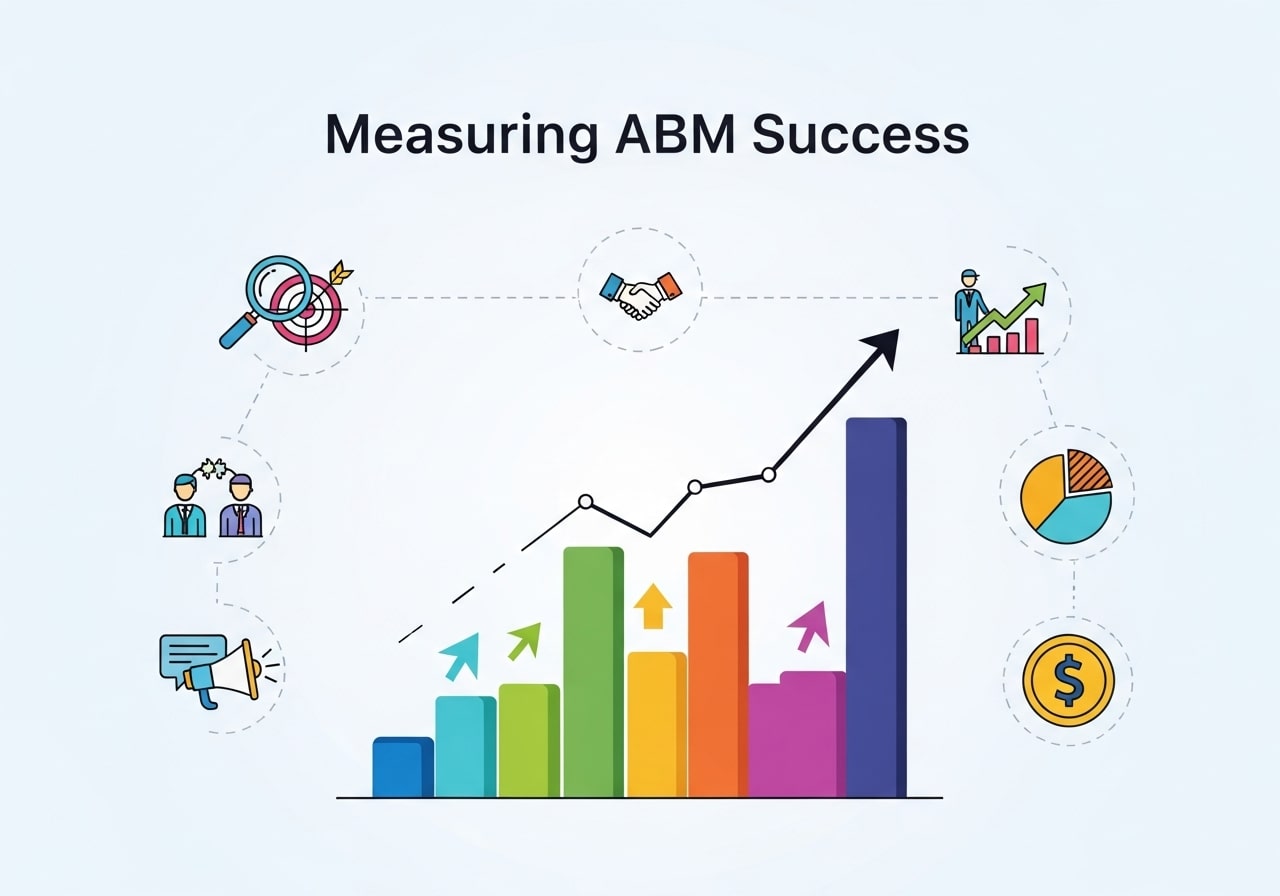
Traditional marketing metrics like cost per lead become less relevant in ABM. Instead, focus on account-level metrics that reflect your ultimate business goals.
Track account engagement scores that combine multiple touchpoints across different stakeholders. Monitor progression through your sales funnel at the account level rather than the individual lead level. Measure the quality of conversations and meetings, not just quantity.
Most importantly, track revenue metrics like deal size, sales cycle length, and customer lifetime value. ABM often results in fewer but higher-value deals, so traditional volume metrics might actually decrease while business results improve.
The Future of ABM in Web Development
ABM represents a fundamental shift toward more strategic, relationship-based marketing. As the web development industry becomes increasingly competitive, companies that can effectively target and engage high-value accounts will have significant advantages.
Emerging technologies like AI-powered personalization and predictive analytics will make ABM more sophisticated and effective. Machine learning algorithms can identify ideal target accounts based on complex data patterns, while marketing automation can deliver increasingly personalized experiences at scale.
Taking Your Next Steps
ABM isn’t a quick fix—it requires sustained effort and strategic thinking. Start by analyzing your most successful client relationships to identify patterns and ideal account characteristics. Then select a small number of high-value targets for your first ABM campaign.
Focus on creating genuinely valuable, personalized experiences for these accounts. Track your results carefully and refine your approach based on what you learn. As you build confidence and see results, gradually expand your ABM efforts to additional accounts.
The web development companies that master ABM will build stronger client relationships, command higher prices, and achieve more predictable growth. The future belongs to those who can combine technical expertise with strategic marketing precision.
Frequently Asked Questions (FAQ)
1. What is Account-Based Marketing (ABM) in web development?
Account-Based Marketing (ABM) is a focused marketing strategy where web development companies target specific high-value businesses instead of a broad audience. Each target account is treated as an individual market, with personalized messaging and campaigns designed to engage all key decision-makers involved in technical purchasing decisions.
2. Why is ABM effective for web development companies?
ABM is effective because web development projects are complex and usually require approval from multiple stakeholders. By addressing the unique technical, financial, and operational concerns of each stakeholder, ABM helps development companies build trust, shorten sales cycles, and close higher-value deals.
3. How is ABM different from traditional marketing approaches?
Traditional marketing aims to generate a large number of leads through broad campaigns, while ABM focuses on a smaller number of carefully selected accounts. Instead of lead quantity, ABM prioritizes personalization, relevance, and long-term relationship building.
4. Which web development businesses should use ABM?
ABM is ideal for web development companies that offer custom solutions, enterprise-level applications, technical consulting, or long-term development services where deal sizes are high and decision-making processes are complex.
5. How do web development companies identify the right target accounts?
The right target accounts are identified by analyzing past successful clients, industry focus, company size, technology stack, funding status, and current business challenges that align with the company’s technical expertise.
6. What type of content works best for ABM campaigns?
Personalized, problem-specific content works best in ABM campaigns. This includes industry-focused case studies, technical documentation, compliance guides, custom demos, and solution-oriented content tailored to the target account’s needs.
7. Is ABM suitable for small web development agencies?
Yes, ABM is suitable for small agencies because it allows them to focus limited resources on high-value accounts. By targeting fewer but more qualified prospects, small agencies can compete effectively with larger firms.
8. How long does it take to see results from ABM?
ABM is a long-term strategy and typically takes more time than traditional marketing to show results. However, it often leads to higher deal values, stronger client relationships, and more predictable revenue growth over time.
9. How should ABM success be measured?
ABM success should be measured using account-level metrics such as engagement across stakeholders, quality of sales conversations, deal size, sales cycle length, and overall revenue impact rather than lead volume.
10. Can ABM be combined with other marketing strategies?
Yes, ABM works best when integrated with other strategies such as content marketing, SEO, LinkedIn outreach, and sales enablement to create a consistent and personalized experience for target accounts.


Live Webinars for ABM: Strategies to Engage High-Value Accounts


Balancing Personalization and Privacy in Modern ABM

Virtual Events and Webinars: Powerful Strategies for ABM Success