
Account Penetration Strategy: Driving Growth Within Existing Accounts
 15 min read

An Account Penetration Strategy helps businesses increase revenue and strengthen relationships by identifying growth opportunities within existing customer accounts. Through customer research, strategic account development, cross-selling, upselling, and data-driven decision-making, companies can expand their presence across departments and deliver greater value. A customer-focused approach supports sustainable B2B growth, improves retention, and creates stronger long-term partnerships.
Winning a new customer is an important achievement for any business, but the real growth potential often lies within relationships that already exist. Many companies focus heavily on acquiring new clients while overlooking opportunities to expand their partnerships with current customers. Existing accounts may have additional departments to serve, new business requirements to address, and services that could create greater value. Recognizing these opportunities is where an effective Account Penetration Strategy becomes essential.
An account penetration strategy helps businesses develop deeper relationships with existing customers, understand their changing priorities, and identify areas where additional products or services can provide meaningful benefits. Rather than approaching every customer interaction as a sales opportunity, companies focus on understanding the customer’s overall business environment and finding ways to support its long-term objectives.
For B2B organizations, this approach can create more predictable revenue, stronger customer relationships, and improved business stability. It also allows sales and marketing teams to make better use of existing customer information instead of depending entirely on new lead generation.
However, successful account penetration requires more than simply increasing sales conversations. It involves understanding customer behavior, recognizing expansion opportunities, coordinating internal teams, and delivering solutions that genuinely address business needs.
Understanding the Value of Account Penetration
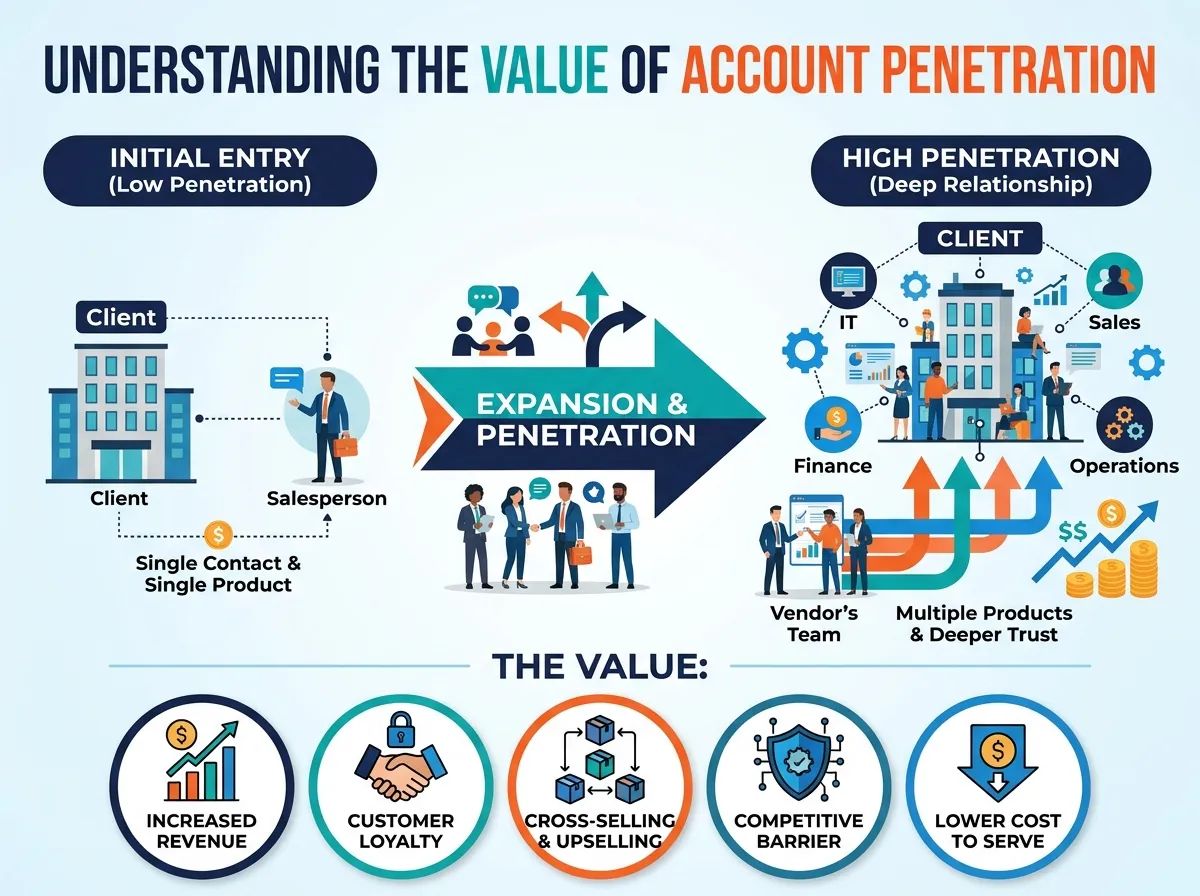
Account penetration refers to the process of increasing a company’s business relationship with an existing customer. This may involve selling additional services, reaching new decision-makers, expanding into different departments, or increasing the customer’s adoption of existing solutions.
For example, a software company may initially provide project management software to one department within a large organization. Over time, the company may discover that the finance, marketing, and operations departments also need similar solutions. Expanding the relationship across these departments creates additional business opportunities without requiring the company to acquire an entirely new customer.
This is the fundamental idea behind account penetration.
A well-developed approach considers both immediate revenue opportunities and the customer’s long-term requirements. Businesses must understand where their products or services fit within the customer’s operations and how additional solutions can improve existing processes.
An effective strategy also requires patience. Expanding a business relationship takes time because customers need confidence in the company’s capabilities. Consistent service quality, reliable communication, and measurable results help create the trust necessary for further growth.
Why Existing Accounts Offer Significant Growth Potential
Existing customers provide an important advantage because businesses already have some understanding of their expectations, purchasing behavior, and operational challenges.
Unlike new prospects, established customers have previous experience with the company’s products or services. This familiarity can make conversations about additional solutions more productive, provided the relationship has been managed effectively.
One major advantage is the ability to identify unmet requirements. A customer may already purchase one service while continuing to work with other providers for related solutions. Understanding these arrangements can reveal opportunities to expand the relationship.
Another benefit comes from stronger customer familiarity. Sales teams can use previous interactions, service records, and feedback to understand what matters most to each account. This makes it easier to recommend relevant solutions rather than relying on generic sales messages.
Existing customer growth can also improve revenue stability. When customers purchase multiple services or expand their engagement, businesses may develop stronger commercial relationships that are less dependent on individual transactions.
However, expansion should always be based on customer value. Pushing unnecessary products or services can weaken trust and create dissatisfaction. The objective is to become a more valuable business partner, not simply to increase the number of products sold.
Building an Account Growth Strategy Around Customer Needs
An effective account growth strategy begins with a clear understanding of each customer’s business structure. Companies need to examine how customers operate, which challenges they face, and where additional solutions could make a difference.
This requires moving beyond basic account information. Knowing a customer’s industry and annual spending is useful, but it does not provide a complete picture of its growth potential.
Sales teams should understand the customer’s organizational structure, business priorities, purchasing processes, and future plans. These details help identify which departments may benefit from additional services and which decision-makers should be involved in future discussions.
Account research also plays an important role. Changes in leadership, business expansion, technology adoption, and operational restructuring may create new requirements. Monitoring these developments allows companies to identify opportunities before competitors approach the same accounts.
For organizations using account-based marketing, customer information can become particularly valuable. Businesses can combine engagement insights with account research to understand which customers are showing signs of expansion potential. A useful starting point is understanding Account Engagement Scoring, which explains how engagement signals can help identify meaningful account activity and opportunities.
When account growth planning is connected with actual customer needs, sales conversations become more relevant and productive.
Identifying Opportunities Across Different Departments
One of the most effective ways to improve key account penetration is to look beyond the department that originally purchased the company’s products or services.
Large organizations often operate through multiple teams, each with different responsibilities and requirements. A company serving one department may have opportunities to establish relationships with several others.
Consider a digital marketing agency working with a company’s marketing department. Its existing services may include SEO and content marketing. However, the customer might also require website development, marketing automation, reputation management, or analytics support.
These additional requirements create opportunities for customer account expansion.
The challenge is discovering them without making assumptions. Sales representatives should communicate with existing contacts, understand organizational priorities, and identify other departments that may benefit from the company’s expertise.
Building relationships with multiple stakeholders can also reduce dependence on a single contact. If the original decision-maker changes roles or leaves the organization, the business relationship can continue through other established connections.
This approach creates a broader account presence and makes the partnership more valuable to both organizations.
Strategic Account Development Through Better Relationships
Account penetration is not entirely a sales activity. Relationship development has a significant influence on whether customers are willing to expand their partnerships.
Customers are more likely to consider additional services when they trust the provider and believe that the company understands their business. This confidence develops through consistent communication, reliable delivery, and a genuine interest in customer success.
Strategic account development focuses on strengthening these relationships over time.
Instead of contacting customers only when renewal or purchasing discussions arise, businesses should maintain regular conversations about performance, challenges, and future priorities. These interactions help sales teams recognize changing requirements while demonstrating continued commitment.
Account managers should also understand the different priorities of stakeholders. A financial decision-maker may focus on cost efficiency, while an operational manager may prioritize productivity and reliability. Communicating relevant benefits to each stakeholder makes expansion discussions more meaningful.
Another important element is following through on commitments. If a company promises improved support, faster delivery, or measurable performance improvements, it must demonstrate those results.
Strong relationships create the foundation for sustainable account expansion. Without trust, even attractive commercial offers may fail to generate long-term customer interest.
Using Cross-Selling and Upselling to Expand Accounts

Cross-selling and upselling are two important methods of increasing business within existing accounts. Although both contribute to revenue growth, they serve different purposes.
Cross-selling involves introducing complementary products or services that support a customer’s existing purchase. For example, a company purchasing CRM software might also benefit from customer analytics or marketing automation services.
Upselling focuses on encouraging customers to adopt a more advanced version of an existing solution. A business using a basic software subscription may eventually require additional features, higher capacity, or enterprise-level functionality.
Both approaches can support an effective account penetration strategy when recommendations are based on actual requirements.
The most important consideration is timing. Introducing additional solutions before understanding the customer’s needs can make sales conversations feel unnecessarily aggressive. On the other hand, waiting until customers independently identify every requirement may result in missed opportunities.
Sales teams should monitor product usage, customer feedback, operational changes, and business objectives to determine when additional solutions may provide value.
A customer experiencing increased demand, for instance, may benefit from a more advanced service package. Another customer struggling with disconnected systems may need a complementary solution that improves integration.
When businesses focus on solving these challenges, cross-selling strategies and upselling opportunities become natural extensions of the customer relationship.
Making Data a Central Part of Account Expansion
Customer information can significantly improve the quality of account expansion decisions. However, businesses often collect large amounts of data without using it effectively.
An organized account management process should bring together customer interactions, purchasing history, service performance, engagement activity, and feedback.
These details help businesses understand which accounts have expansion potential and which relationships require additional attention.
For example, repeated inquiries about a particular service may indicate growing customer interest. Increased product usage could suggest that the customer is approaching the limits of its current solution. Similarly, changes in business size or organizational structure may indicate new requirements.
Predictive analysis can make this process even more useful. By examining historical behavior and engagement patterns, companies can identify accounts that may be ready for additional services.
Businesses interested in applying advanced data techniques can explore Predictive Account-Based Marketing. Predictive approaches help organizations interpret account information and recognize potential opportunities using data-driven insights.
Artificial intelligence can also support this process by analyzing large datasets, identifying patterns, and helping sales teams prioritize accounts.
For organizations exploring these capabilities, Scalable ABM with Generative AI offers relevant insights into how generative AI can support account-based marketing activities as business operations grow.
However, technology should support human decision-making rather than replace customer understanding. Data can identify possible opportunities, but meaningful conversations are still necessary to confirm whether an additional solution is appropriate.
Overcoming Common Account Penetration Challenges
Even businesses with established customer relationships can struggle to expand their accounts. One common challenge is limited access to decision-makers. Sales representatives may have a strong relationship with one contact but little visibility into the wider organization.
This can restrict opportunities because important purchasing decisions often involve several departments and stakeholders.
Another difficulty is customer resistance. Some organizations prefer their current providers or may not see an immediate reason to purchase additional services. In these situations, businesses need to demonstrate clear value rather than relying on repeated sales requests.
Internal coordination can also become a problem. Marketing, sales, customer support, and account management teams may hold different pieces of customer information. When these teams fail to communicate, businesses can overlook important opportunities or provide inconsistent experiences.
A shared account management process can help address these issues. Teams should have access to relevant customer information, understand account objectives, and coordinate their interactions.
Businesses must also avoid excessive communication. Frequent promotional messages and irrelevant offers can create frustration. A better approach is to communicate when there is something useful to discuss, such as a new business requirement, performance improvement, or relevant service opportunity.
Overcoming these challenges requires a customer-focused mindset supported by clear internal processes.
Measuring the Success of an Account Penetration Strategy
Account expansion should be evaluated through more than total revenue. Although increased spending is an important indicator, businesses also need to understand whether their customer relationships are becoming stronger and more valuable.
Several performance indicators can provide useful insights.
Revenue growth within existing accounts measures how much additional revenue comes from current customers over a specific period. It helps businesses understand whether their expansion efforts are generating commercial results.
Customer penetration rate examines how much of a customer’s potential business the company currently serves. This can help identify accounts where significant opportunities remain.
Product or service adoption shows whether customers are using more of the company’s available solutions. Higher adoption may indicate deeper engagement and broader business relationships.
Customer retention rate measures the ability to maintain existing relationships. Strong retention provides a foundation for long-term account development.
Share of wallet estimates the proportion of a customer’s total spending in a relevant category that goes to the business. Increasing this proportion can indicate stronger account penetration.
Businesses can also monitor stakeholder engagement, renewal rates, customer satisfaction, and expansion pipeline value.
These measurements should be reviewed regularly. They help sales leaders understand which accounts are progressing, where additional attention is needed, and whether current expansion activities are producing meaningful results.
Creating a Sustainable B2B Account Growth Planning Process
Long-term account expansion requires coordination between business strategy and everyday customer management.
Companies should establish a clear understanding of their most valuable accounts and identify realistic opportunities within each relationship. Not every customer will have the same expansion potential, so prioritization is essential.
A large organization with multiple departments may offer considerable opportunities, while a smaller customer may have more limited requirements. Both can be valuable, but they may require different account development approaches.
Sales teams should also connect account objectives with the company’s wider business capabilities. Offering additional services is only practical when the organization has the resources and expertise to deliver them effectively.
As account portfolios become larger, businesses may benefit from account-based marketing platforms, customer relationship management systems, and automation tools. These technologies can help organize information, coordinate communication, and identify important customer activities.
However, scalable growth depends on maintaining service quality. Expanding into more departments or increasing the number of services should not create delivery problems. Businesses need to ensure that their internal teams can support additional demand without compromising existing customer experiences.
An effective B2B account growth planning process therefore balances commercial ambition with operational capacity.
The Future of Account Penetration in B2B Markets

B2B customer relationships are becoming increasingly data-driven. Businesses now have access to more information about customer behavior, engagement patterns, purchasing activities, and organizational changes.
This creates new opportunities for identifying account expansion potential.
Artificial intelligence and predictive analytics are helping organizations recognize patterns that may indicate customer interest or changing requirements. Automation can also reduce administrative work, allowing account managers to spend more time developing relationships.
At the same time, customers increasingly expect personalized communication and solutions that reflect their business priorities. Generic sales approaches are becoming less effective when buyers have access to detailed product information and multiple service providers.
Companies that combine useful customer insights with strong relationship management will be better positioned to expand existing accounts. Businesses operating affiliate programs can also improve link organization and tracking through practices such as Affiliate Link Cloaking, helping maintain organized referral links across their marketing activities.
The future of account penetration will not depend only on how many additional products a company can sell. It will depend on how effectively businesses understand their customers, solve complex problems, and become trusted partners throughout the customer’s growth journey.
Conclusion
An effective Account Penetration Strategy helps businesses discover growth opportunities within their existing customer relationships. By understanding customer requirements, developing connections across departments, and introducing relevant additional solutions, companies can increase account value while strengthening long-term partnerships.
Successful account expansion requires a combination of customer research, strategic relationship development, data analysis, and coordinated sales activities. Cross-selling and upselling can contribute to revenue growth, but they are most effective when supported by genuine customer value.
For B2B organizations, the greatest opportunity may not always come from finding more customers. Sometimes, it comes from understanding existing customers more deeply and discovering how the business can support their next stage of growth.
Frequently Asked Questions (FAQs)
1. What is an Account Penetration Strategy?
An Account Penetration Strategy is an approach businesses use to increase their presence and revenue within existing customer accounts by identifying additional needs, expanding services, and developing stronger relationships.
2. Why is account penetration important for B2B companies?
It helps B2B companies generate additional revenue from existing customers, improve retention, strengthen partnerships, and reduce their dependence on acquiring new customers.
3. How does account penetration differ from customer acquisition?
Customer acquisition focuses on attracting new customers, whereas account penetration focuses on expanding business relationships with customers who already purchase from the company.
4. What are the most effective account expansion opportunities?
Common opportunities include reaching additional departments, introducing complementary services, upgrading existing solutions, increasing product adoption, and developing relationships with new decision-makers.
5. How do cross-selling strategies support account penetration?
Cross-selling introduces complementary products or services that address additional customer requirements, helping businesses increase account value while providing more complete solutions.
6. What role does upselling play in account growth?
Upselling encourages customers to adopt more advanced products, premium services, or expanded packages that better support their changing business requirements.
7. How can businesses identify key account penetration opportunities?
Businesses can analyze purchasing history, customer feedback, product usage, organizational changes, engagement activity, and conversations with important stakeholders.
8. How does account relationship management improve customer expansion?
Account relationship management builds trust, improves communication, and helps businesses understand customer priorities, making it easier to identify relevant expansion opportunities.
9. Which metrics help measure account penetration success?
Important metrics include existing account revenue growth, customer retention, share of wallet, product adoption, customer penetration rate, and expansion pipeline value.
10. Can AI improve an Account Penetration Strategy?
Yes. AI can analyze customer information, identify engagement patterns, predict potential requirements, and help sales teams prioritize accounts with promising expansion opportunities.

Account Engagement Scoring: Measuring Business Interest and Opportunities

Live Webinars for ABM: Strategies to Engage High-Value Accounts


Balancing Personalization and Privacy in Modern ABM