
How Account Based Marketing Transforms B2B Lead Generation
 11 min read
Traditional B2B lead generation often feels like casting a wide net and hoping for the best. Marketing teams create broad campaigns, generate thousands of leads, and hand them over to sales teams who then struggle to convert prospects who may not be truly qualified or ready to buy. Account Based Marketing (ABM) flips this approach entirely.
What Makes Account-Based Marketing Different
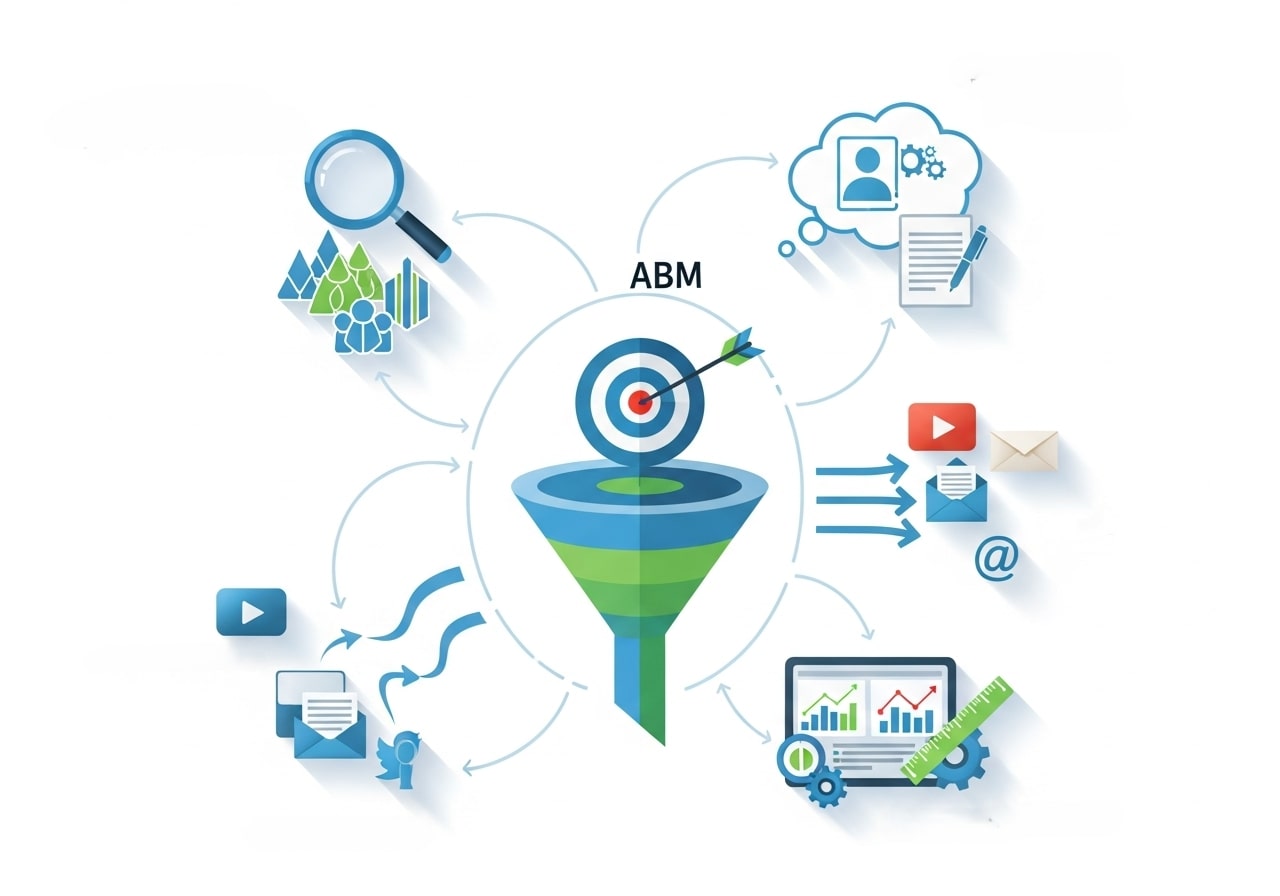
Account Based Marketing treats individual prospects as markets of one. Rather than creating generic campaigns for broad audiences, ABM focuses marketing and sales efforts on a carefully selected group of high-value accounts.
This approach requires marketing and sales teams to work together from the beginning. They collaborate to identify target accounts, research decision-makers, and create customized messaging that addresses specific challenges and goals of each prospect.
The fundamental difference lies in personalization at scale. While traditional lead generation might send the same email to thousands of prospects, ABM creates unique campaigns for each target account. This might include personalized landing pages, custom video messages, or industry-specific case studies.
The Lead Generation Transformation
Higher Quality Leads
ABM eliminates the quantity-over-quality problem that plagues traditional lead generation. Since marketing teams focus only on pre-qualified, high-value accounts, every lead generated through ABM campaigns is already vetted and prioritized.
This targeted approach means sales teams spend less time qualifying leads and more time having meaningful conversations with prospects who are genuinely good fits for their solutions.
Shortened Sales Cycles
When prospects receive highly relevant, personalized content that addresses their specific pain points, they move through the buying process faster. ABM campaigns demonstrate a deep understanding of the prospect’s business, building trust and credibility from the first interaction.
Sales teams can reference the personalized content prospects have already engaged with, creating more informed sales conversations that advance deals more quickly.
Improved Sales and Marketing Alignment
Account Based Marketing forces sales and marketing teams to work together in ways that traditional lead generation doesn’t require. Both teams must agree on target accounts, messaging, and success metrics from the outset.
This alignment eliminates the common friction where marketing generates leads that sales considers unqualified. When both teams focus on the same accounts with coordinated efforts, lead quality and conversion rates improve dramatically.
Key ABM Strategies for Lead Generation
Account Selection and Research
Successful ABM begins with identifying the right accounts to target. This process involves analyzing your current customer base to identify common characteristics of your best clients, then finding similar prospects in the market.
Research goes deeper than basic firmographic data. Teams investigate company initiatives, recent news, leadership changes, and technology stack to understand how their solution fits into the prospect’s current priorities.
Personalized Content Creation
ABM content speaks directly to specific accounts and their unique challenges. This might include creating industry-specific case studies, developing custom ROI calculators, or producing video messages from executives to their counterparts at target companies.
The key is relevance. Every piece of content should feel like it was created specifically for that account, addressing their industry, company size, and current challenges.
Multi-Channel Engagement
ABM campaigns typically use multiple channels to reach different stakeholders within target accounts. This coordinated approach might include personalized email sequences, LinkedIn outreach, targeted advertising, direct mail, and event invitations.
The multi-channel strategy ensures consistent messaging across all touchpoints while recognizing that different decision-makers prefer different communication methods.
Account-Specific Landing Pages
Creating dedicated landing pages for high-value accounts allows for maximum personalization. These pages can include the prospect’s company name, industry-specific imagery, relevant case studies, and customized value propositions.
When prospects visit a page designed specifically for their company, it demonstrates investment in the relationship and increases engagement rates significantly.
Role of Buyer Personas in ABM
Buyer personas play a critical role in the success of Account-Based Marketing campaigns. Unlike traditional marketing, where personas are often broad, ABM requires highly detailed and account-specific buyer personas. These personas go beyond job titles and include business goals, pain points, decision-making authority, and personal motivations. By understanding who influences and who makes the final buying decision within a target account, marketing and sales teams can tailor messaging more effectively. Well-defined buyer personas help ensure that content, outreach, and engagement strategies resonate with each stakeholder, increasing the likelihood of meaningful conversations and faster deal progression.
Importance of Data Accuracy in ABM Campaigns

Accurate data is the foundation of any successful ABM strategy. Since ABM focuses on a limited number of high-value accounts, even small data inaccuracies can significantly impact results. Incorrect company information, outdated contacts, or missing decision-makers can lead to wasted effort and missed opportunities. Maintaining clean CRM data, validating account information regularly, and using reliable data sources help ensure campaigns reach the right people at the right time. High-quality data enables precise personalization, better targeting, and more effective sales outreach, ultimately improving engagement rates and revenue outcomes.
ABM for Customer Retention and Expansion
Account-Based Marketing is not limited to acquiring new customers; it is equally effective for retaining and expanding existing accounts. By applying ABM principles to current customers, businesses can identify upsell and cross-sell opportunities more strategically. Personalized campaigns focused on customer-specific goals, usage patterns, and future needs help strengthen relationships and increase lifetime value. ABM-driven retention strategies demonstrate a deep understanding of the customer’s business, making clients feel valued and understood. This approach leads to higher customer satisfaction, reduced churn, and long-term revenue growth.
Aligning ABM with Long-Term Business Goals
For ABM to deliver sustainable results, it must align with long-term business objectives rather than short-term lead targets. Successful organizations integrate ABM into their overall growth strategy, focusing on strategic accounts that contribute to long-term revenue and market positioning. This alignment ensures consistency across marketing, sales, and customer success teams. When ABM goals match broader business priorities—such as entering new markets or increasing enterprise deal size—teams can measure success more effectively and justify investment. A long-term ABM mindset creates predictable growth and stronger customer relationships.
Technology and Tools for ABM Success
Customer Relationship Management Integration
ABM requires sophisticated tracking and coordination between marketing and sales activities. Modern CRM systems integrate with ABM platforms to provide complete visibility into account engagement across all touchpoints.
This integration ensures that sales teams know exactly which content prospects have consumed, which emails they’ve opened, and which pages they’ve visited, enabling more informed sales conversations.
Intent Data and Analytics
ABM platforms use intent data to identify when target accounts are actively researching solutions. This information helps marketing teams time their outreach perfectly, reaching prospects when they’re most likely to be receptive.
Analytics dashboards provide account-level insights that traditional lead generation metrics can’t capture. Teams can see engagement levels across entire accounts, not just individual contacts.
Marketing Automation for Personalization
Advanced marketing automation enables personalization at scale. These systems can trigger different content sequences based on account characteristics, engagement levels, and behavioral signals.
Automation handles the technical complexity of personalization while allowing marketing teams to focus on strategy and content creation.
Measuring ABM Success
Account Engagement Metrics
Traditional lead generation focuses on individual lead metrics like open rates and click-through rates. ABM measures engagement at the account level, tracking how many stakeholders within target companies are engaging with campaigns.
Key metrics include account penetration (percentage of target accounts showing engagement), stakeholder engagement (number of contacts engaged per account), and progression through the buying journey.
Pipeline Velocity and Quality
ABM success is measured by how quickly target accounts move through the sales pipeline and the quality of opportunities generated. These metrics provide clearer insight into ABM’s impact on revenue than traditional lead volume metrics.
Teams track average deal size, sales cycle length, and win rates specifically for ABM-generated opportunities compared to traditional lead generation results.
Revenue Attribution
The ultimate measure of ABM success is revenue attribution. Since ABM focuses on high-value accounts, the revenue impact per account is typically much higher than traditional lead generation approaches.
This revenue-focused measurement aligns perfectly with business objectives and demonstrates clear ROI for ABM investments.
Overcoming Common ABM Challenges
Resource Allocation
ABM requires significant upfront investment in research, content creation, and technology. Many organizations struggle with allocating sufficient resources to execute ABM effectively while maintaining other marketing activities.
The key is starting small with a pilot program focused on the highest-value accounts, then scaling successful approaches across larger account lists.
Sales and Marketing Coordination
While ABM improves sales and marketing alignment, it also requires new processes and communication protocols. Teams must establish clear roles, responsibilities, and handoff procedures for ABM campaigns.
Regular coordination meetings and shared metrics help maintain alignment throughout the ABM process.
Content Creation at Scale
Creating personalized content for multiple accounts can be resource-intensive. Successful ABM programs develop content frameworks that can be efficiently customized for different accounts while maintaining relevance.
This might include modular content components that can be mixed and matched, or template-based personalization that scales across similar accounts.
The Future of B2B Lead Generation
Account marketing represents a fundamental shift toward more strategic, personalized B2B marketing. As buyers become more sophisticated and selective, the spray-and-pray approach of traditional lead generation becomes less effective.
Companies that embrace ABM are seeing higher conversion rates, shorter sales cycles, and stronger relationships with their most valuable prospects. The transformation from volume-based to value-based lead generation is not just a trend—it’s the future of B2B marketing.
Success with ABM requires commitment, resources, and patience. The results, however, speak for themselves: better leads, faster sales cycles, and stronger revenue growth. For B2B companies serious about improving their lead generation results, Account-Based Marketing offers a proven path forward.
The question isn’t whether ABM will transform your lead generation—it’s how quickly you can implement it to stay competitive in an increasingly sophisticated B2B landscape.
Frequently Asked Questions (FAQ)
1. What is Account-Based Marketing (ABM)?
Account-Based Marketing is a B2B marketing strategy that focuses on targeting a specific set of high-value accounts rather than generating a large volume of leads. Marketing and sales teams work together to create personalized campaigns for each target account.
2. How is ABM different from traditional lead generation?
Traditional lead generation focuses on quantity—attracting as many leads as possible and filtering them later. ABM focuses on quality by identifying ideal accounts first and creating tailored campaigns to engage decision-makers within those companies.
3. Is ABM only suitable for large enterprises?
No. While ABM is commonly used by enterprise companies, small and mid-sized B2B organizations can also benefit. Many companies start with a small ABM pilot targeting a limited number of high-value accounts and scale from there.
4. How many accounts should an ABM campaign target?
The number depends on your resources and goals. Some ABM programs target 10–20 highly strategic accounts (1:1 ABM), while others target hundreds using scalable personalization (1:few or 1:many ABM).
5. What role does sales play in ABM?
Sales plays a critical role in ABM. Sales and marketing teams collaborate on account selection, messaging, outreach strategy, and success metrics. ABM works best when both teams are aligned from the start.
6. What types of content work best for ABM?
Highly personalized content performs best in ABM. Examples include account-specific landing pages, industry-focused case studies, personalized email campaigns, executive-to-executive videos, and customized ROI calculators.
7. How do you measure the success of ABM?
ABM success is measured using account-level metrics such as account engagement, pipeline velocity, deal size, win rates, and revenue generated from target accounts rather than traditional lead volume metrics.
8. How long does it take to see results from ABM?
ABM typically takes longer to show results than traditional lead generation because it focuses on high-value, longer sales cycles. However, the deals generated are usually larger, higher quality, and more likely to convert.
9. What tools are needed to run an ABM campaign?
Common ABM tools include a CRM system, marketing automation software, ABM platforms, intent data tools, and analytics dashboards that track account-level engagement across channels.
10. Can ABM replace traditional lead generation entirely?
ABM doesn’t always replace traditional lead generation—it often complements it. Many B2B companies use ABM for high-value target accounts while continuing traditional demand generation for broader market awareness.


Live Webinars for ABM: Strategies to Engage High-Value Accounts


Balancing Personalization and Privacy in Modern ABM

Virtual Events and Webinars: Powerful Strategies for ABM Success