
Account-Based Marketing for Growth helps businesses focus on high-value accounts instead of mass marketing, aligning sales and marketing while improving personalization and revenue. By adopting ABM, companies can strengthen relationships, speed up conversions, and drive sustainable long-term growth.
Traditional broad-based marketing is becoming less effective as B2B buyers grow more selective and involve more decision-makers. This shift has made Account-Based Marketing for Growth a smarter, more precise, and revenue-focused approach.
Instead of chasing countless leads, businesses now prioritize high-value accounts. With the right strategy and data, Account-Based Marketing for Growth helps align sales and marketing, improve personalization, and drive predictable, efficient growth.
What Is Account-Based Marketing (ABM)?
At the end of the day, account-based marketing is a really specific, targeted approach that involves developing individualized marketing activities for a particular account or company rather than casting a wide net with a generic strategy. Rather than marketing to an industry or persona, ABM focuses on individual companies, treating them essentially as a “market of one” in Account-Based Marketing for Growth.
ABM traditionally requires strong communication and alignment between marketing and sales, so that they find the ICP-targeted accounts, know what they need, and jointly devise actions to involve decision-makers and influencers at these accounts.
Why ABM is Different From Traditional Marketing
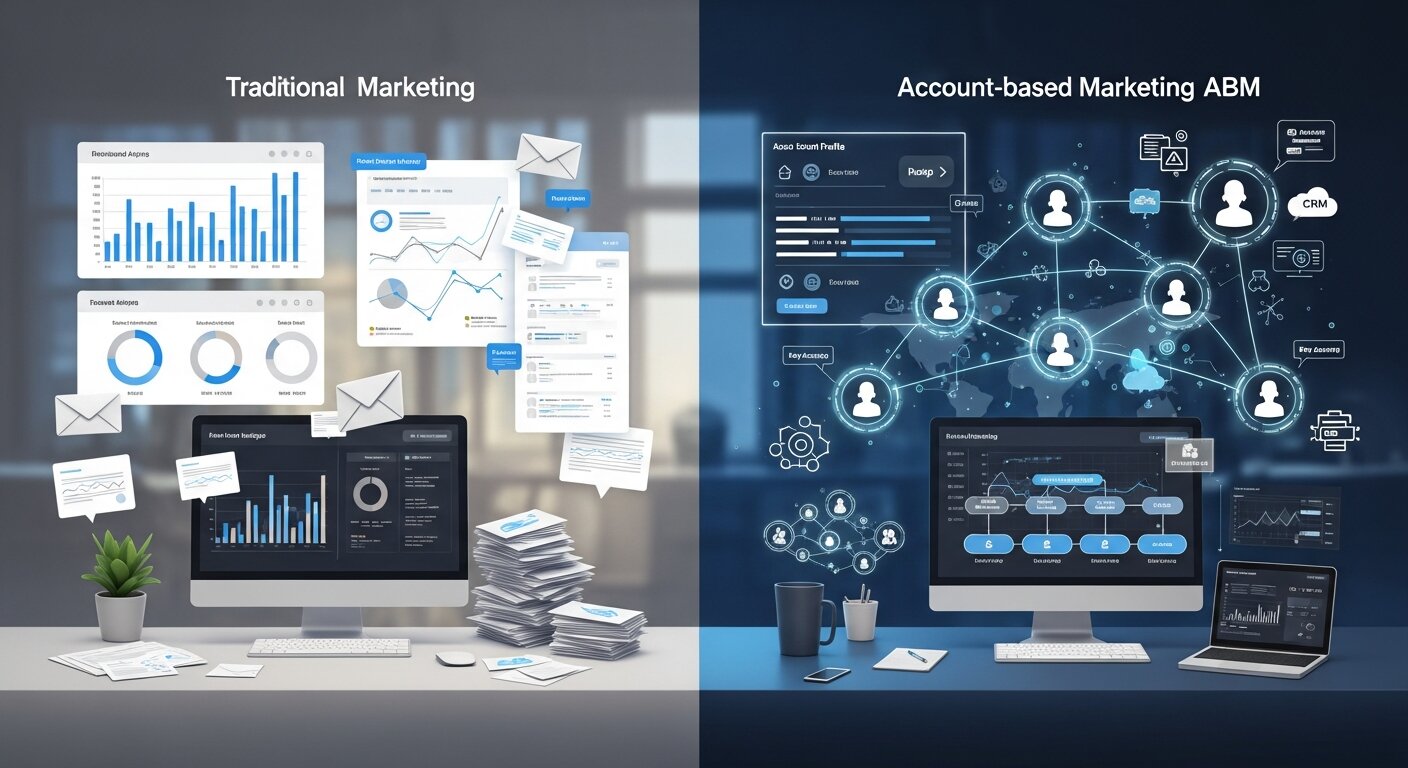
- Focused Targeting: ABM shifts the focus from mass outreach to a select group of high-value prospects, which is the foundation of Account-Based Marketing for Growth.
- Personalization: Each campaign is tailored to the specific needs and goals of the target account.
- Alignment of Sales and Marketing: ABM brings sales and marketing teams together to work cohesively toward shared objectives.
Why You Should Adopt ABM
Higher ROI
ABM stands out as one of the most effective marketing strategies for B2B companies, particularly those selling high-value products or services with longer sales cycles. Research by latest digital marketing research reveals that 87% of marketers say ABM delivers a higher return on investment compared to other marketing strategies. This makes Account-Based Marketing for Growth a powerful and strategic investment for organizations seeking measurable, predictable, and scalable results rather than short-term lead generation.
By concentrating efforts on a carefully selected group of high-value accounts, businesses can avoid wasting time and budget on uninterested or low-quality leads. Instead, marketing and sales teams work together to engage the right decision-makers within target organizations. This targeted focus not only improves efficiency but also increases the likelihood of closing bigger deals through business growth strategies.
Focusing energy and resources on high-value accounts allows your marketing team to generate higher conversion rates, build deeper relationships, and create more meaningful engagements. It also helps speed up the sales cycle by engaging prospects who are already more likely to buy, reducing wasted effort on low-value leads—one of the biggest advantages of modern marketing techniques.
Strengthened Customer Relationships

One of the core strengths of ABM is its ability to create deeply personalized and highly relevant messaging for each target account. Instead of sending generic marketing messages, businesses using Account-Based Marketing for Growth tailor their communication based on the specific challenges, goals, and priorities of each organization through customer engagement strategies.
This personalized approach makes decision-makers feel understood and valued, which significantly improves trust and credibility. When prospects see that your brand truly understands their needs, they are more likely to engage, respond, and eventually become long-term customers with the help of building customer trust online.
Over time, this level of personalization helps businesses build stronger, more strategic relationships with key stakeholders. Rather than being seen as just another vendor, companies using Account-Based Marketing for Growth position themselves as trusted partners invested in their customers’ success through long-term business relationships.
Sales and Marketing Alignment (new anchor texts)
One of the biggest challenges in many organizations is misalignment between sales and marketing teams. ABM directly addresses this issue by bringing both teams together around a shared set of target accounts and common revenue goals using team collaboration in business.
With Account-Based Marketing for Growth, sales and marketing teams work arm-in-arm from the very beginning—from account selection to campaign execution and deal closure. They collaborate on defining ideal customer profiles, designing personalized outreach strategies, and tracking engagement data via business performance tracking tools.
This alignment eliminates confusion, reduces duplication of efforts, and ensures that both teams are working toward the same objectives. By clearly defining target accounts, aligning outreach efforts, and sharing real-time data, Account-Based Marketing for Growth creates seamless collaboration that ultimately leads to greater overall success through improving business efficiency.
Efficient Resource Allocation (new anchor texts)

Traditional marketing often involves spreading budgets across broad campaigns that target undefined or loosely defined audiences. This approach can be expensive and inefficient, with little guarantee of meaningful results compared to smart budgeting in business.
In contrast, Account-Based Marketing for Growth ensures that your marketing budget, time, and resources are focused only on accounts with the highest potential value. Instead of trying to reach everyone, ABM helps businesses invest strategically in the accounts most likely to generate significant revenue usingstrategic business investment.
This precision targeting reduces wasted effort on low-probability leads and maximizes return on investment. By concentrating resources where they matter most, companies can achieve better outcomes with smaller, more efficient marketing budgets throughdata-driven decision making.
Key Steps for Implementing ABM
If you’re ready to harness Account-Based Marketing for Growth, here’s how to get started with a structured and effective approach.
Step 1. Define Your Target Accounts
The foundation of successful Account-Based Marketing for Growth begins with identifying the right target accounts—those most likely to generate substantial revenue and long-term business value.
To do this effectively, businesses should create a detailed Ideal Customer Profile (ICP), which serves as a blueprint for the types of companies they want to target. Your ICP should include key factors such as:
- Industry
- Company size
- Annual revenue
- Pain points your solution addresses
- Geographic location
- Buying behaviors
At this stage, collaboration between marketing and sales is critical. Both teams should work together to agree on the ideal accounts, ensuring alignment from the very beginning of the ABM strategy.
Research and Understand Your Accounts
Once you’ve identified your target accounts, the next step is to conduct in-depth research. Understanding each organization’s challenges, goals, industry trends, and decision-making structure is essential for effective Account-Based Marketing for Growth.
This research helps you craft highly relevant and personalized messaging that resonates with key stakeholders. Valuable sources of information include:
- Company websites
- Press releases and news articles
- Social media profiles (especially LinkedIn)
- Industry reports and market insights
- Conversations with sales teams and existing contacts
The deeper your understanding of each account, the more impactful your ABM campaigns will be.
Personalize Your Campaigns
Personalization is the heart of Account-Based Marketing for Growth. Instead of using generic marketing materials, businesses should create customized content and messaging tailored to each target account’s specific needs and pain points.
Effective personalization strategies include:
- Highlighting the exact challenges the account is facing and how your solution can help
- Addressing decision-makers by name, role, or department
- Using targeted advertising platforms like LinkedIn to reach specific professionals within the organization
The more personalized your approach, the higher the chances of engagement and conversion.
Choose the Right Channels
Successful ABM campaigns rely on using the right mix of communication channels based on where your target accounts are most active.
In Account-Based Marketing for Growth, common ABM channels include:
- Email: Personalized outreach tailored to specific stakeholders
- Social Media: Especially LinkedIn, where most B2B decision-makers are active
- Direct Mail: Customized booklets, reports, or product samples to create a lasting impression
- Webinars: Exclusive sessions focused on industry challenges and solutions
- Content Marketing: Tailored whitepapers, case studies, and thought leadership content
Using multiple channels increases visibility and engagement across different touchpoints.
Measure Your Campaigns
Measurement is critical to the success of Account-Based Marketing for Growth. Unlike traditional marketing, ABM focuses less on lead volume and more on meaningful engagement and revenue impact.
Key metrics to track include:
- Engagement: Email opens, webinar attendance, content downloads, website visits
- Pipeline Growth: Movement of target accounts through the sales funnel
- Revenue Impact: Actual deals closed from ABM-targeted accounts
- Relationship Strength: Depth and quality of engagement with decision-makers
Marketing platforms like HubSpot or ABM-specific tools like Demandbase, 6sense, and Terminus can help you track, analyze, and optimize your campaigns in real time for Account-Based Marketing for Growth
Types of Account-Based Marketing
There are three main approaches to Account-Based Marketing for Growth, and each serves a different purpose depending on your business size, resources, and sales strategy. Understanding these models helps organizations choose the most effective path for targeting and engagement.
Strategic ABM
This is the most personalized and resource-intensive form of ABM. It focuses on a small number of extremely high-value accounts, often enterprise-level organizations. In this model, marketing and sales teams create highly customized campaigns, content, and outreach strategies tailored to each individual account. This approach is best for businesses dealing with complex sales cycles and high-ticket contracts, where deep relationship-building is essential for success in Account-Based Marketing for Growth.
ABM Lite
ABM Lite targets small clusters of similar accounts rather than individual companies. Instead of creating completely unique campaigns for each account, businesses develop semi-personalized messaging for a group of related companies with similar pain points or industry characteristics. This model is ideal for mid-market companies looking to balance personalization with scalability while still benefiting from Account-Based Marketing for Growth.
Programmatic ABM
This approach leverages automation, data, and AI-driven tools to reach hundreds or even thousands of target accounts with personalized but scalable messaging. It allows businesses to expand their reach while maintaining relevance through data-driven targeting. Programmatic ABM is best suited for organizations that want to grow rapidly while still applying the principles of Account-Based Marketing for Growth.
ABM vs. Inbound Marketing: What’s the Difference?
While inbound marketing and Account-Based Marketing for Growth both aim to drive revenue, they take very different approaches.
Inbound marketing focuses on attracting leads through content marketing, SEO, social media, and educational resources. It casts a wide net, hoping that interested prospects will engage with the brand. This works well for businesses with lower-ticket products or self-serve models.
On the other hand, Account-Based Marketing for Growth takes a proactive approach by identifying high-value accounts first and then designing targeted campaigns specifically for them. Instead of waiting for leads to come in, ABM goes directly after decision-makers within chosen organizations.
Many successful B2B companies use a hybrid model—combining inbound marketing for brand awareness with Account-Based Marketing for Growth for high-priority accounts—to maximize impact.
The Role of Data in ABM Success

Data is the backbone of effective Account-Based Marketing for Growth. Without accurate and actionable data, ABM campaigns can miss the mark.
- Intent Data: Helps identify which companies are actively searching for solutions similar to yours, allowing businesses to prioritize accounts that are already in buying mode.
- Firmographic Data: Includes company size, industry, revenue, location, and structure, helping refine target account selection for Account-Based Marketing for Growth.
- Engagement Signals: Tracking website visits, email opens, webinar attendance, and content interactions helps teams understand account interest and personalize outreach accordingly.
By combining these data sources, businesses can make smarter decisions, improve targeting accuracy, and enhance the overall effectiveness of Account-Based Marketing for Growth.
How ABM Supports the B2B Buyer’s Journey
Account-Based Marketing for Growth aligns seamlessly with the different stages of the B2B buying process, ensuring relevant engagement at every step.
Awareness Stage
At this stage, businesses use targeted ads, thought leadership content, and industry insights to introduce their brand to key decision-makers within selected accounts.
Consideration Stage
Here, companies provide personalized case studies, whitepapers, and webinars that directly address the specific pain points of the target account, strengthening trust and credibility in Account-Based Marketing for Growth.
Decision Stage
In the final stage, sales teams deliver customized proposals, tailored product demos, and one-on-one consultations to help close deals effectively using Account-Based Marketing for Growth.
Best Tools and Platforms for ABM Execution
To implement Account-Based Marketing for Growth effectively, businesses rely on advanced ABM tools and platforms.
- Demandbase: Helps identify target accounts and deliver personalized advertising across multiple channels.
- Terminus: Supports multi-channel ABM campaigns, including display ads, email, and social outreach.
- 6sense: Uses AI and predictive analytics to identify in-market accounts and recommend next best actions.
- HubSpot ABM: Integrates ABM within CRM systems for seamless tracking and execution.
- LinkedIn Matched Audiences: Allows businesses to run targeted ad campaigns directly to decision-makers in selected companies.
These tools enable automation, scalability, and better measurement for Account-Based Marketing for Growth.
Real-World ABM Use Cases and Examples
A leading SaaS company implemented Account-Based Marketing for Growth by targeting 50 high-value enterprise accounts with personalized outreach and tailored content. Within six months, they successfully closed 12 major deals, significantly increasing revenue.
Another B2B technology firm used intent data to identify companies actively researching their solutions. By focusing on these accounts, they reduced their sales cycle by 30%, proving the effectiveness of Account-Based Marketing for Growth.
These real-world examples demonstrate how ABM helps businesses close larger deals faster and more efficiently.
Common ABM Challenges (and How to Overcome Them)
Misalignment Between Sales and Marketing
When sales and marketing teams operate separately, Account-Based Marketing for Growth struggles. Regular collaboration, shared KPIs, and unified CRM systems can improve alignment and results.
Personalization at Scale
Creating personalized campaigns for multiple accounts can be overwhelming. Automation tools like Marketo and Terminus help scale personalization while maintaining quality in Account-Based Marketing for Growth.
Measuring ROI
Since enterprise sales cycles are long, tracking ROI can be difficult. Businesses should measure engagement, pipeline movement, deal size, and revenue impact to evaluate Account-Based Marketing for Growth accurately.
Is ABM the Future of B2B Marketing?
The rise of Account-Based Marketing for Growth signals a major shift toward precision and personalization in B2B marketing. As competition increases and buyers demand more relevance, ABM provides a strategic advantage by focusing on quality rather than quantity.
With its data-driven approach, ABM delivers higher ROI, stronger relationships, and more predictable revenue outcomes. Ultimately, Account-Based Marketing for Growth empowers businesses to connect meaningfully with the right accounts and build long-term partnerships rather than chasing short-term leads.
Frequently Asked Questions
1. What is Account-Based Marketing (ABM)?
ABM is a targeted marketing strategy where businesses focus on specific high-value accounts rather than a broad audience, delivering personalized campaigns to key decision-makers.
2. How is ABM different from traditional marketing?
Traditional marketing focuses on lead volume, while ABM focuses on account quality, personalization, and revenue impact.
3. Who should use Account-Based Marketing for Growth?
ABM is best suited for B2B companies with high-ticket products, longer sales cycles, and multiple decision-makers.
4. How long does it take to see results from ABM?
Results typically start appearing within 3 to 6 months, depending on your sales cycle and execution strategy.
5. What tools are best for ABM?
Popular ABM tools include Demandbase, Terminus, 6sense, HubSpot ABM, and LinkedIn Matched Audiences.
6. Can small businesses use ABM?
Yes. Small and mid-sized businesses can use ABM Lite (1:Few) to target a smaller group of high-value accounts effectively.
7. How do you measure ABM success?
Key metrics include engagement, pipeline movement, deal size, revenue impact, and relationship depth with target accounts.