
ABM Performance Benchmarks: Measuring Account-Based Marketing Success
 15 min read

ABM Performance Benchmarks help B2B businesses measure the effectiveness of account-based marketing through account engagement, stakeholder coverage, conversion rates, pipeline contribution, and ROI. By comparing campaign results with relevant industry references and historical performance, organizations can identify stronger target accounts, improve marketing and sales alignment, and make better investment decisions. A reliable benchmarking framework focuses on meaningful account progress rather than relying only on traditional lead generation metrics.
Account-based marketing has changed the way B2B organizations approach customer acquisition. Instead of focusing exclusively on generating large numbers of individual leads, ABM brings marketing and sales teams together to engage carefully selected companies with relevant messages, personalized experiences, and coordinated outreach.
However, personalization and targeted engagement alone do not guarantee success. Businesses also need to understand whether their efforts are creating meaningful account relationships, influencing purchasing decisions, and contributing to revenue growth. This is where ABM Performance Benchmarks become valuable.
Traditional marketing reports often emphasize website traffic, email clicks, lead volume, and campaign impressions. While these indicators can provide useful information, they do not always reflect the progress of an account-based marketing program. A campaign might generate fewer leads than a broad marketing initiative but influence several high-value accounts that eventually become customers.
The difference lies in how performance is evaluated. ABM requires a measurement approach that considers account engagement, buying group activity, sales pipeline development, conversion progress, and long-term customer value.
Establishing meaningful benchmarks helps businesses understand what successful performance looks like within their own market. It also creates a common framework for marketing and sales teams to evaluate campaigns, identify opportunities, and improve future decisions.
Rather than treating benchmarks as fixed numbers that every organization must achieve, businesses should use them as reference points for understanding their performance and developing realistic growth expectations.
Why ABM Performance Benchmarks Matter in B2B Marketing
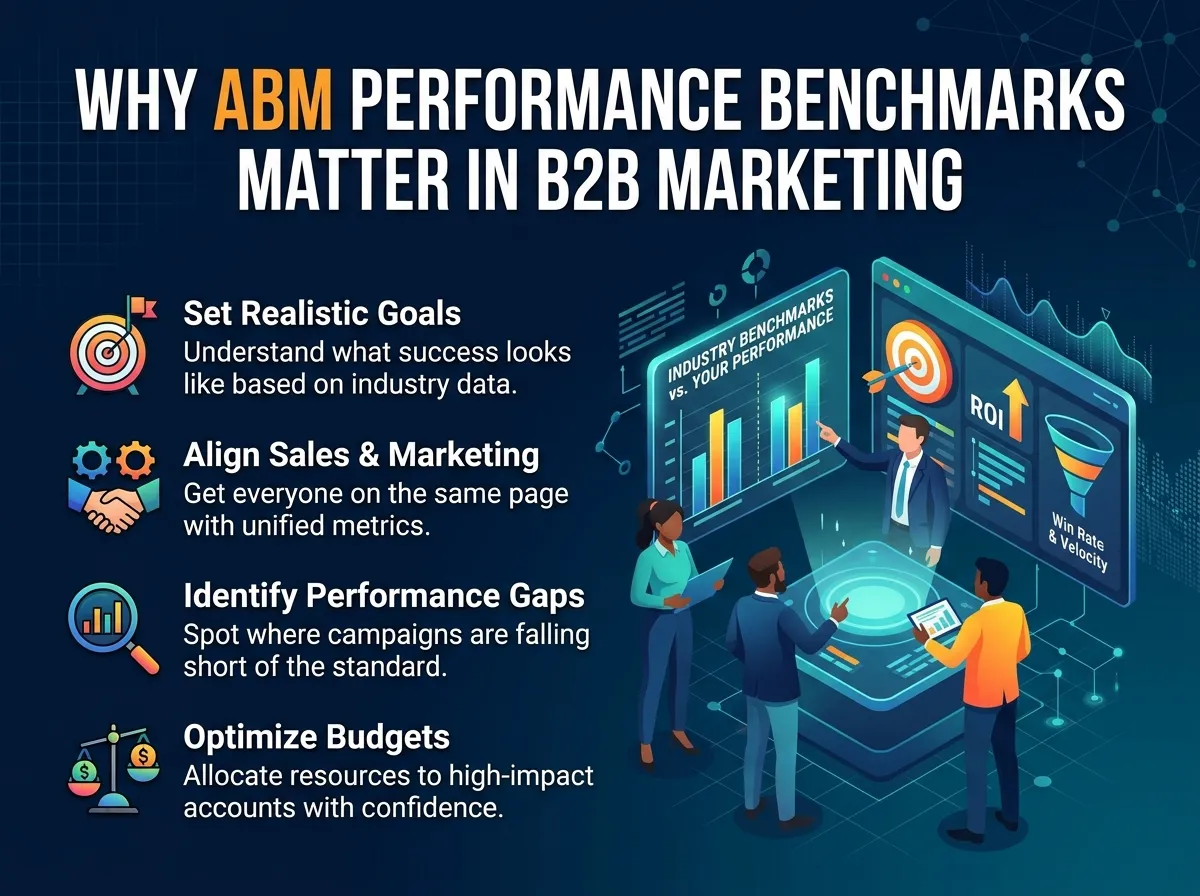
Account-based marketing often involves significant investment in research, personalization, advertising, content development, and sales coordination. Without a reliable measurement system, businesses may struggle to determine whether these activities are producing the expected results.
ABM Performance Benchmarks provide a structured way to evaluate progress across different stages of the account journey.
For example, a company targeting enterprise organizations may spend several months engaging a small group of decision-makers before receiving a sales opportunity. During this period, traditional lead generation metrics may show limited activity, even though the campaign is creating valuable relationships within target accounts.
Benchmarks help teams recognize these early signs of progress.
They also support better resource allocation. When businesses understand which account segments demonstrate stronger engagement or conversion potential, they can prioritize their marketing investments more effectively.
Another important benefit is accountability. Marketing teams can demonstrate how their activities influence sales opportunities, while sales teams can identify which accounts are receiving meaningful engagement from marketing.
This shared understanding reduces the disconnect between campaign activity and business outcomes.
Account-Based Marketing Performance Metrics That Reveal Real Progress
Account-Based Marketing Performance Metrics should reflect the objectives of the campaign rather than simply measuring the volume of marketing activity.
For example, an awareness-focused ABM campaign may aim to introduce a company to relevant decision-makers within a target account. In that situation, account reach and engagement may be useful early indicators.
A campaign designed to generate qualified opportunities requires a different measurement approach. Pipeline creation, opportunity progression, and sales conversion become more important.
Several performance indicators can help businesses understand these differences.
Account engagement
Account engagement measures how actively people within a target organization interact with marketing content, advertisements, emails, and other campaign touchpoints.
A meaningful engagement assessment should consider the quality and relevance of interactions, not just the total number of clicks.
Target account coverage
Coverage indicates whether marketing and sales teams are reaching the appropriate people within selected accounts. Strong coverage may involve engaging multiple stakeholders across relevant departments and buying roles.
Pipeline contribution
Pipeline contribution evaluates the opportunities associated with ABM activities. It helps businesses understand whether targeted marketing is supporting sales conversations and commercial progress.
Account conversion
Account conversion measures how effectively engaged target organizations move toward meaningful outcomes, such as qualified opportunities, closed deals, or new customer relationships.
These metrics create a more complete picture of ABM performance because they connect marketing activity with account-level business objectives.
Establishing Reliable ABM Campaign Benchmark Data
ABM Campaign Benchmark Data becomes useful when businesses collect consistent information across campaigns and compare results using similar definitions.
One challenge is that account-based marketing programs vary significantly. A campaign targeting 50 enterprise accounts with personalized executive outreach will not produce the same results as a program targeting 500 mid-market companies through coordinated digital advertising.
Differences in industry, account size, sales cycle, product complexity, and campaign duration can all influence performance.
For this reason, businesses should avoid comparing unrelated campaigns without considering their context.
A more reliable approach is to group campaigns according to relevant characteristics. For example, organizations might compare enterprise ABM programs with other enterprise initiatives, or evaluate campaigns targeting similar industries and account segments.
Historical performance can also provide valuable reference points. If a business consistently tracks engagement, pipeline creation, and conversion across several campaigns, it can identify patterns that help establish realistic internal benchmarks.
External industry data may offer additional context, but it should not replace company-specific analysis. A published benchmark may reflect a different audience, campaign structure, or measurement method.
The strongest benchmark framework combines relevant external references with the organization’s own performance history.
Account-Based Marketing KPIs and Their Relationship to Business Goals
Account-Based Marketing KPIs should reflect the outcomes a business expects from its ABM strategy.
A common mistake is selecting too many indicators without identifying which ones influence important decisions. A large dashboard may contain impressive amounts of information while providing little clarity about campaign effectiveness.
Instead, businesses should connect each KPI with a specific marketing or sales objective.
For an awareness campaign, relevant KPIs might include the percentage of target accounts reached, engagement from important stakeholders, and growth in account-level website activity.
For a pipeline-focused campaign, the priorities may include qualified opportunities, opportunity value, sales meeting progression, and conversion from engaged accounts.
For customer expansion programs, businesses may evaluate account retention, cross-selling opportunities, additional stakeholder engagement, and revenue growth within existing accounts.
This approach creates a direct relationship between campaign objectives and measurement.
It also makes reporting more useful for leadership. Rather than presenting a collection of unrelated statistics, marketing teams can explain how their activities support account acquisition, pipeline development, and revenue objectives.
ABM Success Measurement Across the Account Journey
ABM Success Measurement requires businesses to understand that account relationships develop over time.
A target account may initially show limited interest, gradually engage with educational content, begin interacting with sales representatives, and eventually enter a formal purchasing process.
Measuring only the final conversion can overlook important progress that occurs earlier in the journey.
At the awareness stage, businesses may evaluate account reach and engagement. During consideration, they can examine content interactions, stakeholder participation, and responses to personalized outreach.
When accounts enter the opportunity stage, measurement should focus more heavily on sales progression, pipeline value, and commercial outcomes.
This is particularly important for organizations using Predictive Account-Based Marketing. Predictive approaches can help identify accounts that demonstrate characteristics associated with stronger buying potential. By combining these insights with performance benchmarks, businesses can evaluate whether their targeting decisions are producing more relevant engagement and better sales opportunities.
The objective is to measure progress in a way that reflects the actual buying process.
B2B Marketing Performance Benchmarks: Understanding Industry Differences
B2B Marketing Performance Benchmarks can help organizations evaluate their ABM results against broader market expectations. However, these comparisons require careful interpretation.
Different industries have different purchasing behaviors. A software company selling a relatively straightforward subscription may experience a shorter sales cycle than a business offering complex industrial solutions.
Enterprise purchasing decisions may also involve several departments, financial approvals, technical evaluations, and executive discussions.
These differences influence engagement patterns, conversion timelines, and the amount of marketing investment required to create an opportunity.
For example, a campaign targeting a large financial organization may need to engage compliance teams, technology leaders, procurement specialists, and senior executives. A campaign targeting a smaller professional services company may involve fewer stakeholders.
Because of these differences, businesses should compare their results with organizations that share similar characteristics whenever possible.
Industry benchmarks can reveal whether performance appears unusually strong or weak, but they should not be treated as universal standards.
The most useful comparisons account for audience size, account value, sales cycle length, campaign objectives, and the maturity of the marketing program.
Account Engagement Benchmarks and the Quality of Interaction
Account Engagement Benchmarks help businesses understand whether target organizations are interacting meaningfully with their marketing activities.
However, engagement is not simply a matter of counting every available interaction.
A single click from a senior decision-maker may be more valuable than several low-intent interactions from people who have no influence over the purchasing process.
Similarly, repeated engagement from multiple departments within an account may indicate stronger organizational interest than activity from one individual.
Businesses should therefore evaluate engagement through both quantity and relevance.
An effective engagement framework might consider:
-
The number of relevant stakeholders interacting with campaigns.
-
The frequency of meaningful account interactions.
-
Engagement with high-value content and service information.
-
Responses to personalized sales and marketing outreach.
-
Activity from different departments within the same organization.
This broader perspective helps teams understand whether an account is becoming more familiar with the business and its offerings.
Content relevance also plays an important role. An Account Based Marketing Content Strategy can help businesses develop materials that address the specific challenges, interests, and priorities of their target accounts.
When content reflects actual account needs, engagement becomes more meaningful and easier to interpret.
ABM Conversion Rate Benchmarks: Measuring Movement Toward Revenue
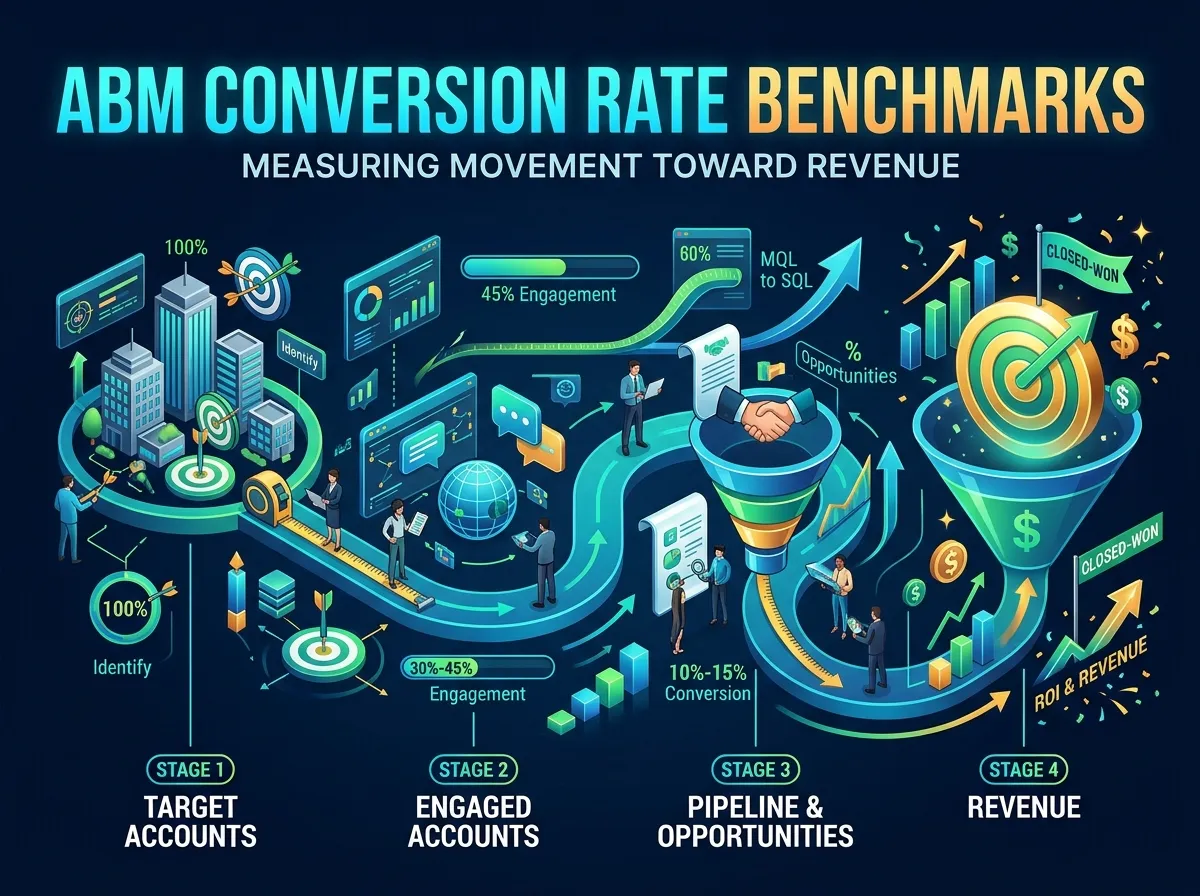
ABM Conversion Rate Benchmarks help businesses evaluate how effectively target accounts move from one stage of the marketing and sales process to another.
However, conversion rates should be defined carefully.
A business might measure the percentage of engaged accounts that become qualified opportunities, the percentage of qualified opportunities that enter the sales pipeline, or the percentage of opportunities that become customers.
Each calculation answers a different question.
For example, a campaign may generate strong engagement but produce few qualified opportunities. This could indicate that the targeting criteria are too broad or that the campaign messaging attracts people who are interested in the topic but not the commercial offering.
Another campaign may produce a smaller number of engaged accounts but convert a higher percentage into sales opportunities.
This difference shows why conversion rates should be interpreted alongside account quality and pipeline value.
Businesses should also consider the time required for conversion. Enterprise ABM campaigns may influence opportunities that do not close until several months after the initial engagement.
Evaluating conversion too early can lead to inaccurate conclusions about campaign performance.
A reliable benchmark framework should therefore account for both conversion outcomes and the time needed for accounts to progress through the sales cycle.
Account-Based Marketing ROI Metrics and Financial Accountability
Account-Based Marketing ROI Metrics help organizations understand whether their ABM investments are generating sufficient business value.
Return on investment is particularly important because account-based marketing often requires substantial resources. Personalized campaigns may involve account research, sales enablement, advertising, content creation, technology, and specialized team coordination.
A basic ROI calculation compares the financial return generated by a campaign with its total investment.
However, ABM ROI can be more complicated than measuring the immediate revenue generated by a single campaign.
Marketing activities may influence opportunities that involve several campaigns, sales conversations, and customer interactions. A target account might engage with content, attend a webinar, receive personalized outreach, and later become a customer.
Attributing the entire outcome to one activity may create an inaccurate picture.
Businesses should therefore define their attribution approach and consider the broader account journey when evaluating financial performance.
Pipeline value, closed revenue, customer acquisition cost, and account lifetime value can provide additional context.
For organizations promoting educational or engagement initiatives such as Live Webinars for ABM, measurement may include registration quality, attendance from target accounts, stakeholder participation, and the opportunities influenced by webinar engagement.
Financial reporting becomes more meaningful when it connects campaign investment with relevant commercial outcomes.
Target Account Performance Analysis: Finding Patterns That Matter
Target Account Performance Analysis helps businesses identify which accounts are responding to their marketing efforts and where additional attention may be needed.
Not every target account will demonstrate the same level of interest. Some organizations may engage quickly, while others require repeated interactions before showing signs of commercial intent.
Analyzing accounts individually can reveal useful patterns.
For example, a company may discover that accounts within a particular industry respond more strongly to technical content, while another segment demonstrates greater interest in business case studies and financial information.
These findings can influence future campaign planning.
Performance analysis can also reveal gaps in account coverage. A target organization may receive advertising exposure but lack meaningful engagement from the people involved in purchasing decisions.
Marketing teams can use this information to coordinate with sales and identify opportunities for more relevant outreach.
The analysis should also consider account value. A high-value enterprise account may deserve a different engagement strategy from a smaller organization with a lower potential contract value.
By examining account-level performance, businesses can make more informed decisions about campaign priorities and resource allocation.
ABM Campaign Effectiveness Metrics: Connecting Marketing and Sales
ABM Campaign Effectiveness Metrics become more useful when marketing and sales teams share a common understanding of success.
Marketing may focus on account engagement, content interactions, and campaign reach, while sales may prioritize qualified opportunities, meetings, and revenue.
Both perspectives are important, but they need to be connected.
A successful ABM campaign should create opportunities for meaningful sales conversations while helping marketing understand which activities contribute to account progression.
Regular collaboration allows teams to review campaign performance, identify account-level challenges, and adjust their approach.
For example, marketing may discover that several target accounts are engaging with content but not responding to sales outreach. Sales feedback may reveal that the messaging does not address the accounts’ immediate business priorities.
This information can guide changes to campaign content, outreach timing, and account segmentation. Understanding how businesses measure Affiliate Earnings can also provide useful perspective on tracking performance and connecting marketing activities with measurable financial outcomes.
The goal is to create a shared measurement process that reflects the entire account journey rather than evaluating marketing and sales activities separately.
Building a Smarter ABM Benchmarking Framework
ABM Performance Benchmarks provide businesses with a clearer way to evaluate account-based marketing activities and understand their contribution to growth.
Rather than relying exclusively on traditional lead generation statistics, organizations should examine account engagement, stakeholder coverage, conversion progression, pipeline development, and financial outcomes.
The most effective benchmarking approach combines relevant industry references with historical company data and clearly defined campaign objectives.
Businesses should also recognize that ABM performance develops over time. Early engagement may create the foundation for opportunities that emerge months later, particularly when targeting complex B2B accounts.
By measuring the right indicators, analyzing account-level behavior, and maintaining alignment between marketing and sales, organizations can improve campaign effectiveness and make more informed investment decisions.
Ultimately, meaningful benchmarks do more than show whether a campaign performed well. They help businesses understand why it performed that way and what they can improve next.
10 Frequently Asked Questions
1. What are ABM performance benchmarks?
ABM performance benchmarks are reference points used to evaluate account-based marketing results. They help businesses understand how their campaigns perform in areas such as account engagement, pipeline generation, conversion, and revenue contribution.
2. Why are ABM performance benchmarks important?
They help organizations measure progress, identify campaign strengths and weaknesses, improve resource allocation, and demonstrate the business value of account-based marketing.
3. Which metrics are most important for ABM campaigns?
Important metrics include target account engagement, account coverage, qualified opportunities, pipeline value, conversion rates, sales cycle progression, and return on investment.
4. How can businesses establish ABM benchmarks?
Businesses can establish benchmarks by defining campaign objectives, tracking consistent performance metrics, reviewing historical results, and comparing their outcomes with relevant industry data.
5. What is account engagement in ABM?
Account engagement measures how actively people within target organizations interact with marketing content, advertisements, events, and sales outreach.
6. How do ABM conversion rate benchmarks work?
They measure the percentage of target accounts moving from one stage to another, such as progressing from engagement to qualified opportunities or from opportunities to closed deals.
7. How can ABM ROI be measured?
ABM ROI can be evaluated by comparing the financial return generated by marketing activities with the total investment required to run the campaigns.
8. Should businesses use industry benchmarks or internal benchmarks?
Both can be useful. Industry benchmarks provide external context, while internal benchmarks reflect the company’s own audience, sales cycle, campaign structure, and historical performance.
9. How does sales and marketing alignment improve ABM measurement?
Alignment ensures that both teams evaluate account progress using shared definitions. It also helps connect marketing engagement with sales opportunities and revenue outcomes.
10. How often should ABM performance benchmarks be reviewed?
Businesses should review campaign indicators regularly and conduct deeper evaluations at appropriate stages of the sales cycle. The review frequency should reflect campaign duration, account complexity, and business objectives.


Account-Based Advertising: Reaching High-Value Business Audiences With Precision

Account Penetration Strategy: Driving Growth Within Existing Accounts

Account Engagement Scoring: Measuring Business Interest and Opportunities