
Account-Based Advertising: Reaching High-Value Business Audiences With Precision
 16 min read
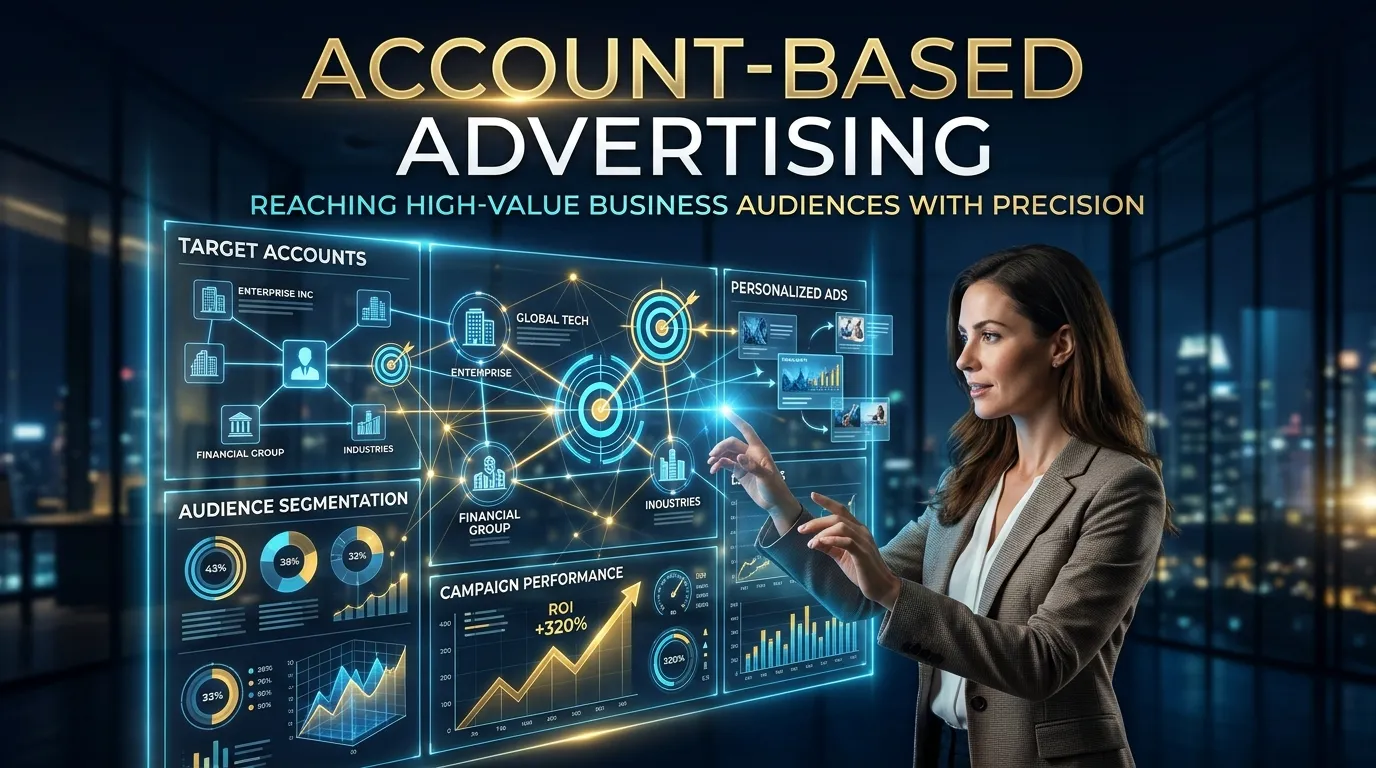
Account-Based Advertising is a B2B marketing approach that focuses on reaching specific high-value organizations rather than broad audiences. It combines business account targeting, personalized advertising, audience segmentation, and targeted campaigns to connect companies with relevant decision-makers. By using suitable advertising platforms, accurate business data, and performance tracking, organizations can improve campaign relevance, strengthen account engagement, and support long-term sales opportunities. Its success depends on aligning advertising activities with broader marketing objectives and maintaining responsible data practices.
Businesses operating in competitive B2B markets often struggle to reach the right decision-makers through traditional advertising. Broad advertising campaigns may generate thousands of impressions, clicks, and website visits, but these interactions do not always translate into meaningful business opportunities. Many companies spend significant marketing budgets attracting audiences that have little interest in their products or services. Account-Based Advertising offers a more focused approach by directing advertising efforts toward specific businesses that have the greatest potential to become valuable customers.
Instead of treating every visitor or potential buyer as an equal opportunity, this advertising approach prioritizes selected organizations and the people responsible for purchasing decisions within them. Marketing teams can use business information, industry data, company size, professional roles, and buying signals to deliver relevant advertisements to carefully selected audiences. This creates a closer connection between advertising activities and broader business objectives.
Account-Based Advertising has become an important part of modern B2B marketing because purchasing decisions often involve multiple stakeholders, longer sales cycles, and higher transaction values. Reaching the right people at the right organizations can help businesses build awareness, develop relationships, and create more meaningful sales opportunities. When supported by reliable data and a coordinated marketing strategy, it can make advertising more relevant and efficient.
Understanding the Meaning of Account-Based Advertising
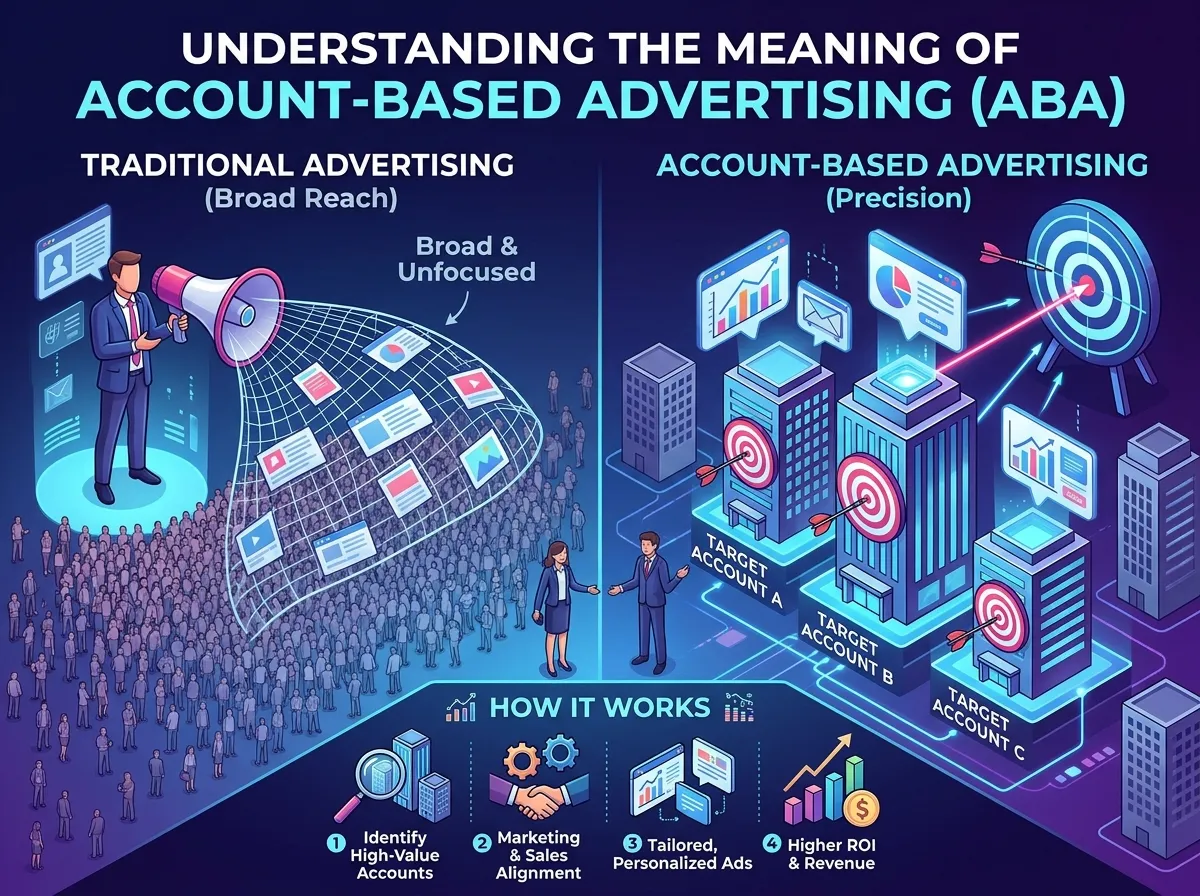
Account-Based Advertising is a targeted advertising approach that focuses on reaching specific companies rather than advertising to a broad audience. It allows businesses to identify organizations that match their ideal customer profile and deliver relevant advertisements to employees, managers, executives, and other decision-makers within those organizations.
For example, a software company selling enterprise security solutions may identify financial institutions, healthcare organizations, and large technology companies as its primary target accounts. Instead of promoting its services to everyone interested in technology, the company can concentrate its advertising on professionals working within those selected organizations.
This approach connects advertising activities with account-based marketing objectives. While traditional advertising often prioritizes audience size and general engagement, account-focused advertising places greater importance on reaching organizations that have a realistic opportunity to become customers.
The difference is particularly important in B2B environments, where a single business relationship can generate significant long-term revenue. Reaching five relevant decision-makers within a suitable organization may be more valuable than attracting hundreds of unrelated website visitors.
Account-Based Advertising also supports consistency across marketing channels. A company can introduce its solutions through professional advertising networks, display campaigns, industry publications, and other digital platforms while maintaining a consistent message for its selected accounts.
Why Businesses Are Moving Toward Account-Focused Advertising
Traditional digital advertising provides opportunities to reach large audiences, but wider exposure does not necessarily produce better business results. Many B2B companies need a more deliberate approach because their products and services are designed for specific industries, business sizes, or professional requirements.
Account-focused advertising helps address this challenge by connecting campaign decisions with the characteristics of potential customers. Marketing teams can prioritize companies that have the appropriate business requirements, financial capacity, operational needs, and purchasing potential.
Another important reason is the complexity of B2B purchasing decisions. Enterprise purchases rarely depend on one individual. A technology investment, for example, may involve IT managers, department heads, financial officers, procurement teams, and senior executives. Each stakeholder may evaluate the same product from a different perspective.
Advertising can help businesses reach these different professionals with relevant messages. Technical content may attract IT managers, while financial benefits and operational improvements may appeal to senior management.
This approach also makes marketing and sales coordination more practical. When both departments work with the same target account information, they can develop consistent communication and focus their resources on organizations that support business growth.
Building an Effective Account-Based Advertising Strategy
A successful Account-Based Advertising Strategy begins with a clear understanding of the organizations a business wants to reach. Selecting companies simply because they operate in a particular industry is not enough. Marketing teams need to consider whether those organizations have the requirements, resources, and purchasing potential that match their offerings.
Ideal customer profiles provide a useful starting point. These profiles describe the types of organizations that are most likely to benefit from a company’s products or services. Relevant characteristics may include industry, company size, annual revenue range, geographical location, technology usage, and business challenges.
Once the ideal customer profile is established, businesses can develop a list of priority accounts. Some organizations may represent immediate sales opportunities, while others may require longer-term awareness and relationship-building activities. Separating these accounts according to their potential value helps marketing teams allocate advertising resources more effectively.
Campaign messaging should also reflect the needs of the selected organizations. A company targeting financial institutions may emphasize security, regulatory requirements, and operational reliability. A campaign targeting manufacturing businesses may focus on productivity, automation, and cost control.
This is where coordination becomes especially important. Advertising should not operate independently from the wider sales process. Its purpose is to introduce relevant solutions, strengthen brand familiarity, and support conversations that may eventually lead to commercial relationships.
Companies developing a broader account-focused growth approach can also explore Account Penetration Strategy, which explains how businesses can identify additional opportunities and strengthen relationships within existing customer organizations.
How B2B Targeted Advertising Reaches the Right Organizations
B2B Targeted Advertising depends on the ability to identify and reach professionals associated with selected businesses. Rather than relying exclusively on general demographic characteristics, marketers use business-related information to define more relevant advertising audiences.
Company identification is one important part of this process. Advertising platforms and specialized targeting technologies may use company names, business domains, professional information, and other available signals to help advertisers reach employees associated with particular organizations.
Job roles and seniority also influence campaign relevance. A business selling enterprise management software may want to reach operations directors, technology leaders, and senior executives rather than employees in unrelated positions.
Industry and company size provide additional targeting opportunities. These characteristics help businesses distinguish between organizations that may have similar interests but very different purchasing requirements.
However, effective targeting requires more than selecting the largest possible audience. Marketing teams should consider whether the selected professionals can influence, recommend, approve, or participate in purchasing decisions.
Advertising platforms may also differ in their targeting capabilities, data availability, and audience coverage. Therefore, businesses should evaluate platform suitability before committing substantial campaign budgets.
Creating More Relevant Account-Based Ad Campaigns

Account-Based Ad Campaigns work best when their messages reflect the challenges and priorities of the organizations they target. Generic advertisements often struggle to create meaningful connections because they do not explain why a particular solution matters to a specific business audience.
Personalization can improve this experience. For example, an advertisement targeting logistics companies might highlight inventory visibility, delivery efficiency, and supply chain coordination. The same company could create a separate campaign for healthcare organizations that emphasizes data protection and operational continuity.
The objective is not to create an entirely different advertisement for every employee. Instead, businesses can develop message variations for account groups, industries, business functions, and purchasing stages.
Campaign timing is equally important. Organizations that have already interacted with a company’s website or downloaded its resources may respond differently from businesses discovering the brand for the first time.
A well-coordinated campaign can introduce a solution, provide educational information, highlight customer experiences, and eventually encourage interested prospects to speak with the sales team.
Advertising should also maintain a consistent message across different channels. When professionals encounter the same business value proposition through display advertisements, professional networks, and relevant industry content, the company becomes easier to recognize and understand.
The Role of Business Account Targeting and Audience Segmentation
Business Account Targeting helps marketing teams organize advertising activities around organizations with similar characteristics and commercial potential. Instead of treating an entire account list as one audience, companies can divide it into smaller groups based on meaningful business differences.
For instance, an enterprise software provider may separate its target organizations into large corporations, medium-sized companies, financial institutions, and technology businesses. Each group may have different purchasing processes, operational priorities, and expectations.
Target Account Segmentation makes it easier to create relevant advertising messages without making campaign management unnecessarily complicated.
Account segmentation can also reflect the relationship between a company and a potential customer. New target accounts may need introductory information about the brand, while organizations that have already engaged with the business may benefit from more detailed product information.
Another useful distinction involves account value. Businesses can prioritize organizations according to their potential revenue, strategic importance, purchasing readiness, and likelihood of conversion.
However, segmentation should remain flexible. Business priorities change, new decision-makers enter organizations, and market conditions influence purchasing behavior. Regularly reviewing account information helps prevent campaigns from relying on outdated assumptions.
Personalized B2B Advertising and the Customer Experience
Personalized B2B Advertising makes communication more relevant by connecting advertising messages with the professional interests and business challenges of the intended audience.
A company offering cloud infrastructure services, for example, may target technology executives with advertisements about scalability and system reliability. Finance professionals within the same organization may receive messages highlighting cost visibility and resource efficiency.
This type of personalization recognizes that different stakeholders participate in the same purchasing decision for different reasons.
It can also improve the quality of the customer experience. Professionals are more likely to find advertisements useful when the content addresses genuine business concerns instead of presenting unrelated promotional messages.
Nevertheless, personalization should be handled carefully. Excessive targeting or advertisements that reveal unexpectedly specific information about an individual can create discomfort. Businesses should prioritize relevant messaging, responsible data practices, and appropriate privacy controls.
A thoughtful approach makes advertising feel more like useful business communication and less like repeated promotional interruption.
Connecting Account-Based Marketing Ads With the Wider Sales Process
Account-Based Marketing Ads are most effective when they support activities beyond generating impressions and clicks. Their value increases when advertising contributes to a coordinated process involving brand awareness, engagement, lead development, and sales conversations.
For example, a company may launch an advertising campaign targeting 100 organizations that match its ideal customer profile. Some organizations may recognize the brand for the first time, while others may already have visited the website or interacted with previous content.
The marketing team can use these differences to deliver more appropriate messages. New accounts may receive educational advertisements introducing the company’s expertise. Engaged accounts may see case studies, product demonstrations, or industry-specific resources.
This creates opportunities for account-level engagement rather than relying on individual advertising interactions.
Retargeting can further support this process by reconnecting with eligible audiences who have previously interacted with a business. Companies interested in developing this activity can explore Account-Based Retargeting Strategies to understand how repeated advertising exposure can support account engagement.
The relationship between advertising and sales should also remain measurable. Marketing teams can communicate which organizations have engaged with campaigns, what content attracted attention, and which accounts may deserve additional sales attention.
Choosing the Right Account-Based Advertising Platforms
Account-Based Advertising Platforms provide the technology needed to plan, manage, deliver, and evaluate campaigns targeting selected business audiences.
Different platforms offer different capabilities. Some focus on professional audience targeting, while others specialize in account identification, programmatic advertising, display campaigns, or marketing automation.
Businesses should evaluate platforms according to their campaign requirements rather than choosing a solution based only on popularity.
Audience coverage is an important consideration. A platform may provide strong targeting opportunities for certain industries or geographical markets but limited access to other business audiences.
Integration capabilities also matter. Connecting advertising platforms with customer relationship management systems and marketing automation tools can help businesses maintain consistent account information and coordinate campaign activities.
Reporting features deserve similar attention. Marketing teams should be able to evaluate account reach, engagement, advertising frequency, and the contribution of campaigns to wider business objectives.
Cost is another factor. Some platforms may require substantial advertising budgets, minimum commitments, or additional technology investments. Companies should compare these requirements with their available resources and expected outcomes.
For businesses developing an integrated marketing approach, Account-Based Marketing provides additional context on connecting targeted marketing activities with relevant business audiences.
Measuring the Performance of Account-Level Ad Targeting
Measuring Account-Level Ad Targeting requires a broader perspective than evaluating ordinary advertising performance. Click-through rates and impressions provide useful information, but they do not fully explain whether campaigns are reaching the right organizations or supporting commercial opportunities.
Account reach is one useful measurement. It indicates how many selected organizations have been exposed to campaign advertisements. Marketing teams can compare this information with their target account lists to understand whether campaigns are reaching their intended audiences.
Account engagement provides another perspective. Website visits, content interactions, resource downloads, and other meaningful activities can help identify organizations showing interest in the company’s offerings.
Marketing teams should also examine engagement across different stakeholders. If several relevant professionals from the same organization interact with campaign content, it may indicate broader organizational awareness.
Pipeline contribution is particularly important for B2B businesses. Advertising may influence opportunities by introducing a brand, supporting ongoing sales conversations, or encouraging previously inactive accounts to reconsider a solution.
However, businesses should avoid assuming that every conversion is directly caused by advertising. B2B purchasing decisions usually involve multiple interactions across different channels.
Combining advertising data with CRM information, sales feedback, and account engagement records provides a more balanced understanding of campaign performance.
Privacy, Data Quality, and Responsible Advertising Practices
Account-focused advertising relies on business information, professional audience data, and advertising technologies. Therefore, responsible data management should remain an essential part of campaign planning.
Inaccurate company information can result in advertisements reaching irrelevant audiences. Outdated employee details may also reduce targeting quality and create unnecessary advertising expenses.
Businesses should regularly review their account records and use reliable data sources. They should also understand how advertising platforms collect, process, and use audience information.
Privacy requirements must be considered throughout the campaign lifecycle. Depending on the applicable regulations and markets, businesses may need to follow specific rules concerning personal information, consent, cookies, and advertising communications.
Transparency is equally important. Companies should avoid misleading advertisements, exaggerated product claims, and targeting practices that could negatively affect professional trust.
Ethical advertising also extends to the way businesses promote products and services through third-party partnerships. Companies using affiliate promotions alongside their account-based campaigns can benefit from understanding Ethical Affiliate Marketing and the importance of transparent promotional practices.
Ultimately, responsible advertising protects brand credibility while helping organizations build stronger relationships with potential customers.
The Future of Account-Based Advertising

Account-Based Advertising is likely to become increasingly connected with artificial intelligence, predictive analytics, and automated campaign management.
AI-powered technologies can help marketers analyze large volumes of business information, identify potential target accounts, and recognize patterns in audience engagement. These capabilities may support better audience selection and more relevant advertising messages.
Predictive analytics can also help businesses identify organizations that demonstrate characteristics associated with potential purchasing interest. Although these predictions are not guaranteed indicators of buying intent, they can provide useful information for campaign planning.
Another developing area is cross-channel coordination. Businesses increasingly want their advertising, email marketing, content distribution, and sales activities to work together rather than operate as separate functions.
This creates opportunities for more consistent communication throughout the customer journey.
However, technology alone will not determine campaign success. Businesses still need accurate information, meaningful messaging, clear objectives, and a strong understanding of their target markets.
The companies most likely to benefit from account-based advertising will be those that combine technological capabilities with thoughtful marketing decisions and genuine customer understanding.
Conclusion
Account-Based Advertising provides B2B companies with a focused way to reach organizations that have the greatest potential to become valuable customers. By combining business account targeting, audience segmentation, personalized messaging, and coordinated advertising campaigns, businesses can make their marketing activities more relevant to professional audiences.
Its effectiveness depends on selecting appropriate target accounts, understanding the needs of different decision-makers, maintaining reliable data, and measuring results beyond traditional advertising metrics. When connected with broader account-based marketing and sales activities, advertising can contribute to stronger brand recognition, meaningful engagement, and long-term business relationships.
Rather than prioritizing the largest possible audience, companies can use this approach to concentrate their resources on the organizations that matter most to their growth.
10 Frequently Asked Questions About Account-Based Advertising
1. What is Account-Based Advertising?
Account-Based Advertising is a targeted B2B advertising approach that focuses on reaching specific businesses and their decision-makers. It helps companies promote relevant products and services to organizations that match their ideal customer profiles.
2. How does Account-Based Advertising work?
It works by identifying suitable target organizations, segmenting them according to business characteristics, and delivering relevant advertisements to professionals associated with those companies through supported advertising platforms.
3. What is the difference between Account-Based Advertising and traditional advertising?
Traditional advertising generally targets broader audiences based on interests or demographics. Account-Based Advertising focuses on selected organizations and the professionals who influence purchasing decisions within them.
4. Why is Account-Based Advertising important for B2B companies?
It helps B2B companies concentrate advertising resources on high-value organizations, improve message relevance, reach important decision-makers, and support longer sales cycles.
5. What is an Account-Based Advertising Strategy?
An Account-Based Advertising Strategy is a structured approach to selecting target accounts, developing relevant advertising messages, choosing suitable platforms, and measuring campaign performance.
6. Which platforms support Account-Based Advertising?
Several professional advertising networks, programmatic advertising platforms, and specialized account-based marketing solutions support account-focused campaigns. Their targeting capabilities vary by platform.
7. How does audience segmentation improve account-based campaigns?
Audience segmentation divides target organizations into meaningful groups based on industry, company size, business needs, and account value. This helps marketers create more relevant advertising messages.
8. What metrics should businesses track in Account-Based Advertising?
Businesses should monitor account reach, engagement, website activity, advertising frequency, qualified opportunities, pipeline contribution, and the influence of campaigns on sales progress.
9. Can small businesses use Account-Based Advertising?
Yes. Small businesses can use it by focusing on a manageable number of high-potential organizations. A carefully selected account list can make targeted advertising more practical without requiring an enterprise-level budget.
10. What is the future of Account-Based Advertising?
Its future will likely involve greater use of artificial intelligence, predictive analytics, automated targeting, and cross-channel campaign coordination to improve advertising relevance and account engagement.


Account Penetration Strategy: Driving Growth Within Existing Accounts
Account Engagement Scoring: Measuring Business Interest and Opportunities

Live Webinars for ABM: Strategies to Engage High-Value Accounts
