
Account-Based Marketing Strategies
 14 min read
In today’s digital-first business environment, competition is more intense than ever. Businesses often find themselves struggling to stand out in saturated markets while failing to connect with the right customers. Traditional marketing strategies that rely on mass lead generation may produce a high volume of leads, but many of those leads lack intent, relevance, or purchasing power.
This growing disconnect has pushed marketers to rethink their strategies—and that is where Account-Based Marketing (ABM) has emerged as a powerful alternative.
Account-Based Marketing moves away from broad, one-size-fits-all marketing tactics and instead focuses on a select group of high-value accounts. By treating each account as a market of its own, ABM humanizes marketing efforts, strengthens relationships, and drives measurable business outcomes.
This complete guide will walk you through everything you need to know about Account-Based Marketing—from understanding the fundamentals to implementing proven strategies that help you engage high-value accounts and generate sustainable revenue.
What Is Account-Based Marketing (ABM)?
Account-Based Marketing is a strategic B2B marketing approach in which sales and marketing teams work together to target a carefully selected list of accounts that have the highest potential to generate revenue.
Instead of casting a wide net, ABM prioritizes precision, relevance, and personalization. Each target account receives tailored messaging, customized content, and personalized experiences designed to resonate with decision-makers and influencers.
ABM is especially effective for:
-
B2B companies
-
SaaS and technology providers
-
Enterprise service organizations
-
Businesses with long or complex sales cycles
Does Account-Based Marketing Sound Complicated?
At first glance, ABM may seem complex—but its core principle is surprisingly simple:
Focus your resources on the accounts that matter most.
Traditional marketing aims to attract as many leads as possible, hoping that some will convert. ABM flips this model by identifying the most valuable prospects upfront and designing campaigns specifically for them.
When sales and marketing teams are aligned, ABM:
-
Builds stronger customer relationships
-
Delivers personalized buying experiences
-
Improves customer retention
-
Generates higher return on investment (ROI)
In fact, studies show that 87% of marketers using ABM report higher ROI compared to other marketing strategies, making it one of the most effective approaches in modern B2B marketing.
Why Account-Based Marketing Works So Well
The success of ABM lies in its customer-centric approach. Instead of pushing generic messages, ABM focuses on understanding each account’s unique challenges, goals, and decision-making process.
Key benefits of Account-Based Marketing include:
-
Stronger alignment between sales and marketing teams
-
Higher-quality leads and opportunities
-
Shorter sales cycles
-
Increased deal sizes
-
Better customer lifetime value
ABM allows businesses to invest their marketing budget more efficiently by targeting accounts that are most likely to convert and grow.
Step 1: Find Your Sweet Spots – Identifying High-Value Accounts
The foundation of any successful ABM strategy is identifying the right accounts. These accounts represent your ideal prospects—organizations that align closely with your solution and have the highest revenue potential.
Create Your Ideal Customer Profile (ICP)
An Ideal Customer Profile (ICP) describes the type of company that would benefit the most from your product or service.
When creating your ICP, consider the following criteria:
-
Company size (number of employees)
-
Industry or niche
-
Annual revenue
-
Geographic location
-
Technology stack
-
Common challenges or pain points
-
Buying behavior
Example:
If you offer enterprise software solutions, your ICP might include companies with 500+ employees, a strong technology infrastructure, and operational inefficiencies that your software can solve.
A clear ICP ensures your ABM efforts remain focused and effective.
Use Data Analytics and ABM Tools
Data-driven decision-making is essential for successful ABM.
Leverage analytics tools and platforms such as:
-
CRM systems (HubSpot, Salesforce)
-
Sales intelligence tools (ZoomInfo, Clearbit, Apollo)
-
LinkedIn Sales Navigator
-
Predictive analytics software
These tools help you analyze firmographic data, buyer intent signals, and engagement patterns to identify accounts that are ready to buy.
Collaborate Closely With Sales Teams
Sales teams are a valuable source of insights. They understand customer objections, buying triggers, and real-world challenges faced by prospects.
To ensure ABM success:
-
Align sales and marketing goals
-
Hold regular strategy meetings
-
Share insights and feedback
-
Define shared KPIs
When sales and marketing operate as a unified revenue team, ABM delivers significantly better results.
Step 2: Customize Marketing Activities for Target Accounts
Once you have identified your high-value target accounts through a clearly defined Ideal Customer Profile (ICP) and data analysis, the next critical step in Account-Based Marketing (ABM) is customizing your marketing activities to meet the unique needs and objectives of each account. This step is where ABM truly differentiates itself from traditional marketing, as it focuses on personalization, relevance, and delivering a meaningful experience to each decision-maker.
Why Customization Matters
In traditional marketing, campaigns are designed to reach as many people as possible, often with generic messaging. While this approach may generate leads, it rarely resonates with high-value accounts that require more tailored messaging. In ABM, each account is treated as a market of one, meaning the marketing strategy for each account is unique. By customizing your approach, you demonstrate a deep understanding of the account’s challenges, goals, and industry, which helps in building trust and positioning your business as a valuable partner rather than just a vendor.
Personalized campaigns have been shown to increase engagement rates, shorten sales cycles, and improve ROI. According to studies, companies implementing highly customized ABM campaigns see significantly higher conversion rates compared to generic marketing campaigns.
Key Steps in Customizing Marketing Activities
1. Segment Your Target Accounts
Although ABM focuses on one-to-one marketing, grouping accounts into smaller segments can make customization more manageable. Segmentation allows you to create campaigns that are highly relevant while still being scalable. Common segmentation criteria include:
-
Industry: Target messaging based on sector-specific challenges and trends.
-
Company size: Tailor solutions differently for mid-market vs enterprise clients.
-
Business objectives: Align messaging with specific goals like digital transformation, cost reduction, or revenue growth.
-
Pain points: Customize content to address the challenges your solution solves for each account.
Segmentation ensures that your messaging resonates with the right people in the right way, without diluting the personalization that ABM requires.
2. Personalize Communication Channels
Every interaction with your target account should feel deliberate and customized. Personalization is not limited to just addressing recipients by name. Effective personalization includes:
-
Email campaigns: Include account-specific messaging and references to their unique challenges or goals.
-
Direct outreach: Use LinkedIn InMail or direct messages to speak to decision-makers personally.
-
Video messaging: Short, personalized videos can explain solutions and address specific account pain points in a more engaging way.
-
Retargeting ads: Display relevant solutions or content based on previous interactions with your website or other channels.
By ensuring that every touchpoint aligns with the account’s specific context, you reinforce relevance and increase engagement.
Once high-value accounts are identified, the next step is creating personalized marketing campaigns that address each account’s specific needs and objectives.
At its core, ABM is a personalization-driven strategy.
Segment Your Target Accounts
Not all target accounts are the same. Segmenting them allows for more precise messaging.
Common segmentation methods include:
-
Industry-based segmentation
-
Company size
-
Business goals
-
Pain points
Segmentation increases the relevance of your campaigns and improves engagement rates.
Personalize Communication at Every Touchpoint
Every interaction with a target account should feel intentional and relevant.
Effective personalization includes:
-
Addressing decision-makers by name
-
Referencing company-specific challenges
-
Demonstrating how your solution supports their growth
For example, instead of sending generic email campaigns, you can send personalized video messages, customized proposals, or tailored LinkedIn messages.
Use a Multi-Channel ABM Strategy
ABM is not limited to one channel. Successful campaigns span multiple platforms, including:
-
Email marketing
-
LinkedIn and social media ads
-
Direct LinkedIn messaging
-
Webinars and virtual events
-
Website personalization
A consistent, personalized presence across channels builds trust and reinforces brand credibility.
Step 3: Creating Targeted Content for ABM Campaigns
Content is the backbone of any effective ABM strategy. High-value accounts expect content that is relevant, insightful, and tailored to their business needs.
Create Content for Specific Accounts
Personalized content shows that you understand your target accounts and their industries.
Examples include:
-
Custom case studies
-
Industry-specific whitepapers
-
Personalized blog posts
Using industry-specific language and real-world examples builds trust and authority.
Focus on Educational Content
ABM is about building relationships—not pushing sales.
Educational content positions your brand as a trusted advisor. Examples include:
-
How-to guides
-
Industry reports
-
Video tutorials
-
Infographics
By solving problems first, you earn trust and long-term loyalty.
Invest in Interactive Content
Interactive content increases engagement and helps prospects experience your solution before making a decision.
Effective formats include:
-
Product demos
-
ROI calculators
-
Personalized assessments
-
Virtual walkthroughs
These tools help decision-makers visualize the value of your offering.
Tailor Landing Pages for ABM
Personalized landing pages significantly improve conversion rates.
Effective ABM landing pages include:
-
Account-specific messaging
-
Company name and logo
-
Industry-relevant testimonials
-
Customized calls to action
These elements make prospects feel recognized and valued.
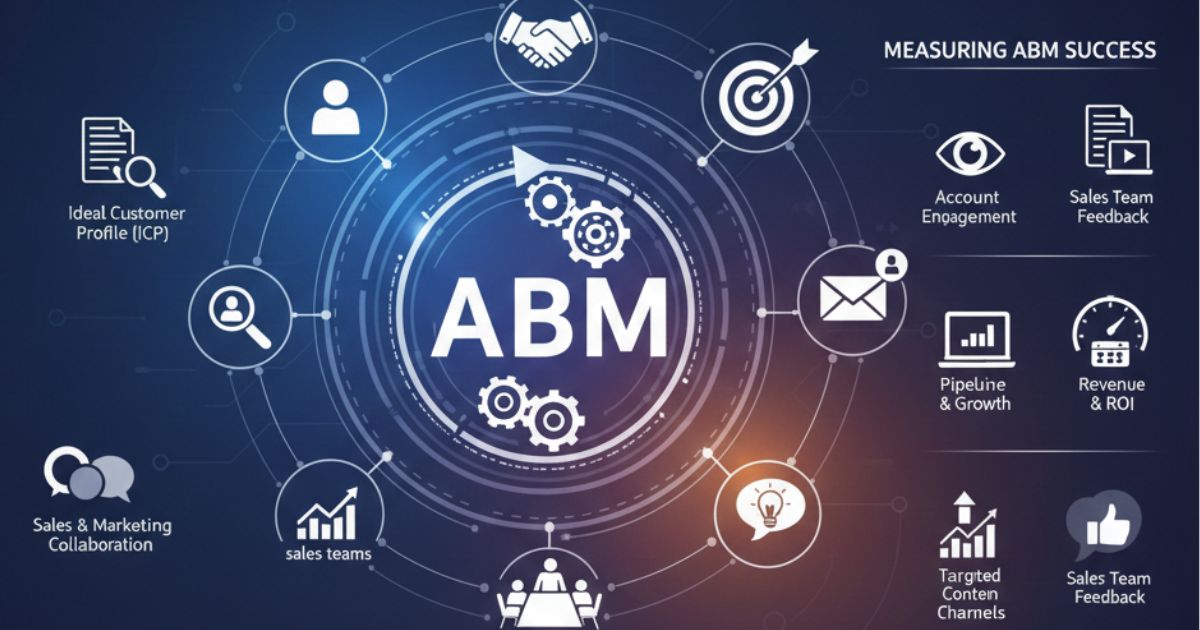
Step 4: Measuring the Success of Your i
In Account-Based Marketing (ABM), success is measured differently compared to traditional marketing strategies. Unlike broad-based campaigns that focus on generating large numbers of leads, ABM is account-centric, prioritizing the quality of engagement and the value generated from each high-priority account. Measuring the effectiveness of your ABM strategy is critical because it allows your team to identify what’s working, optimize campaigns, and demonstrate ROI to leadership.
Why Measuring ABM Success is Crucial
ABM requires significant investment in terms of time, resources, and coordination between marketing and sales teams. Without proper measurement, it’s impossible to determine whether these efforts are producing meaningful results. Effective measurement ensures that your campaigns are not only engaging target accounts but also driving business outcomes, such as pipeline growth, revenue acceleration, and long-term account retention.
Key Metrics for Measuring ABM Success
1. Account Engagement
Engagement is the first indicator that your ABM strategy is resonating with target accounts. It reflects whether your personalized content, messaging, and campaigns are capturing attention and creating meaningful interactions.
Metrics to track include:
-
Email open and click-through rates
-
Website visits and page interactions
-
Social media engagement (likes, shares, comments)
-
Webinar or virtual event attendance
Monitoring engagement provides insight into which accounts are interacting most with your campaigns and where your messaging may need adjustment.
2. Pipeline Velocity and Growth
One of ABM’s primary goals is to accelerate the sales process by focusing on high-value accounts. Measuring pipeline velocity helps you understand how quickly deals are moving through the sales funnel and whether ABM is helping to shorten the sales cycle.
Key metrics include:
-
Number of opportunities created per target account
-
Average time for opportunities to progress through each stage
-
Deal size and revenue potential
Faster pipeline movement indicates that your personalized marketing and sales alignment are effectively influencing account decisions.
3. Revenue and ROI
Ultimately, the success of ABM is measured by its ability to generate revenue. ABM campaigns often target fewer accounts, but each account carries higher potential value, so monitoring ROI is essential.
Revenue-focused metrics include:
-
Revenue generated per target account
-
Closed-won deals from ABM-targeted accounts
-
Return on marketing investment (ROMI)
Tracking these metrics demonstrates the tangible financial impact of ABM, helping justify continued investment.
4. Account Penetration and Influence
ABM is also about increasing influence within key accounts, especially when multiple stakeholders are involved in purchasing decisions. Measuring penetration helps assess the breadth of engagement within an organization.
Metrics include:
-
Number of stakeholders engaged per account
-
Interactions with multiple decision-makers across departments
-
Growth in account-specific opportunities over time
Broader account influence often leads to stronger relationships and larger deals.
5. Feedback from Sales Teams
Sales teams interact directly with target accounts and can provide qualitative insights that data alone cannot reveal. Collecting feedback helps identify:
-
How receptive accounts are to personalized campaigns
-
Which messaging or content resonates most
-
Potential gaps in the ABM strategy
Regular collaboration with sales ensures that ABM efforts are aligned with real-world account needs and objectives.
Best Practices for Measuring ABM
-
Set clear goals and KPIs upfront: Define what success looks like for engagement, pipeline, and revenue before campaigns launch.
-
Use a combination of quantitative and qualitative data: Combine metrics with sales feedback for a complete view.
-
Measure at the account level, not the lead level: ABM is account-centric, so your success metrics should reflect that focus.
-
Continuously optimize campaigns: Regularly review metrics to refine messaging, content, and channel strategies.
-
Leverage ABM tools and analytics platforms: Platforms like HubSpot, Salesforce, and 6sense provide insights into account-level engagement, pipeline performance, and ROI.
Tracking the right metrics is essential to evaluate the effectiveness of your ABM initiatives.
Account Engagement Metrics
Focus on engagement at the account level rather than individual leads.
Key metrics include:
-
Email open and click-through rates
-
Website visits from target accounts
-
Webinar attendance
-
Social media interactions
High engagement indicates strong campaign relevance.
Pipeline Velocity and Growth
Monitor how quickly deals move through your sales pipeline.
ABM often accelerates sales cycles by targeting decision-makers directly, leading to faster deal progression and higher deal values.
Revenue and ROI
Revenue is the ultimate measure of ABM success.
Compare:
-
Revenue generated from ABM campaigns
-
Total cost of ABM initiatives
This analysis helps justify ABM investments and optimize future campaigns.
Sales Team Feedback
Sales teams provide valuable qualitative insights.
Their feedback helps identify:
-
Messaging that resonates
-
Common objections
-
Opportunities for improvement
Long-Term Success With Account-Based Marketing
Account-Based Marketing is not a short-term tactic—it is a long-term growth strategy.
Companies that adopt ABM gain a competitive advantage by:
-
Building deeper customer relationships
-
Delivering personalized experiences
-
Driving sustainable revenue growth
To succeed with ABM, focus on these three pillars:
-
Strong sales and marketing alignment
-
Continuous optimization
-
Deep understanding of target accounts
Conclusion
In an era where customers expect personalization and relevance, Account-Based Marketing offers a smarter, more effective way to engage high-value prospects.
By focusing on the right accounts, delivering tailored experiences, and aligning sales and marketing teams, ABM helps businesses achieve higher ROI and long-term success.
If you want to improve your marketing performance and connect with the right customers, now is the time to embrace Account-Based Marketing.
FAQ: Account-Based Marketing (ABM)
1. What is Account-Based Marketing (ABM)?
ABM is a strategic B2B approach where sales and marketing teams collaborate to target high-value accounts with personalized campaigns. Unlike traditional marketing, ABM focuses on quality over quantity, delivering tailored experiences to accounts with the highest revenue potential.
2. How is ABM different from traditional marketing?
Traditional marketing casts a wide net to generate as many leads as possible, often using generic campaigns. ABM, on the other hand, identifies high-value accounts upfront and creates personalized campaigns for each, resulting in stronger engagement, shorter sales cycles, and higher ROI.
3. Which businesses benefit most from ABM?
ABM works best for:
-
B2B companies
-
SaaS and technology providers
-
Enterprise service organizations
-
Businesses with long or complex sales cycles
4. How do I identify the right accounts for ABM?
Start by creating an Ideal Customer Profile (ICP) that defines the types of companies most likely to benefit from your solution. Use data analytics, CRM tools, and sales insights to select high-value accounts aligned with your business objectives.
5. What types of content should I create for ABM campaigns?
Effective ABM content is highly personalized and relevant. Examples include:
-
Custom case studies and whitepapers
-
Industry-specific blog posts
-
Educational guides, reports, and tutorials
-
Interactive tools like demos, ROI calculators, or personalized assessments
6. How do I personalize marketing for target accounts?
Personalization goes beyond addressing recipients by name. It involves:
-
Tailoring messaging to each account’s challenges and goals
-
Using multiple channels (email, LinkedIn, social media, webinars, personalized landing pages)
-
Creating account-specific proposals or video messages
7. How do I measure ABM success?
Key metrics include:
-
Account engagement (email opens, website visits, social interactions)
-
Pipeline velocity and deal progression
-
Revenue generated from target accounts
-
Account penetration and influence (stakeholders engaged)
-
Feedback from sales teams
8. How long does it take to see results from ABM?
ABM is a long-term strategy. While some engagement and pipeline results can appear in a few months, significant revenue impact and ROI usually develop over 6–12 months as relationships deepen and campaigns optimize.
9. How do I align sales and marketing for ABM?
Alignment is crucial for ABM success. Ensure sales and marketing:
-
Share goals, KPIs, and account insights
-
Collaborate on messaging and campaigns
-
Meet regularly to review progress and optimize strategies
10. Is ABM suitable for small businesses?
Yes, but ABM is most effective when targeting a select list of high-value accounts. Even small businesses can use ABM principles by focusing on their top potential clients and delivering personalized experiences.
11. What tools can help with ABM?
Useful ABM tools include:
-
CRM platforms: HubSpot, Salesforce
-
Sales intelligence: ZoomInfo, Clearbit, Apollo
-
LinkedIn Sales Navigator
-
ABM and predictive analytics platforms: 6sense, Demandbase
12. What are the key benefits of ABM?
ABM helps businesses:
-
Build deeper customer relationships
-
Increase deal sizes and shorten sales cycles
-
Improve ROI and marketing efficiency
-
Gain better alignment between sales and marketing teams


Live Webinars for ABM: Strategies to Engage High-Value Accounts


Balancing Personalization and Privacy in Modern ABM

Virtual Events and Webinars: Powerful Strategies for ABM Success