
The world of digital marketing has changed and evolved massively in the past few years. Gigantic, universal campaigns are no longer what drives conversions, particularly for B2B organizations. Five years from now, we’re getting smarter and more targeted, which is where Account-Based Marketing (ABM) comes in.
If you’re ready to reach, engage, and convert your ideal prospects in a more targeted and personal way, across the entire customer lifecycle, ABM is clearly the way that works.
This ultimate guide will help you understand the basics of ABM, its advantages, tools & also actionable tactics you can apply in your business.
What Is Account-Based Marketing?
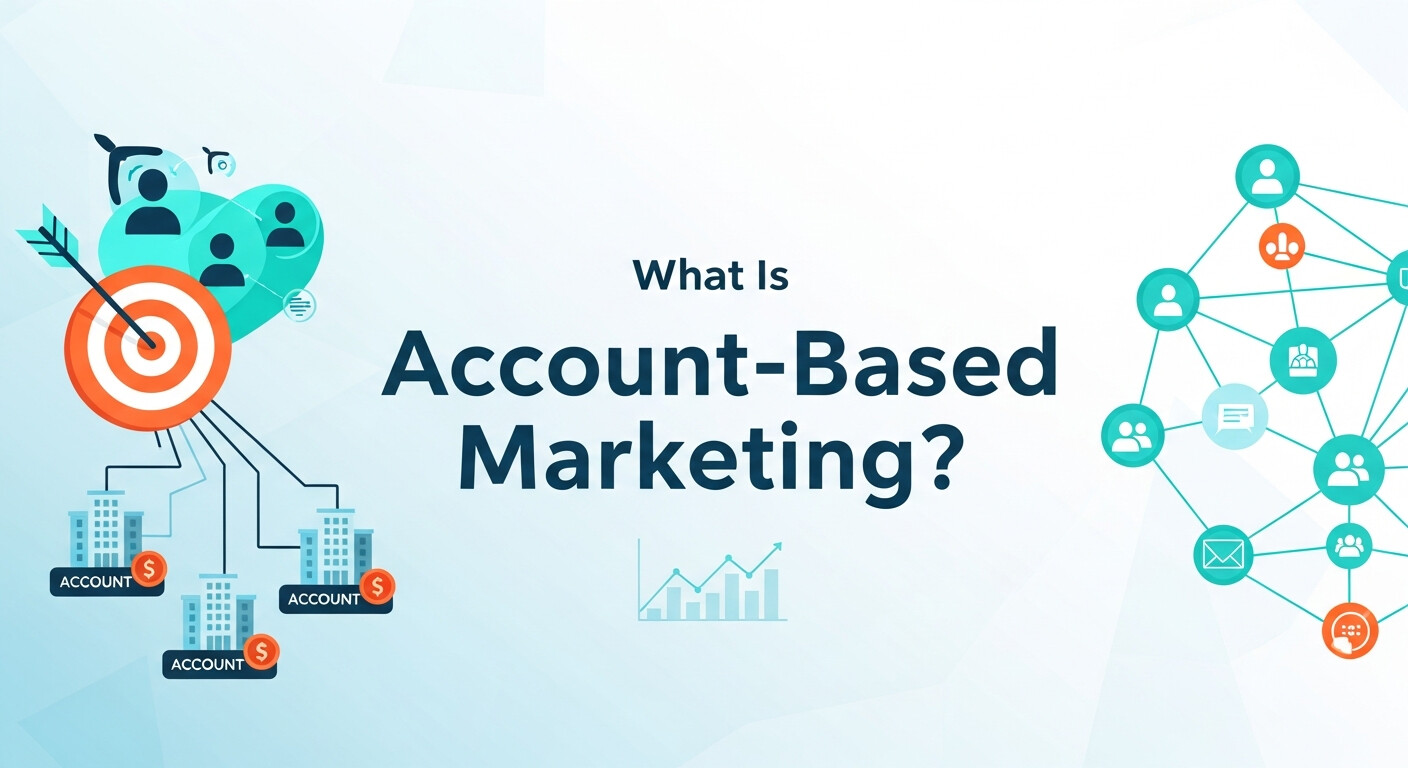
Account-Based Marketing, also known as ABM, is a B2B marketing strategy that focuses on specific high-value accounts instead of just throwing a wide net. Rather than aiming for a large number of people, in contrast to the blasting and praying method, Account-Based Marketing considers specific companies—or even specific people within those companies—as unique markets.
With ABM, marketing and sales staff collaborate to pinpoint target accounts, develop personalized content and messaging, and provide individualized experiences that address particular issues of each of the target groups.
This hyper-targeted, personalized approach results in stronger relationships, deeper engagement, and much greater ROI.
Why Account-Based Marketing Matters Today
In an increasingly competitive digital environment, businesses are seeking ways to maximize impact while minimizing waste. ABM addresses these concerns directly by focusing efforts on the highest-value opportunities.
Here’s why ABM continues to gain traction:
- Higher ROI: A report by ITSMA finds that 87% of marketers agreed that ABM outperformed other marketing investments.
- Better Alignment Between Sales and Marketing: ABM fosters collaboration and shared goals, improving communication and efficiency.
- Personalization at Scale: With advancements in data and automation, companies can now deliver personalized experiences to hundreds of accounts.
- Shorter Sales Cycles: Targeting decision-makers directly with relevant content often accelerates the buyer journey.
- Improved Customer Retention: ABM doesn’t stop at acquisition; it’s also a powerful tool for upselling and retaining top clients.
Core Principles of Account-Based Marketing
To succeed with ABM, it’s essential to understand and apply the following principles:
1. Focused Targeting
ABM begins by identifying high-value accounts that align with your ideal customer profile (ICP). This ensures your efforts are concentrated on prospects most likely to convert and provide long-term value.
2. Personalized Engagement
Every piece of content and communication in an ABM strategy is tailored to the specific needs, pain points, and goals of the target account. This might include custom emails, targeted ads, or bespoke content offers.
3. Sales and Marketing Alignment
ABM requires close collaboration between sales and marketing teams. Both departments work together to select target accounts, craft messaging, and measure success using shared KPIs.
4. Multi-Channel Outreach
ABM strategies leverage multiple channels, including email, social media, content marketing, events, and direct outreach, to create a cohesive and consistent experience across touchpoints.
5. Data-Driven Decision Making
Data plays a critical role in ABM. From selecting accounts to personalizing content and optimizing campaigns, success depends on accurate, real-time data and analytics.
Building an Account-Based Marketing Content Strategy for B2B Growth
A successful ABM program depends heavily on a strong account-based marketing content strategy. Instead of generic messaging, ABM content is created for specific industries, companies, and stakeholders—making it far more effective for B2B lead generation.
Your content should address real business challenges while guiding prospects through every stage of the buyer journey, from awareness to decision-making.
Core Elements of an Effective ABM Content Strategy
- Industry-specific case studies and success stories
- Personalized email sequences for key stakeholders
- Custom landing pages for target accounts
- Thought leadership blogs and whitepapers
- Sales enablement materials, such as pitch decks and ROI calculators
Content Types Mapped to the Buyer Journey
| Buyer Stage | Content Type | Goal |
|---|---|---|
| Awareness | Blog posts, industry reports | Educate and build credibility |
| Consideration | Webinars, case studies | Demonstrate expertise and relevance |
| Decision | Product demos, personalized proposals | Drive conversions |
| Post-Sale | Onboarding guides, customer success content | Support retention and expansion |
For fintech and enterprise B2B brands, this personalized approach builds trust faster and shortens sales cycles. When paired with automation and analytics, your Account-Based Marketing content strategy becomes a powerful system for nurturing high-value accounts and increasing lifetime customer value.
Steps to Build an Effective ABM Strategy
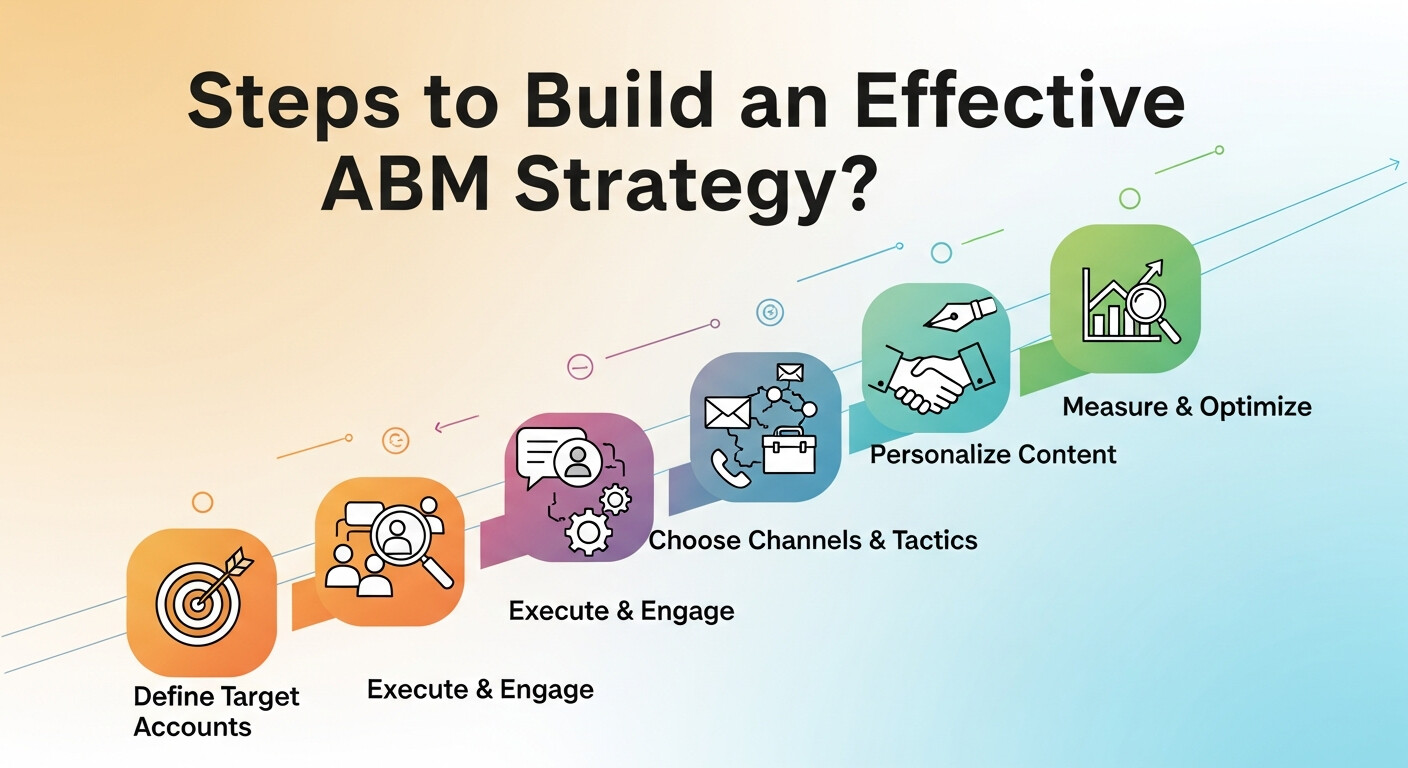
If you’re ready to implement ABM in your business, follow these steps for the best results:
Step 1: Define Your Ideal Customer Profile (ICP)
Start by identifying the traits of your best customers—industry, company size, revenue, location, and decision-maker roles. This helps narrow down the types of companies you should target.
Step 2: Build a Target Account List
Use CRM data, intent data platforms, and tools like LinkedIn Sales Navigator to create a list of high-value target accounts. Focus on companies that are a strong fit for your product or service.
Step 3: Research Key Stakeholders
Understand who the decision-makers are within each account. Research their roles, interests, challenges, and how your solution can meet their specific needs.
Step 4: Develop Personalized Content and Messaging
Develop content for every stage of the buyer journey. This might be something like personalized emails, customized landing pages, case studies for your industry or whitepapers of interest.
Step 5: Choose the Right Channels
Select the channels where your target accounts are most active. This might include LinkedIn, email marketing, webinars, paid media, or even direct mail for an added personal touch.
Step 6: Launch and Monitor Campaigns
Coordinate outreach between your sales and marketing teams. Use marketing automation and ABM platforms to track engagement, conversions, and pipeline growth.
Step 7: Analyze and Optimize
Measure the success of your ABM efforts by tracking key metrics such as account engagement, pipeline velocity, deal size, and customer lifetime value. Use this data to refine your strategy over time.
Role of Technology in Account-Based Marketing
Modern Account-Based Marketing is powered by advanced tools and data platforms that help businesses identify high-intent accounts, personalize outreach, and measure performance accurately. The growing impact of technology in account based marketing allows teams to automate repetitive tasks while delivering highly relevant experiences across multiple channels.
For industries like fintech, where sales cycles are complex and compliance matters, account-based marketing fintech strategies rely heavily on AI-driven insights, CRM integrations, and intent data to reach decision-makers at the right moment.
Key Benefits of Technology in Account-Based Marketing
- Improves account targeting using predictive analytics
- Enhances personalization through AI-powered content recommendations
- Strengthens B2B lead generation with real-time intent signals
- Enables better sales and marketing alignment via shared dashboards
- Provides detailed attribution and ROI tracking
Common ABM Technologies and Their Use Cases
| Technology Type | Purpose | How It Supports ABM |
|---|---|---|
| CRM Systems | Account data management | Centralizes customer insights and engagement history |
| Intent Data Platforms | Buyer behavior tracking | Identifies accounts actively researching solutions |
| Marketing Automation | Campaign execution | Automates personalized email and content delivery |
| AI & Analytics Tools | Predictive insights | Helps prioritize high-conversion accounts |
| Advertising Platforms | Targeted outreach | Runs account-level ads on LinkedIn and display networks |
By combining these technologies, businesses can scale personalization while maintaining precision—turning Account-Based Marketing into a measurable revenue engine rather than just a branding tactic.
Top ABM Tools and Platforms
Several tools can help streamline your ABM process. Here are some of the top platforms to consider:
- Demandbase: Offers account identification, intent data, and personalized content delivery.
- Terminus: Full-funnel ABM platform that helps align marketing and sales.
- HubSpot ABM Tools: Built-in features for targeting, tracking, and reporting ABM campaigns.
- Engagio (by Demandbase): Provides deep analytics and engagement insights.
- LinkedIn Ads: Useful for targeting professionals at specific companies.
Common Challenges in ABM and How to Overcome Them
While ABM is highly effective, it comes with its own set of challenges:
Challenge 1: Misalignment Between Teams
Solution: Establish common goals, conduct mutual planning sessions, and communicate frequently during the campaign.
Challenge 2: Resource Intensiveness
Solution: Start small with a pilot ABM campaign. Use automation tools to scale personalization efficiently.
Challenge 3: Measuring ROI
Solution: Define clear success metrics early. Use CRM and ABM platforms to track engagement and revenue impact per account.
The Future of Account-Based Marketing
Account-Based Marketing is evolving rapidly, driven by advancements in artificial intelligence, predictive analytics, and real-time data. As technology continues to improve, ABM strategies are becoming more intelligent, personalized, and scalable. Here’s what we can expect moving forward:
- AI-Powered Personalization: Advanced AI tools will make it easier to deliver 1:1 content at scale.
- Deeper Integration with CRM Systems: ABM platforms will offer tighter integrations for more precise tracking.
- Account-Based Everything (ABX): Expanding ABM beyond sales and marketing to include customer success and service teams.
- Increased Focus on Customer Experience: Delivering value across the entire customer journey will be key to retention and expansion.
Is ABM Right for Your Business?
ABM works best for companies that:
- Sell high-value products or services
- Have long or complex sales cycles
- Need to reach multiple decision-makers
- Want to build deeper relationships with fewer, more valuable clients
If that sounds like your business, ABM is a powerful strategy worth investing in.
Conclusion
Account-Based Marketing is not a fad—it’s a proven, high-impact strategy that, when done right, can drive outstanding growth in your business-to-business (B2B) company! By prioritizing your best leads and providing them with tailored, data-backed experiences, you can drive substantial increases in engagement, conversions, and revenue.
FAQ: About Account-Based Marketing
1. What is Account-Based Marketing (ABM)?
Account-Based Marketing is a B2B strategy that focuses on targeting specific high-value accounts with personalized campaigns instead of broad lead generation. It aligns sales and marketing teams to deliver tailored experiences that drive higher engagement and revenue.
2. How does Account-Based Marketing improve B2B lead generation?
Unlike traditional B2B lead generation, ABM prioritizes quality over quantity. By targeting decision-makers at ideal companies, businesses generate warmer leads, shorten sales cycles, and increase conversion rates.
3. Is Account-Based Marketing suitable for fintech companies?
Yes. Account-based marketing for fintech works especially well because fintech sales cycles are complex and involve multiple stakeholders. ABM allows fintech brands to personalize messaging, address compliance concerns, and build trust with enterprise accounts.
4. What is an account based marketing content strategy?
An account based marketing content strategy focuses on creating personalized content—such as custom landing pages, industry-specific case studies, and targeted emails—designed to address the exact pain points of each target account.
5. What types of businesses benefit most from ABM?
ABM is ideal for B2B companies that sell high-ticket solutions, have long sales cycles, target enterprise clients, or need to influence multiple decision-makers within one organization.
6. How long does it take to see results from Account-Based Marketing?
Most businesses start seeing engagement improvements within a few months. Revenue impact typically becomes visible in 3–6 months, depending on sales cycle length and campaign maturity.
7. What are the key metrics to measure ABM success?
Measuring the effectiveness of Account-Based Marketing requires tracking a combination of account-level and revenue-focused metrics. Key performance indicators (KPIs) include account engagement, which shows how actively your target accounts interact with your content; pipeline velocity, which tracks how quickly opportunities move through the sales funnel; deal size, customer lifetime value, and influenced revenue per account, all of which help quantify ABM’s impact on overall business growth and ROI.
8. Can small businesses use Account-Based Marketing?
Absolutely. Small teams can begin with a focused ABM pilot targeting 5–20 high-value accounts. By leveraging automation tools and personalized content, even lean businesses can execute effective ABM campaigns, build meaningful relationships with key prospects, and achieve measurable results without needing large marketing resources.
9. What tools are commonly used for ABM?
Popular ABM tools help businesses identify, target, and engage high-value accounts efficiently. These include Demandbase for account insights, Terminus for full-funnel ABM, HubSpot ABM for campaign management, LinkedIn Ads for precise outreach, and CRM platforms like Salesforce to track engagement, measure performance, and optimize results across campaigns.
10. How is Account-Based Marketing different from traditional marketing?
Traditional marketing casts a wide net. Account-Based Marketing treats each target company as its own market, delivering personalized outreach that builds stronger relationships and produces higher ROI.
11. Can small businesses implement ABM?
Yes. Small teams can start with a focused ABM pilot targeting a small number of high-value accounts. Automation tools make it scalable for lean teams.