
Account-Based Marketing enables businesses to focus their resources on high-value accounts, deliver personalized experiences, and align sales and marketing efforts more effectively. When powered by a robust platform like HubSpot, ABM becomes not only more manageable but also more scalable and measurable.
In this guide, we explore how Account-Based Marketing works, why HubSpot is a strong ABM platform, and how you can successfully implement ABM using HubSpot’s built-in tools.
The Power of ABM in a B2B World

As B2B buyers become more selective and buying committees more complex, generic marketing tactics simply don’t deliver the ROI they once did. Decision-makers now expect relevance, personalization, and value at every touchpoint. This is why Account-Based Marketing has become the go-to strategy for targeting high-value accounts and driving meaningful business outcomes rather than vanity metrics. If your company already uses HubSpot or is considering it, you’re in a great position to implement ABM without relying on expensive add-ons or third-party tools.
HubSpot’s built-in ABM features make it easier than ever for both marketers and sales teams to identify target accounts, engage key decision-makers, and personalize the buyer’s journey—all within a single, unified platform. Instead of juggling multiple tools, teams can collaborate, track engagement, and optimize campaigns in one central system.
This guide will walk you through everything you need to know about implementing Account-Based Marketing using HubSpot, from strategy and setup to execution and measurement.
What Is Account-Based Marketing (ABM)?
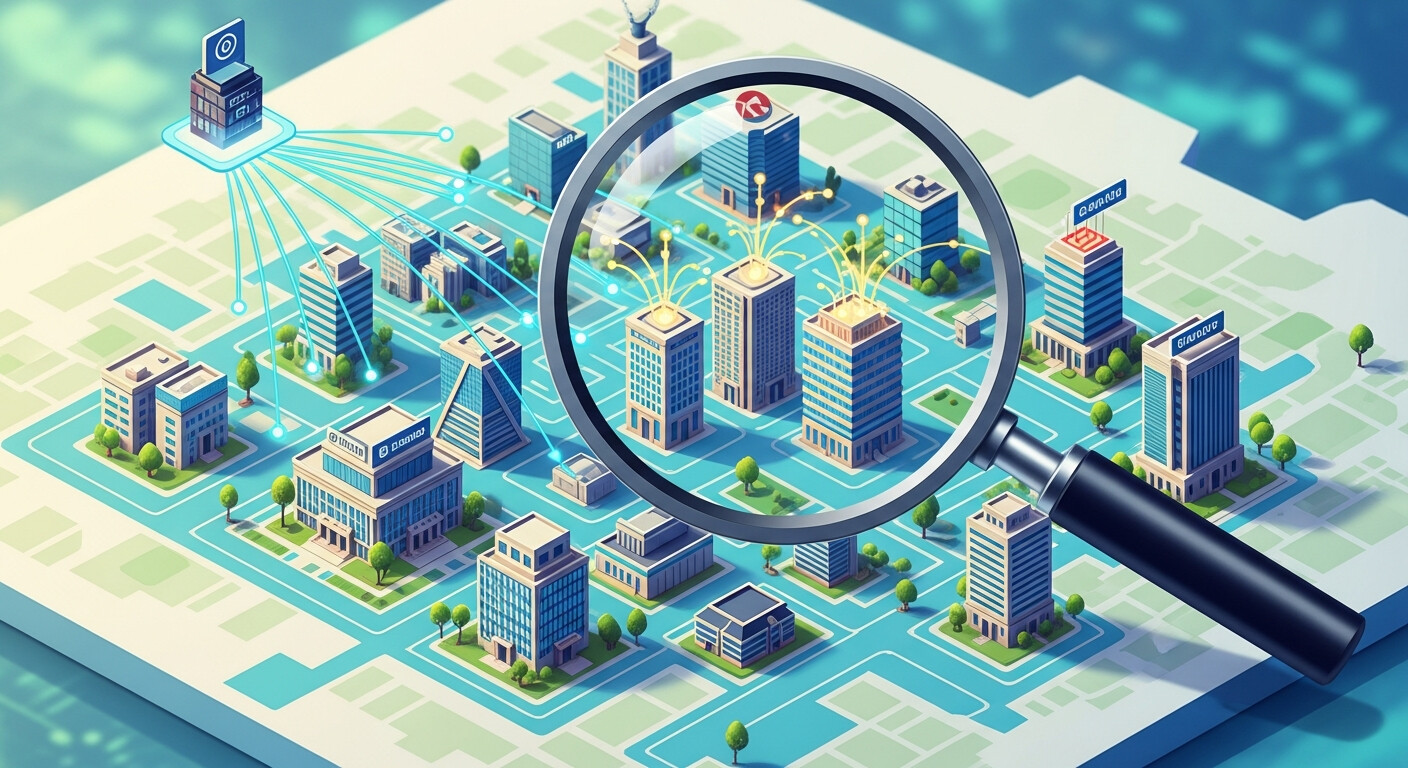
At its core, Account-Based Marketing is a strategic approach where marketing and sales work together to focus on specific high-value companies rather than casting a wide net to generate as many leads as possible. Instead of treating all prospects the same, ABM treats each account as a unique market with its own needs, challenges, and decision-making dynamics.
With ABM, each account is treated as a “market of one,” allowing for deeply personalized engagement that leads to stronger relationships, higher conversion rates, and increased lifetime value. Rather than chasing volume, businesses focus on quality, relevance, and impact.
When implemented effectively, Account-Based Marketing helps organizations build deeper trust with target accounts, shorten sales cycles, and improve overall revenue performance.
Key characteristics of ABM include:
- Identifying and prioritizing target accounts
- Tailoring messaging and campaigns to each account
- Aligning sales and marketing for seamless collaboration
- Measuring results based on account engagement and revenue impact
Why Use HubSpot for Account-Based Marketing?
HubSpot has evolved far beyond a basic CRM or email marketing platform. It now offers a comprehensive suite of tools designed to support modern B2B marketing strategies, including ABM.
HubSpot is built to support Account-Based Marketing at scale by providing native features that help teams identify, engage, and nurture high-value accounts without technical complexity.
Here’s why HubSpot is a strong choice for ABM:
- All-in-One Platform: Marketing, sales, and service tools in one place, ensuring seamless collaboration.
- ABM-Specific Features: Native properties, smart lists, workflows, and dashboards tailored for account-based strategies.
- Easy-to-Use: No-code workflows and automation that empower marketers without IT dependency.
- Flexible: Suitable for small businesses while scalable for mid-sized B2B companies.
- Strong Integrations: Connects with LinkedIn, Salesforce, ZoomInfo, Clearbit, and other data enrichment tools.
How ABM Transforms the Traditional B2B Funnel
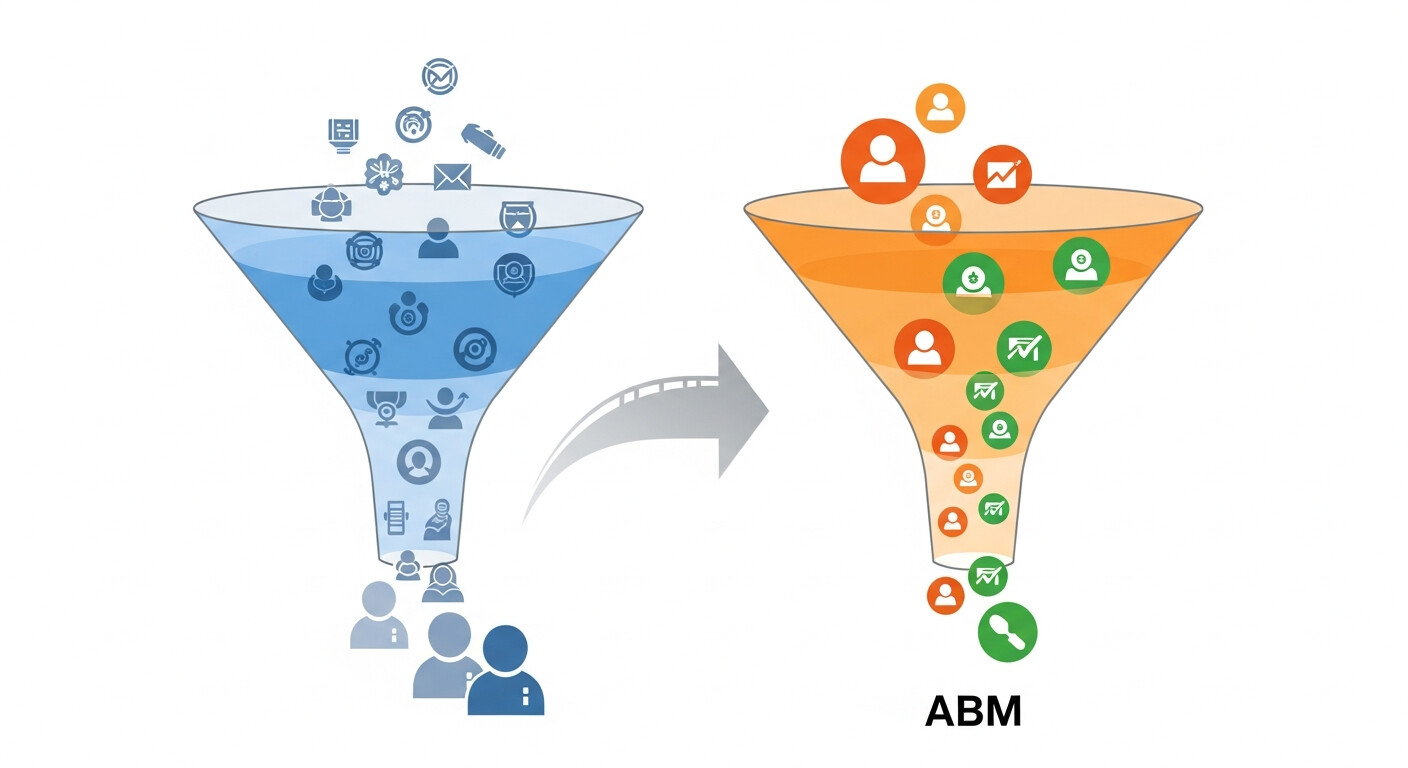
Traditional marketing focuses on generating as many leads as possible, often pushing them through a broad, linear funnel. This approach prioritizes quantity over quality and can result in wasted resources on low-intent prospects.
ABM flips this model by prioritizing specific high-value accounts instead of sheer lead volume. Instead of asking “How many leads can we generate?” teams ask “Which accounts matter most to our business?”
This shift moves businesses from lead-based marketing to account-based engagement, leading to stronger relationships, higher deal values, and more meaningful interactions with decision-makers. Rather than treating contacts in isolation, ABM considers the entire buying committee within an account.
This is the essence of Account-Based Marketing in practice—fewer accounts, deeper engagement, and better business results.
The Role of Data in Successful ABM Campaigns
ABM is only as effective as the data behind it. Accurate, enriched, and up-to-date data is essential for identifying the right accounts, understanding their needs, and personalizing outreach effectively.
Without reliable data, teams risk targeting the wrong companies, sending irrelevant messages, or missing key decision-makers within an account. That’s why data quality is a foundation of any successful ABM strategy.
Platforms like HubSpot, along with integrations such as ZoomInfo and Clearbit, help marketers clean their databases, enrich company and contact records, and gain deeper insights into account intent and behavior.
High-quality data fuels Account-Based Marketing success by enabling smarter targeting, better personalization, and more informed decision-making across marketing and sales teams.
Aligning Marketing Content with Buyer Stages in ABM
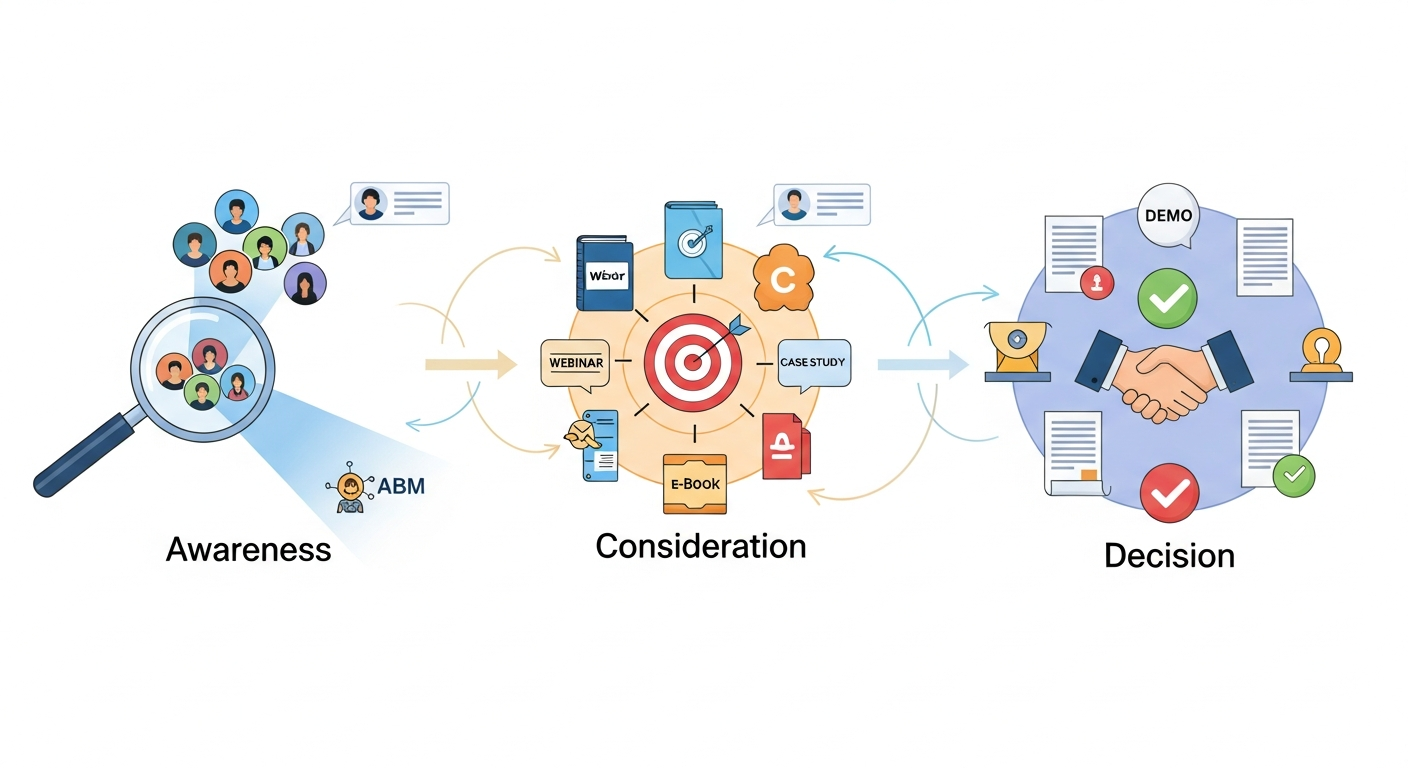
In Account-Based Marketing, content must align closely with where each account is in the buying journey. Unlike traditional marketing, where generic content is distributed broadly, ABM requires highly relevant, stage-specific, and account-specific content.
Awareness Stage
At the awareness stage, target accounts may not yet recognize a clear problem or opportunity. Here, thought leadership content plays a crucial role in building credibility and trust. This can include:
- Industry reports
- Expert blog posts
- Educational whitepapers
- Trend analysis and insights
The goal is not to sell but to position your brand as a knowledgeable and trustworthy partner.
Consideration Stage
During the consideration stage, accounts are actively evaluating solutions. At this point, content should help them compare options and understand your value proposition. Effective content includes:
- Case studies showcasing real results
- Comparison guides
- Product demos or walkthroughs
- Customer testimonials
This type of content helps influence decision-making by demonstrating how your solution addresses their specific challenges.
Decision Stage
At the decision stage, accounts are ready to choose a solution. Content should now be highly personalized and conversion-focused, such as:
- Customized proposals
- ROI calculators
- Personalized demos tailored to their business
- One-on-one consultations with sales
By aligning content with each stage of the journey, ABM ensures that every interaction feels relevant, timely, and valuable to the target account
How Sales Teams Benefit from ABM in HubSpot
Account-Based Marketing fundamentally changes how sales teams operate. Instead of chasing a high volume of loosely qualified leads, sales reps can focus their time and energy on a smaller set of high-value, high-intent accounts that are most likely to convert.
With HubSpot’s ABM capabilities, sales teams gain clearer priorities and deeper insights into account behavior. Real-time engagement alerts notify reps when key stakeholders visit important pages, open emails, or interact with content. Shared timelines provide full visibility into marketing activities, ensuring that sales conversations are timely, relevant, and well-informed.
Account-level tracking in HubSpot allows sales teams to see the bigger picture rather than focusing on individual contacts in isolation. This holistic view improves relationship-building, helps identify buying committee dynamics, and supports more strategic outreach. Ultimately, this results in more efficient sales efforts, stronger alignment with marketing, and better outcomes across the entire Account-Based Marketing strategy.
Common Challenges in ABM and How to Overcome Them
While Account-Based Marketing offers significant benefits, many organizations face common challenges when implementing it. Limited resources, lack of internal alignment, poor data quality, and long sales cycles can all hinder ABM success.
One of the biggest obstacles is misalignment between sales and marketing teams. Without shared goals and coordinated efforts, ABM campaigns can become fragmented and ineffective. HubSpot helps bridge this gap through shared dashboards, unified reporting, and collaborative workflows that keep both teams aligned.
Data quality is another major challenge in Account-Based Marketing. Inaccurate or incomplete data can lead to targeting the wrong accounts or missing key decision-makers. HubSpot’s centralized CRM, along with integrations like ZoomInfo and Clearbit, helps businesses maintain clean, enriched, and up-to-date data.
By providing automation, transparency, and a single source of truth, HubSpot makes it easier for organizations to overcome these challenges and run more effective Account-Based Marketing campaigns.
The Future of ABM: AI, Personalization, and Intent Data
The future of Account-Based Marketing is being shaped by advanced technology, particularly artificial intelligence, predictive analytics, and real-time intent data. These innovations are making ABM more precise, scalable, and impactful than ever before.
AI-driven tools are helping marketers identify patterns in account behavior, predict buying intent, and personalize outreach with greater accuracy. Instead of reacting to engagement, businesses can proactively anticipate needs and deliver relevant content at the right moment.
As platforms like HubSpot continue to evolve, marketers will gain deeper visibility into account-level interactions across multiple channels. This will enable smarter automation, more dynamic personalization, and stronger alignment between sales and marketing.
In this new era, Account-Based Marketing will not just be about targeting the right accounts—it will be about delivering the right message, at the right time, through the right channel, every time.
Key ABM Features in HubSpot
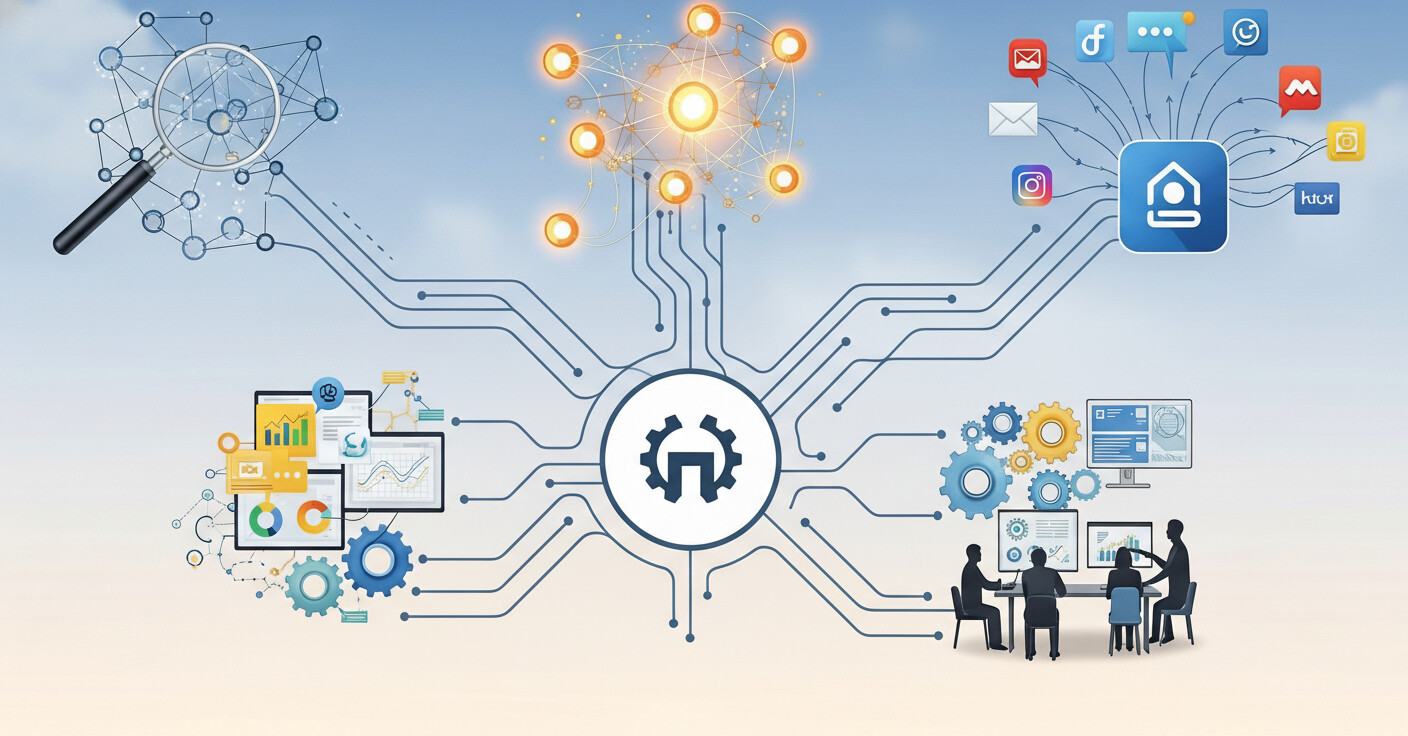
HubSpot offers several native tools that support Account-Based Marketing. These can be customized based on your campaign goals, industry, and target accounts.
Target Account Management
HubSpot includes a “Target Account” property in the Company object, which serves as the foundation of Account-Based Marketing within the platform. This allows you to tag key accounts, track engagement, and filter them easily across campaigns, workflows, and reports.
By clearly identifying target accounts, marketing and sales teams can prioritize efforts, personalize outreach, and ensure that resources are allocated strategically.
Ideal Customer Profile (ICP) Tiering
HubSpot enables businesses to define and segment their Ideal Customer Profile (ICP) using custom properties or default tiers such as Tier 1, Tier 2, and Tier 3.
This tiering helps teams prioritize accounts based on strategic importance, revenue potential, or likelihood to convert. Higher-tier accounts receive more personalized and high-touch engagement, while lower-tier accounts can be nurtured through scalable marketing efforts.
ABM Lists and Smart Segmentation
Dynamic smart lists are a powerful feature in HubSpot for scaling Account-Based Marketing without losing personalization. These lists can automatically update based on criteria such as industry, company size, location, or engagement level.
You can create lists for:
- All target accounts
- Specific buyer personas within accounts
- Companies in particular industries or regions
This ensures that the right messaging reaches the right stakeholders at the right time.
Custom ABM Dashboards
HubSpot’s pre-built ABM dashboards provide real-time insights into account performance and engagement. These include metrics such as:
- Target account engagement score
- Open deals by ICP tier
- Contacts influenced by marketing campaigns
- Revenue attribution per account
These dashboards help teams measure the true impact of their Account-Based Marketing efforts and make data-driven decisions.
Personalized Email and Web Content
HubSpot allows marketers to deliver highly personalized experiences through smart content, personalization tokens, and automated workflows.
Emails, landing pages, and website content can be customized based on company name, industry, job role, or previous interactions. This level of personalization strengthens relationships and increases the effectiveness of Account-Based Marketing campaigns.
Sales and Marketing Alignment Tools
HubSpot makes collaboration between sales and marketing seamless by providing shared tools and real-time communication features, including:
- Shared timelines for full visibility into account activity
- Automated task creation based on engagement signals
- Real-time notifications when target contacts take key actions
- Slack or email alerts for important behaviors
These features ensure that both teams work in sync, respond quickly to opportunities, and execute a truly unified Account-Based Marketing strategy.
Implementing Account-Based Marketing in HubSpot
Implementing Account-Based Marketing in HubSpot requires a structured approach that aligns strategy, data, and execution. The following steps help you build a scalable and effective ABM framework to engage high-value accounts.
Enable ABM Tools
Start by enabling the “Target Account” property in Settings > Objects > Companies > Properties. This becomes the foundation of your ABM setup in HubSpot.
Once activated, HubSpot provides built-in reports, properties, and workflows that support account-level tracking and collaboration between sales and marketing.
Define Your Ideal Customer Profile (ICP)
Your Account-Based Marketing strategy should be based on a clear Ideal Customer Profile (ICP) drawn from your best existing customers.
Key criteria include:
- Company size
- Industry
- Revenue
- Location
- Technology stack
- Pain points
Use this data to categorize accounts into Tier 1, Tier 2, and Tier 3 for prioritization.
Identify and Assign Target Accounts
Create a static or smart list of high-value accounts in HubSpot based on your ICP.
Assign account owners and tag these companies using the “Target Account” property so they are easily trackable across reports and workflows.
Map Out Buying Committees
B2B decisions involve multiple stakeholders. Identify key decision-makers such as:
- Executives
- Procurement leads
- Department heads
- Influencers
Use HubSpot’s contact records, notes, and associations to map relationships and influence levels.
Build Multi-Touch Campaigns
Use HubSpot’s Marketing Hub to run coordinated, personalized campaigns, including:
- Targeted email workflows
- Smart landing pages and CTAs
- Industry-specific content offers
- LinkedIn or Google Ads synced with HubSpot
Ensure all messaging is relevant to each account’s needs and challenges.
Align with Sales Teams
Alignment between sales and marketing is essential for successful Account-Based Marketing. HubSpot supports this through shared data, automation, and real-time insights.
Key features to enable include:
- Lead scoring based on account engagement
- Real-time alerts when target contacts engage with content
- Automated tasks when an account reaches key milestones
These features help sales teams prioritize high-value accounts and engage them at the right moment with relevant messaging.
Measure and Optimize
Ongoing measurement is crucial for improving your ABM strategy. HubSpot’s ABM dashboards help track:
- Account engagement score
- Deal progression by ICP tier
- Email performance by account
- Marketing-influenced revenue
Use these insights to refine campaigns, improve personalization, and strengthen results over time.
HubSpot ABM Example Campaign
Goal:
Win Tier 1 cybersecurity accounts using a targeted ABM approach.
Ideal Customer Profile (ICP):
Mid-sized finance and healthcare companies with compliance and security needs.
Campaign Assets:
- Industry-specific eBooks and case studies
- Personalized email workflows
- Smart landing pages and CTAs
- LinkedIn retargeting ads
- Customized sales call scripts
Tracking Metrics:
- Account engagement score
- Meetings booked per account
- Pipeline value generated
- Closed/won conversion rate
This ensures a focused, personalized, and results-driven ABM strategy.
Pros and Cons of HubSpot for ABM
Pros:
- Easy to set up
- Ideal for small to mid-sized teams
- No-code automation
- Strong built-in dashboards
Cons:
- Limited advanced predictive analytics
- Less customization for enterprise use
- Some features require higher-tier plans
How HubSpot Compares to Other ABM Platforms
| Feature | HubSpot ABM | Demandbase | Terminus | 6sense |
|---|---|---|---|---|
| CRM Integration | Built-in | Yes | Yes | Yes |
| Ease of Use | Very High | Medium | Medium | Low |
| AI/Intent Data | Basic | Advanced | Moderate | Very Advanced |
| Best For | SMBs, Mid-size | Enterprises | Mid-large teams | Enterprise ABM |
| Pricing | Affordable | Premium | Premium | Premium |
Tips to Maximize ABM Success in HubSpot
- Start with a pilot campaign targeting high-value accounts
- Use custom properties to capture niche data (e.g., renewal dates, tools used)
- Build sales enablement playbooks inside HubSpot
- Add chatbots or live chat for target account visitors
- Consider integrating with ZoomInfo or Clearbit for better data enrichment
Conclusion: HubSpot Makes ABM Accessible and Scalable
Whether you’re just starting out with Account-Based Marketing or refining your approach, HubSpot provides a user-friendly and effective ABM solution. With built-in tools for targeting, segmentation, personalization, and reporting, you can run sophisticated ABM campaigns without needing multiple platforms.
If your business is focused on building deeper, more profitable relationships with fewer, high-value clients—HubSpot is one of the best platforms to support your ABM strategy
Frequently Asked Questions
1. What is Account-Based Marketing (ABM)?
Account-Based Marketing is a strategy where marketing and sales teams focus on specific high-value accounts rather than targeting a broad audience. It emphasizes personalization, alignment, and account-level engagement.
2. Is HubSpot good for ABM?
Yes. HubSpot offers native ABM features such as target account properties, smart lists, custom dashboards, personalized content, and sales-marketing alignment tools, making it suitable for small to mid-sized B2B companies.
3. Do I need a separate ABM platform if I use HubSpot?
Not necessarily. For most businesses, HubSpot’s built-in ABM tools are sufficient. However, enterprise companies may consider additional platforms like 6sense or Demandbase for advanced predictive analytics.
4. How long does it take to implement ABM in HubSpot?
Implementation can take anywhere from a few weeks to a few months, depending on data quality, team alignment, and campaign complexity.
5. What is the biggest challenge in ABM?
The most common challenge is alignment between sales and marketing teams, followed by poor data quality and lack of clear ICP definition.
6. Can small businesses use ABM?
Yes. ABM is effective for businesses of any size, especially if they have a smaller number of high-value clients rather than a large customer base.
7. How do you measure ABM success?
Key metrics include account engagement score, pipeline value, deal progression, marketing-influenced revenue, and meetings booked per account.